


AI Infrastructure Dependency

The Hidden Strategic Layer of Global AI Expansion
Artificial intelligence companies expanding internationally often focus on two primary variables:
product and customers.
In the early stages of growth, these are the most visible drivers of success.
But as AI systems scale, another factor increasingly shapes the trajectory of technology companies:
infrastructure.
Cloud platforms, compute capacity, semiconductor supply chains, and global data center networks have become the operational foundation of modern AI systems.
For many organizations entering the United States market, integration into this infrastructure ecosystem is both inevitable and advantageous.
It provides access to world-class compute resources, advanced development platforms, and the capital-intensive systems required to train and deploy large-scale AI models.
However, this integration also introduces a structural dynamic that is often underestimated:
infrastructure dependency.
Understanding this dynamic is becoming essential for companies building AI systems at scale.
Infrastructure as the Foundation of AI Capability
Artificial intelligence differs from traditional software in one fundamental way:
AI performance is directly tied to infrastructure capacity.
Training modern AI models requires enormous computational resources and specialized hardware.
As a result, AI companies rely simultaneously on several infrastructure layers:
• hyperscale cloud platforms
• high-performance compute clusters
• advanced semiconductor manufacturing
• global data center networks
• large-scale data storage and networking
These layers together form the physical and digital architecture of AI capability.
Unlike traditional software companies, AI organizations cannot operate independently of this infrastructure.
Their growth, performance, and economics are tightly coupled to it.
The Concentration of AI Infrastructure
A defining feature of the modern AI ecosystem is the concentration of critical infrastructure.
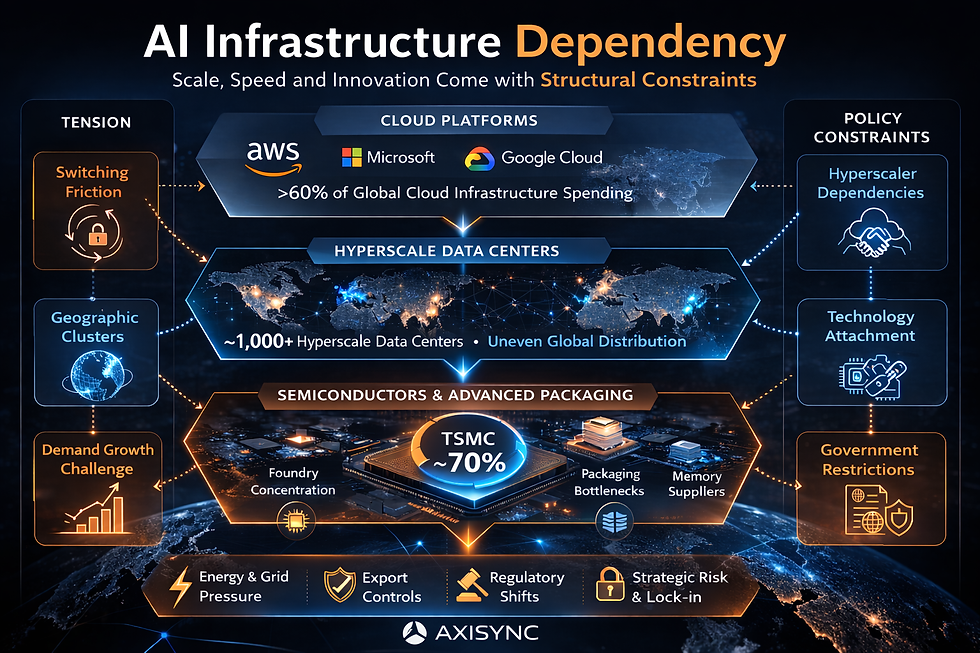
In cloud infrastructure services, the three largest providers collectively control more than 60% of global infrastructure spending.
At the hardware layer, semiconductor manufacturing is even more concentrated. Leading-edge AI accelerator production relies heavily on a small number of advanced fabrication facilities.
Recent industry analysis shows one foundry capturing approximately 70% of advanced-node manufacturing revenue.
Meanwhile, hyperscale data center networks continue to expand rapidly, with more than 1,000 hyperscale facilities now operating globally and capacity growing faster than the number of sites themselves.
These systems combine:
• technology platforms
• massive capital investment
• global infrastructure
• developer ecosystems
Together they create powerful infrastructure ecosystems that attract companies building advanced AI capabilities.
But this concentration also creates structural dependencies.
See AI Infrastructure Dependency MapConcentration • Chokepoints • Policy Pressure
How Infrastructure Dependency Emerges
Infrastructure dependency rarely results from a single strategic decision.
Instead, it develops gradually through rational engineering choices.
A company may initially adopt a cloud platform to train models.
Over time it integrates additional services from the same ecosystem:
• deployment platforms
• monitoring systems
• security frameworks
• identity management
• development tools
• proprietary AI accelerators
Each step improves operational efficiency.
But each step also deepens integration with the underlying infrastructure provider.
Competition authorities studying cloud markets have found that less than 1% of customers switch cloud providers annually, highlighting how switching barriers can accumulate over time.
In many cases, the technical and operational costs of switching grow so large that organizations effectively become locked into a specific infrastructure ecosystem.
What begins as an operational optimization can gradually evolve into a strategic constraint.
Infrastructure Decisions Are Strategic Architecture Decisions
For companies building AI systems, infrastructure choices influence far more than technical performance.
They shape multiple dimensions of long-term strategy.
Operational flexibility
The ability to move workloads between providers or regions can determine how quickly companies respond to changing conditions.
Cost structures
Compute pricing, storage costs, and network fees directly affect the economics of large-scale AI operations.
Regulatory exposure
Infrastructure choices influence how companies interact with data governance laws, export controls, and national security policies.
Geopolitical resilience
AI supply chains are increasingly shaped by international policy decisions, including semiconductor export restrictions and technology controls.
As a result, infrastructure decisions are not simply engineering decisions.
They are architecture decisions that determine strategic control.
The Emerging Constraints of the AI Infrastructure System
Beyond provider concentration, several structural pressures are shaping the AI infrastructure landscape.
Semiconductor chokepoints
Advanced chip manufacturing and packaging capacity remain highly concentrated geographically.
Supply constraints in advanced packaging technologies have already slowed the delivery of next-generation compute systems.
Energy demand
AI infrastructure is becoming increasingly energy intensive.
Forecasts suggest global data center electricity consumption could roughly double by the end of the decade, driven largely by AI workloads.
Policy constraints
Governments are beginning to treat AI infrastructure as strategic technology.
Export controls, investment screening, and national AI strategies are increasingly influencing how advanced compute resources are distributed globally.
Together these forces mean that infrastructure decisions increasingly interact with policy, energy systems, and supply chains.
Designing Infrastructure Optionality
Infrastructure dependency cannot be eliminated entirely.
Modern AI systems operate within interconnected ecosystems that require large-scale infrastructure investment.
However, organizations can design architectures that preserve strategic optionality.
Several approaches are particularly important.
Multi-cloud architectures
Operating across multiple cloud providers can reduce reliance on a single infrastructure ecosystem.
Modular system design
Separating model development, training, deployment, and data management into modular components can make it easier to adapt infrastructure choices over time.
Data portability
Ensuring that data can be moved between infrastructure environments reduces switching barriers.
Infrastructure abstraction layers
Containerization and orchestration technologies allow workloads to run across different infrastructure environments with minimal modification.
These approaches allow companies to scale while maintaining the ability to adapt their infrastructure strategies over time.
Decision Framework: Evaluating AI Infrastructure Strategy

AI Infrastructure Strategy Decision Flow:
Platform Dependency
Compute Supply Exposure
Geographic Infrastructure Exposure
Switching Costs
Long-Term Strategic Optionality
When organizations expand AI systems into large infrastructure ecosystems, leadership teams should evaluate several key architectural questions.
1. Platform Dependency
Which infrastructure platforms does the organization rely on today?
Key considerations:
• Is the AI stack tightly coupled to a single cloud ecosystem?
• Are proprietary services deeply embedded in the system architecture?
• How difficult would it be to redeploy workloads elsewhere?
Understanding platform dependency is the first step in managing infrastructure risk.
2. Compute Supply Exposure
Where does the organization’s compute capacity ultimately originate?
Key considerations:
• Which semiconductor suppliers support the infrastructure platform?
• Are supply chains geographically concentrated?
• How exposed is the system to semiconductor bottlenecks or packaging constraints?
AI performance increasingly depends on access to scarce compute resources.
3. Geographic Infrastructure Exposure
Where are the systems physically operating?
Key considerations:
• Which jurisdictions host training infrastructure?
• How do data residency and regulatory frameworks affect operations?
• Could geopolitical developments affect access to infrastructure?
Geography increasingly shapes the availability of AI infrastructure.
4. Switching Costs
How easily could the organization move workloads if required?
Key considerations:
• Are applications portable across environments?
• Are data formats transferable?
• Are there large data egress costs or migration barriers?
Competition research shows that very few organizations switch infrastructure providers once deeply integrated, making switching costs a critical strategic factor.
5. Long-Term Strategic Optionality
Does the organization maintain the ability to adapt its infrastructure architecture over time?
Key considerations:
• Are systems modular or tightly integrated?
• Is multi-cloud architecture technically feasible?
• Can the infrastructure strategy evolve with the AI ecosystem?
Optionality allows organizations to adjust as technology, regulation, and markets evolve.
Axisync Perspective
Axisync Partners focuses on the intersection of technology architecture, capital dynamics, and regulatory environments within complex digital ecosystems.
In the modern AI economy, infrastructure decisions increasingly determine the strategic positioning of companies operating across global markets.
Organizations that design infrastructure architecture intentionally can scale within powerful ecosystems while preserving long-term strategic control.
Those that treat infrastructure as a purely technical choice may eventually find that their strategic flexibility narrows over time.
Infrastructure determines scale.
Architecture determines control.
Erik Kling


Comments