


ART IS THE ARCHITECTURE OF TIME - Why Perception Is a Structural Layer
Updated: Sep 1
ART IS THE ARCHITECTURE OF TIME RHODES — PART III
A structural model of how creative energy shapes perception across time - Why Perception Is a Structural Layer
Most systems are designed to produce outcomes.
But very few are designed to shape how those outcomes are perceived.
This is where most organizations fail.
Because perception is not random.
It is structured.
And historically, one discipline has always understood this: Art.
Introduction — The Missing Layer
Empires were never built on infrastructure alone.
They were stabilized through meaning.
Roads moved armies.
Ports moved goods.
Systems organized power.
But something else made them endure:
Symbols.
Narratives.
Art.
Because systems organize the world. But art defines how the world is understood.
Ancient Architecture — Meaning as Structure
In the ancient world, art was never decoration. It was embedded into architecture.
Temples aligned to the cosmos. Reliefs encoded political narratives. Spaces shaped human perception.
Art was not applied after the system. It was part of the system.
A structural layer.
Because perception stabilizes power.
Leonardo da Vinci — The Unified Architecture
Leonardo da Vinci did not separate art, science, and engineering.
He worked across anatomy, geometry, mechanics, and painting as parts of a single system.
Because he understood:
Structure governs outcome.
For Leonardo, art was not expression.
It was a method of investigation.
A way to understand reality.
And a way to shape it.
Art was architecture — extended into perception and time.
The Structure of Power
Power is not singular.
It operates across layers:
• Infrastructure → enables movement
• Systems → create stability
• Art → shapes perception
Infrastructure moves the world. Systems stabilize it.
Art defines how it is experienced. And that matters.
Because perception determines:
• what is accepted
• what is questioned
• what becomes possible
Reading the System — The Architecture of Creative Energy
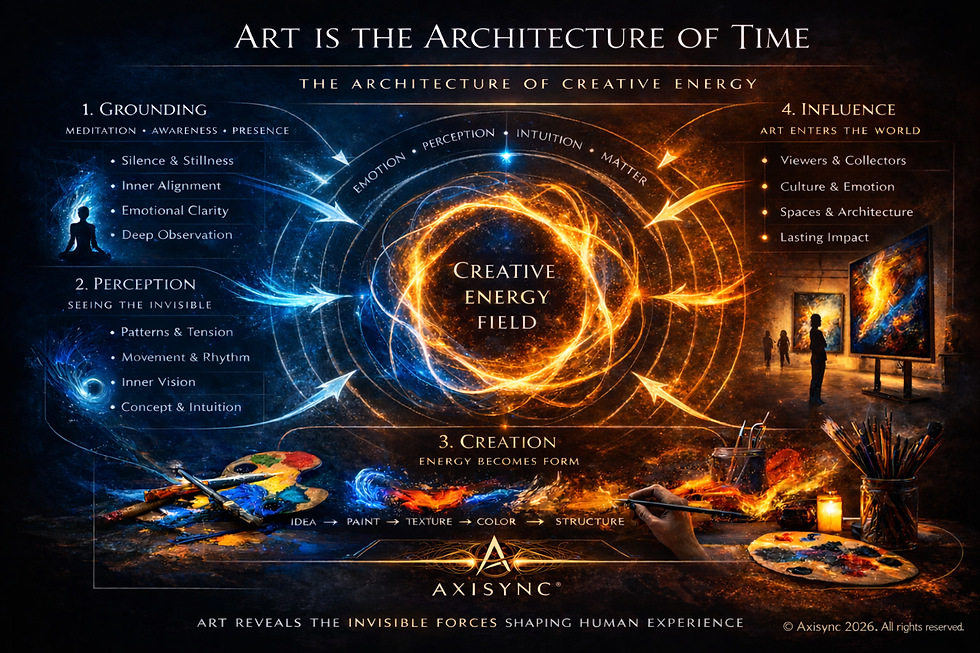
The diagram above is not conceptual.
It is structural.
A system model.
It describes how creative energy moves from the individual into the world.
1. Grounding — The Human FoundationStability. Awareness. Presence.The source condition of all creation.
2. Perception — Seeing the InvisiblePatterns. Tension. Intuition.The ability to recognize structure before it becomes visible.
3. Creation — Energy Becomes FormIdea → material → structureThe execution layer.
4. Influence — Art Enters the WorldPeople. Culture. Space.The moment perception begins to scale.
This is not different from architecture, infrastructure, or organizational systems.
It is the same logic applied to a different domain.
The Shared Structure — Axisync × Art
The underlying architecture is identical.
Axisync (Systems Architecture)Grounding → Architecture → Creation → Influence
Art (Creative Architecture)Grounding → Perception → Creation → Influence
Different language. Same structure.
Because both operate on one principle:
Structure determines outcome.
Art Operates Across Time
Art does not operate as decoration.
It operates as the architecture through which time is experienced.
It connects moments into continuity, and experience into meaning.
In that sense, art performs the same function for perception that architecture performs
for space:
It structures how reality is understood.
Architecture organizes space.
Art organizes time.
It carries:
The past Shapes the present Projects the future
Simultaneously.
Art does not only reflect reality. It defines how reality is experienced.
And experience determines what endures.
When Art Precedes Its Time
Hilma af Klint created work for a future context.
She understood that meaning requires readiness.
Her work was not late. It was early.
This is the nature of true creative architecture:
It does not follow time. It shapes it.
Conclusion — Architecture Beyond Space
Architecture is not limited to space.
It extends into:
Systems.
Perception.
Time.
If systems define outcomes and art defines perception across time
Then:
Art is not decoration.
It is architecture.
One builds the world. The other gives it meaning.
Both are required for power to endure.
For leaders, this matters more than it appears.
Because systems without meaning do not endure.
And meaning is not created by infrastructure.
It is created by how that infrastructure is perceived over time.
RHODES — The Full Structure
What began as infrastructure has revealed a complete system:
• Origins of Power → infrastructure
• Invisible Architecture → systems
• Network → geography
• Power Stack → components
• Sovereignty → responsibility
• Art → perception + time
This is not a sequence.
It is a model of civilization.
Stoic Closing - Art is the Architecture of Time
You can build systems without meaning.
They will function.
But they will not endure.
You can create meaning without structure.
It will inspire.
But it will not hold.
Enduring power requires both.
Structure to build the world.
Perception to make it last.
Erik Kling - Art is the Architecture of Time

Explore the Second Layer
This idea becomes clearer when viewed through art — where perception is structured over time.
The Architecture of Creative Energy:👉 https://www.eriksartstudio.com
First published at Eriks Art Studio, April 13, 2026. The canonical, sourced edition is published by AXYNAO
Final note
This is now:
👉 not just Part III
👉 but the completion of RHODES as a full system


soi cầu mb mình cũng chỉ ghé vì thấy mọi người bàn tán nhiều, tò mò xem trang họ làm có dễ coi không thôi. Vào rồi mới thấy họ để bài theo ngày khá rõ, kiểu tiêu đề “3 9 2026” nổi bật nên khỏi phải mò. Mình không rành mấy vụ chốt số, nhưng đọc phần dự đoán XSMB hôm nay thấy viết ngắn gọn, lướt nhanh vẫn hiểu họ đang nói gì. Cái mình thích là các đoạn thống kê nhận định được tách thành từng khối riêng, nhìn phát biết đang ở mục nào chứ không bị dính một cục dài. Nói chung trải nghiệm xem cho vui cũng ổn vì heading theo ngày và các…