


Strategic Freedom Is Lost Gradually, Then Suddenly

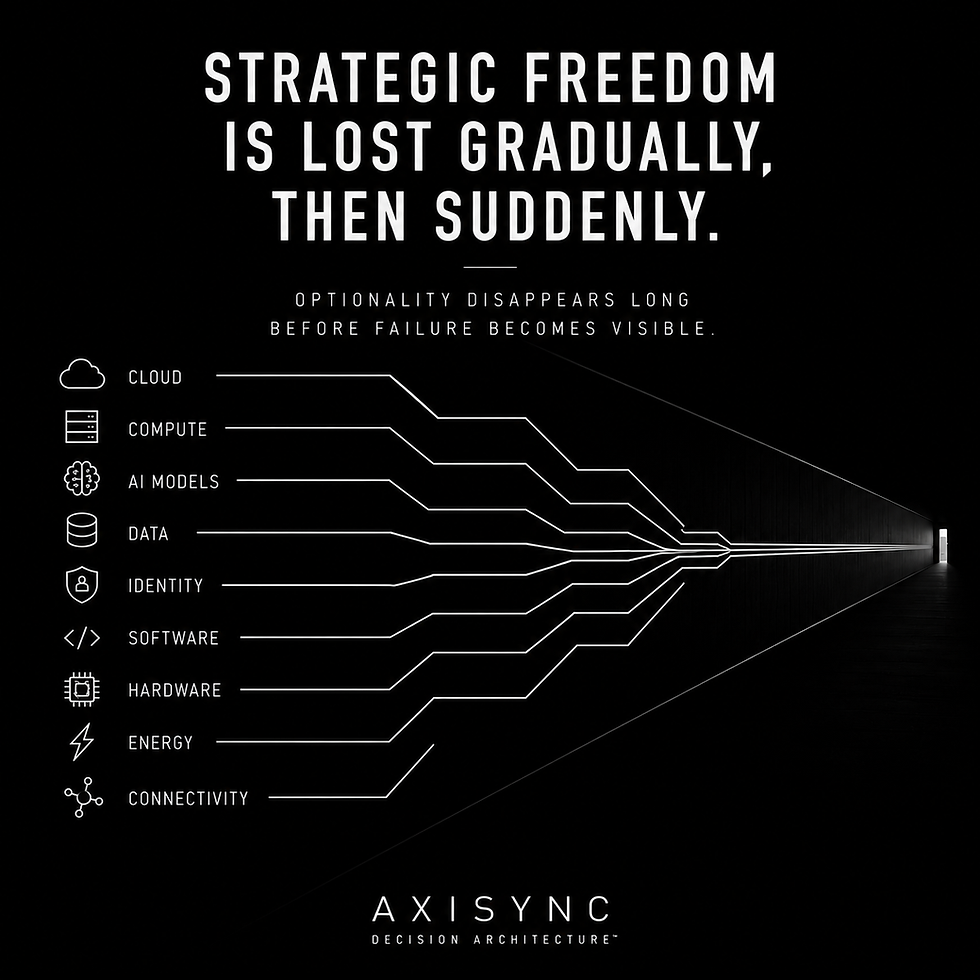
Optionality Disappears Long Before Failure Becomes Visible
Part of the AXISYNC Cloud Sovereignty Series
This article is Part 3 of the AXISYNC Cloud Sovereignty Series.
Part 1 exposed the growing gap between cloud compliance narratives and actual infrastructure sovereignty.
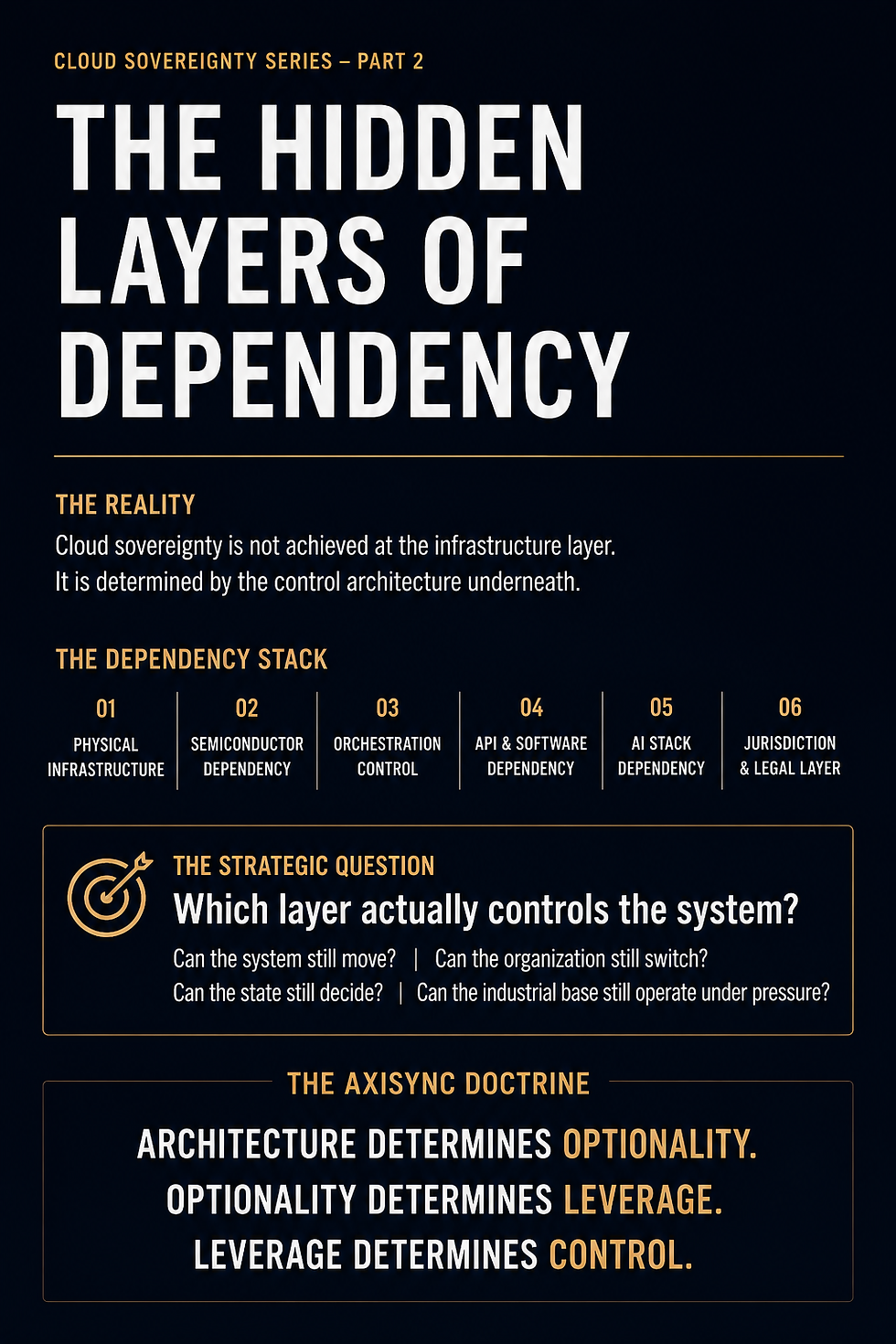
Part 2 mapped the hidden dependency layers beneath modern digital systems:cloud,compute,semiconductors,AI orchestration,energy,network infrastructure,and software control layers.
This third article examines the consequence of those dependencies over time:
the gradual loss of strategic optionality.
Because most organizations do not lose strategic freedom at the moment of visible failure.
They lose it earlier, when architecture decisions become difficult to reverse.
That is the infrastructure challenge now emerging across AI, cloud, sovereign infrastructure, digital identity systems, and geopolitical power itself.
The Infrastructure Layer Is Becoming the Power Layer
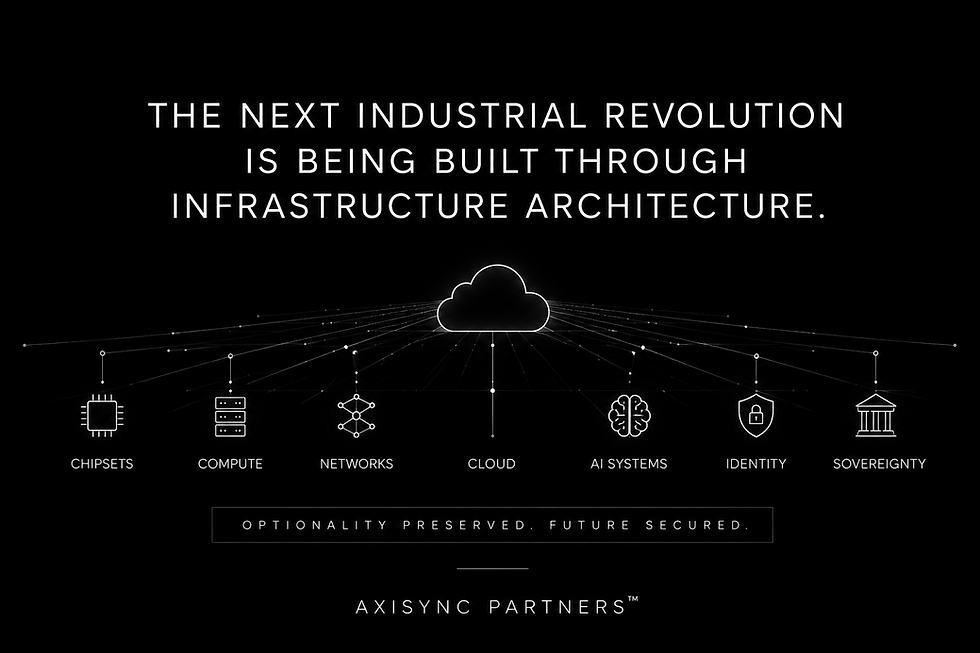
The next industrial era is not being built only through AI.
It is being built through the infrastructure that determines who retains optionality, who accumulates leverage, and who ultimately controls the architecture of the future.
Cloud.Compute.Semiconductors.Energy.Identity systems.Network infrastructure.AI orchestration layers.
These are no longer isolated technology decisions.
They are strategic architecture decisions that shape economic resilience, sovereignty, and human optionality for decades.
Infrastructure Is Never Neutral - Cloud Sovereignity Architecture
Because infrastructure is never neutral.
Infrastructure determines dependency. Dependency determines leverage.
Leverage determines strategic freedom.
And once architecture becomes irreversible, optionality begins disappearing long before failure becomes visible.
Efficiency and Strategic Freedom Are Not the Same Thing
For decades, organizations evaluated infrastructure primarily through efficiency.
Lower cost.Faster deployment.Operational simplification.Vendor consolidation.Global scale.
The logic appeared rational.
But efficiency and strategic freedom are not the same thing.
In many cases, they move in opposite directions.
The architecture that maximizes short-term efficiency frequently destroys long-term optionality.
Optionality Disappears Gradually
Most systems do not lose strategic freedom suddenly.
They lose it gradually.
Quietly.
One integration at a time.
One platform standardization at a time.
One outsourced capability at a time.
One convenience decision at a time.
The architecture hardens incrementally until future choices begin disappearing.
The Most Dangerous Systems Still Appear Successful
At first, nothing appears wrong.
Operations improve.
Deployment accelerates.
Capabilities expand.
Partnerships deepen.
The system appears successful.
But beneath the visible layer, optionality is already narrowing.
Internal capability erodes.
Switching costs compound.
Operational knowledge externalizes.
Migration complexity increases.
Decision pathways compress.
Dependencies accumulate across layers.
Strategic Freedom Is Usually Lost Before Failure Appears
Eventually, the organization reaches a point where changing direction becomes economically, politically, or operationally impossible.
This is the moment most leadership teams fail to recognize.
Because visible failure has not yet appeared.
Revenue still flows.
Customers remain active.
Systems still function.
But strategic freedom is already gone.
Temporary Dependency vs Structural Irreversibility
This distinction matters enormously.
There is a difference between:
temporary dependency
and
structural irreversibility.
Temporary dependency preserves optionality.
Structural irreversibility destroys it.
Every Infrastructure Layer Accumulates Leverage Over Time
Every dominant infrastructure layer in history accumulates leverage by increasing switching friction over time.
Railroads.
Energy corridors.
Telecommunications networks.
Operating systems.
Cloud orchestration layers.
AI compute ecosystems.
Digital platforms.
Financial settlement systems.
The deeper the integration, the harder the exit.
Eventually, the architecture itself begins determining strategic behavior.
Most Technology Decisions Are Actually Sovereignty Decisions
This is why many organizations believe they are making technology decisions when in reality they are making future sovereignty decisions.
A nation can localize data and still remain structurally dependent.
An enterprise can operate multi-cloud and still lack meaningful optionality.
A company can appear diversified while remaining locked into irreversible dependencies across APIs, orchestration layers, compute supply chains, licensing structures, and operational workflows.
This Is Where AXISYNC Operates
This is where AXISYNC operates.
Not at the implementation layer.
At the architecture layer where future optionality is either preserved or structurally eliminated.
Most organizations do not lack innovation.
Their architecture prevents synthesis.
The Infrastructure Question of the AI Era
The most dangerous architecture decisions are rarely the ones that fail immediately.
They are the ones that appear successful while progressively eliminating future strategic freedom.
That is the infrastructure challenge of the AI era.
Not simply:
“How do we scale?”
But:
“How do we scale without structurally surrendering future optionality?”
Architecture Determines What Futures Remain Possible
That question now applies across:states,enterprises,critical infrastructure,AI ecosystems,and digital civilization itself.
Because architecture determines far more than operational capability.
Architecture determines what futures remain possible.
Civilizations do not lose strategic freedom in a single moment.
They lose it gradually,through architectures that become impossible to reverse.
The systems that shape the next industrial era will not be remembered only for their scale.
They will be remembered for whether they preserved human optionality —or eliminated it.
Because once optionality disappears, control consolidates quietly long before collapse becomes visible.
Architecture determines optionality.
Optionality determines leverage.
Leverage determines control.
Erik Kling
Mình hay xem soi cầu XSMB với soi cầu MB mỗi ngày để kịp cập nhật trước giờ quay số, coi như thêm góc nhìn cho yên tâm. Ngoài việc đọc dự đoán XSMB, mình còn để ý thống kê lô gan và lô xiên để nhìn ra nhịp xuất hiện của vài bộ số quen. Thỉnh thoảng anh em trong nhóm cũng nhắc tới mấy công cụ như quay thử XSMB, Rồng Bạch Kim và dữ liệu lịch sử, vì dựa vào tần suất thực tế nên dễ soi lại cho rõ hơn. Mình cũng có ghé soicauxsmb.pro ở giữa quá trình tham khảo, chủ yếu để đối chiếu thêm chứ không kỳ vọng gì quá. Nói chung dự…
Mình mua xổ số chủ yếu cho vui, kiểu giải trí nhẹ nhàng thôi nên không đặt nặng chuyện trúng hay không. Trước đây nghe bạn bè bàn tán về “cầu” các kiểu, mình cũng nửa tin nửa ngờ vì thấy khó nắm bắt. Nhưng theo dõi một thời gian, mình lại để ý có vài dạng số hay lặp khiến mình tò mò hơn chút. Lúc rảnh mình hay lướt đọc mấy bài như https://soicauxsmb.io/soi-cau-568-chinh-xac.html rồi ghi lại vài ý ngắn gọn, sau đó đối chiếu kết quả để xem có phải mình tự tưởng tượng ra không. Có hôm trúng lặt vặt thì vui, có hôm lệch hết nên mình cũng tự nhắc đừng tin tuyệt đối. Nói…