


Power with Humanity - Human Aligned Systems Architecture

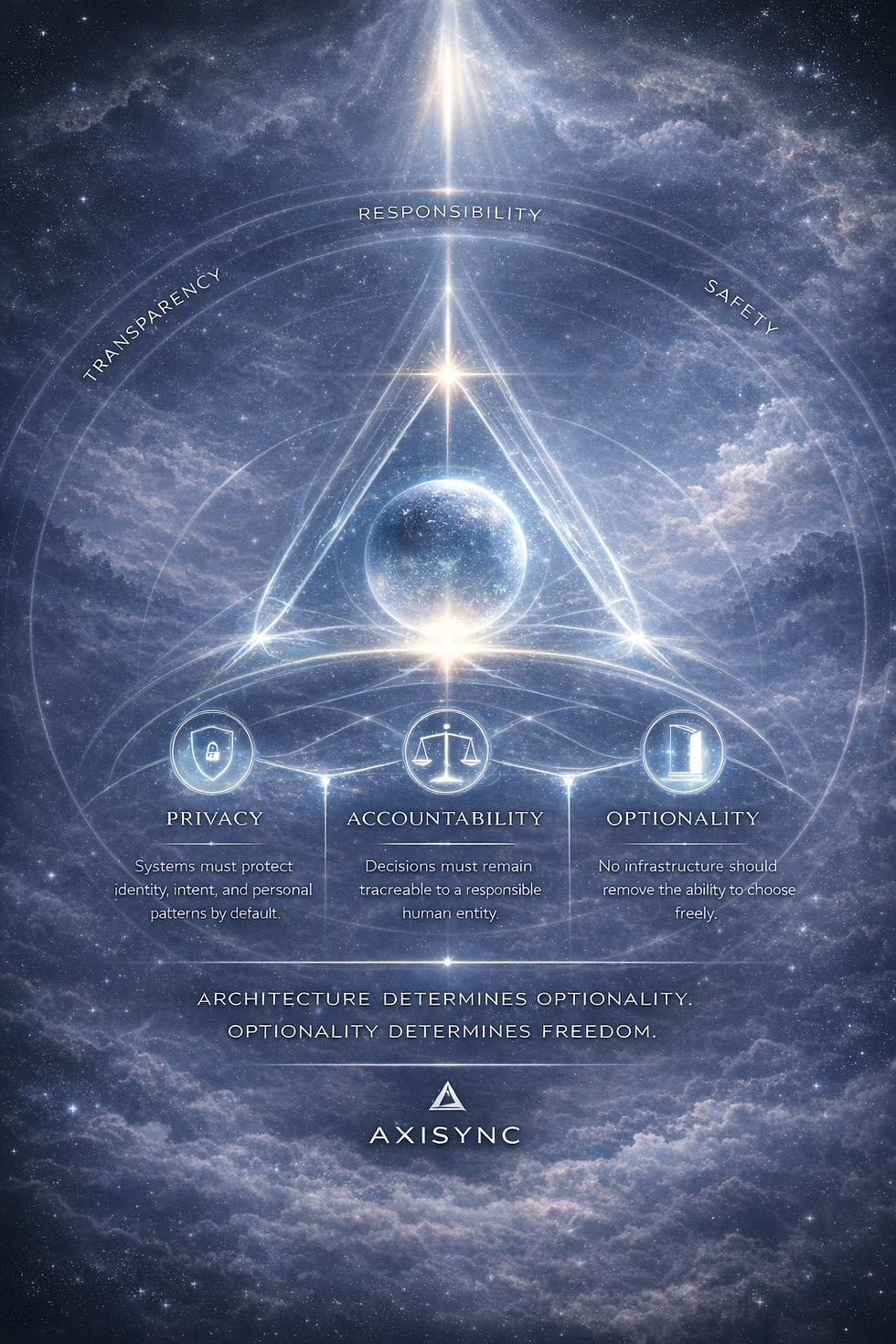
The Design of Responsibility in the Age of AI
Introduction — The Real Question
The discussion around artificial intelligence often focuses on capability.
Speed.
Scale.
Intelligence.
But this is not the real question.
The real question is:
👉 What kind of world are we designing?
Because AI is not just technology.
It is infrastructure.
And infrastructure defines how people live, decide, and experience reality.
AI Is Not Just Built — It Is Designed
Every system carries intent.
Not only in what it does.
But in how it shapes:
behavior
decisions
perception
This is not new.
Design has always influenced human experience.
Architecture, interiors, environments — they are not neutral.
They shape how we feel:
calm or overwhelmed
balanced or fragmented
free or constrained
Leading firms like Rockwell Group and Arquitectonica understand this deeply.
They do not just build spaces.
👉 They design how humans experience those spaces
Peace.Harmony.
Clarity.
Freedom.
Digital Systems Are Now Environments
What architecture once did for physical space, AI now does for digital and decision environments.
Interfaces.
Algorithms.
Data systems.
They are not tools.
👉 They are environments people live inside
And just like physical environments:
👉 they can support humanity
👉 or erode it
The Risk — Invisible Influence
The greatest risk is not intelligence.
It is:
👉 loss of agency
When systems:
guide decisions invisibly
prioritize outcomes without transparency
optimize without human alignment
Then power does not disappear.
👉 It shifts.
Quietly.
Structurally.
Power Must Be Designed With Humanity
This is the defining principle:
AI must not replace human responsibility.
It must:
👉 reinforce it
Because:
judgment must remain human
accountability must remain visible
responsibility cannot be outsourced
Historical Context — This Is Not New
This moment feels unprecedented.
But the underlying question is ancient.
Leonardo da Vinci
He did not separate:
art
science
engineering
Creation was always integrated.
Human understanding and technical capability moved together.
Marcus Aurelius
He governed an empire.
But his focus was not control.
It was:
👉 discipline
👉 responsibility
👉 inner alignment
Because power without self-governance collapses.
👉 Technology evolves.
👉 Responsibility does not.
The Design Principle
AI systems must follow the same standard as great architecture:
👉 They must be designed for human well-being
Not only:
efficiency
optimization
scale
But:
dignity
clarity
autonomy
The Conditions for Human-Aligned Systems Architecture
Designing AI with humanity is not abstract.
It requires structure.
Privacy
Human data is not a resource to be extracted.
It is an extension of the individual.
👉 Systems must protect:
identity
intent
behavioral patterns
Not as a feature.
But as a foundation.
Accountability
Decisions must remain traceable.
There must always be:
a clear decision layer
a responsible entity
a defined point of control
Because:
👉 responsibility cannot be outsourced
Optionality
No system should become unavoidable.
No architecture should remove the ability to choose.
Because:
👉 dependency is not efficiency
👉 it is constraint
Extended Conditions — Institutional Alignment
A system aligned with humanity must protect more than control and privacy.
It must also make power legible, safe, fair, and challengeable.
Transparency
Systems must be understandable enough to be trusted — or questioned.
People should know:
when they interact with AI
what the system does
what it cannot do
Safety & Resilience
Systems must remain stable under pressure.
They must be:
secure
reliable
resistant to misuse or failure
Because systems that fail unpredictably erode trust.
Fairness & Inclusion
Human-centered systems must not exclude.
They must avoid:
bias
structural inequality
hidden discrimination
Because humanity includes everyone.
Contestability
Decisions must be challengeable.
People must be able to:
question outcomes
appeal decisions
correct errors
👉 Not only exit systems
👉 but have a voice within them
Societal & Generational Well-Being
Systems must not optimize at the cost of society.
They must consider:
long-term impact
social cohesion
future generations
Because progress without responsibility creates instability.
The Core Principle
Architecture determines optionality. Optionality determines freedom.
What this means
If users cannot leave → they are locked
If systems cannot be replaced → they are controlled
If decisions cannot be challenged → they are imposed
👉 Freedom is not declared.
👉 It is designed.
Structural Warning
Systems that remove optionality do not scale freedom. They scale dependency.
Power With Humanity — Defined
Power is not the problem.
Unaligned power is.
Power moves through infrastructure.
It is stabilized through systems.
It is shaped — and confronted — through art.
And ultimately:
👉 It must be governed through responsibility
The Generational Contract
This is not only a technical challenge.
It is a generational decision.
What we design now will define:
how future generations think
how they decide
how much agency they retain
👉 This is the contract - Human-Aligned Systems Architecture:
We do not build systems that replace humanity.
We build systems that:
👉 protect it
The Axisync Position
This is where Axisync operates.
At the intersection of:
power
systems
human experience
Not to accelerate blindly.
But to ensure:
👉 alignment between capability and humanity
Stoic Close
You may not control the systems that emerge.
But you can decide:
👉 whether they are designed with humanity
👉 or without it
Because in the end:
Technology will shape the world.
But:
👉 design determines whether that world remains human
Final Closing Line
Humanity is not protected by intention. It is protected by architecture.
Erik Kling - Axisync


Comments