


THE ARCHITECTURE OF CAPITAL — PART 1

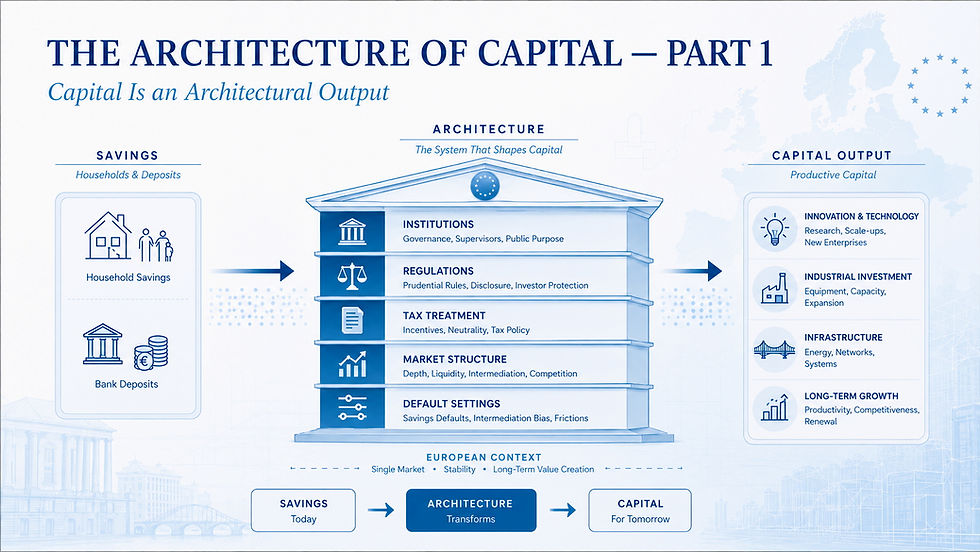
Capital Is an Architectural Output
How capital architectures determine who builds AI — and who rents it.
Europe holds roughly €10 trillion in household savings sitting in bank deposits.
Europe is also told, in the Draghi competitiveness report, that it faces combined additional investment needs of €750–800 billion every year through 2030 to remain competitive, finance the green and digital transitions, and strengthen its strategic autonomy.
Both statements are true at the same time.
The deposit stock alone is more than ten times the annual gap. European households save around €1.4 trillion a year — more, in absolute terms, than households in the United States.
So the shortfall is not a shortage of money.
It is something more specific, and more difficult to fix.
Capital Is Produced, Not Merely Allocated
Most analysis treats capital as a substance. It exists somewhere, in some quantity, and the task is to direct it toward better uses.
That framing is incomplete.
Capital is produced. And what a system produces depends on how that system is built.
Institutions, regulations, tax treatment, market structure and default settings determine:
where savings accumulate
how risk is priced
who can access funding
how losses are treated
how success is rewarded
and whether returns are recycled into the next generation of investment
None of that is a matter of national appetite or entrepreneurial temperament. It is a matter of design.
Which changes the question.
Not: how much capital does a society possess?
But: what kind of capital does its architecture repeatedly produce?
The Wrong Debate
The familiar explanation is that European savings leave Europe. Around €300 billion of European savings flows into non-EU markets each year, and that figure has become the centerpiece of the argument.
It is a real number. It is also the wrong place to look.
Economists examining the flow point out that most European savings never leave at all. The bulk of it stays inside Europe — in deposits, insurance products, pension structures and sovereign instruments — and even the portion invested in securities shows a strong domestic bias.
Which makes the diagnosis harder, not easier.
If the money were leaving, the remedy would be to keep it. The money is largely here.
The issue is not location.
The issue is form.
A euro in a deposit account and a euro funding a frontier technology company are both capital. They are not the same kind of capital.
One preserves wealth. The other finances uncertainty.
One seeks protection. The other seeks possibility.
The AI economy runs on the second.
Savings Are Not Risk Capital
Frontier technology requires capital willing to do three things: tolerate uncertainty, absorb losses, and wait for asymmetric outcomes.
Not every financial system is built to produce that.
Every capital architecture selects for something.
Some select for preservation.
Some for experimentation.
Some for industrial coordination.
Some for disciplined allocation.
Some for concentrated execution.
The output reflects the selection.
The United States built an architecture that routes vast institutional pools — retirement capital above all — into public equities, venture funds, private markets and an active acquisition ecosystem.
Europe built an architecture that routes a larger share of household wealth into banks, deposits, insurance structures and lower-risk instruments.
Both systems accumulate capital successfully.
They do not produce the same capital.
Architecture Is Not a Metaphor
This is where the argument stops being an opinion.
In March 2025 the European Commission adopted the Savings and Investments Union — a strategy whose explicit purpose is to change how the European financial system converts savings into productive investment, by integrating capital markets with the banking sector.
Read the stated objective carefully. The SIU is intended to strengthen Europe's economic resilience and reduce dependency on external sources of financing by improving the internal allocation of savings.
That is not a critic's framing. That is the Council's own language.
The instruments follow the diagnosis. A blueprint for European savings and investment accounts, to give households a direct route into capital markets. A review of the pan-European personal pension product, on which the Council agreed its negotiating position in June 2026. Work on venture capital regulation, listing venues, and the tax frictions that fragment cross-border investment.
Every one of those changes the rules and incentives governing where savings can go and what forms of risk the system can carry.
Which is the proof of the claim. Europe has not diagnosed itself as short of money. It has diagnosed itself as holding the wrong architecture — and is now attempting to legislate a different capital output.
The open question is not whether the diagnosis is correct.
It is whether the redesign arrives before the dependency it describes has hardened.
Capital Does Not End With Allocation
Most analysis stops at the point of investment. Where does the money go?
The more consequential question is what happens afterwards.
Because capital becomes strategically significant only when it compounds. A company is funded. It grows. Employees accumulate wealth. Founders become investors.
Acquirers deploy capital. Public markets absorb the next generation. Institutional investors receive returns and allocate again.
That is not allocation. It is regeneration — and it is the mechanism that explains why gaps between systems widen rather than close.
Whether a given architecture actually performs that loop, and where it breaks when it fails to, is the evidence this series takes up next.
But the principle can be stated now:
The decisive advantage is not possessing capital once. It is possessing an architecture that regenerates it.
Where This Leads
If capital is an architectural output, three things follow.
Architecture determines what kind of capital a system produces.
That capital determines which layers of an industry a system can finance for itself.
And whatever it cannot finance for itself, it must obtain from someone else — on terms set elsewhere.
That is where dependency begins. Not with a failure of ambition, and not with a shortage of savings, but with an architecture that produces the wrong form of capital for the thing being built.
The United States, China, Japan, South Korea and Europe each generate capital through different institutional architectures. Each produces different strengths. Each produces different dependencies.
Which architecture produces what, and what each one owes to the others as a result, is the subject of Part 2.
RHODES OBSERVATION
Capital is not merely a resource.
It is an architectural output.
And architectures reveal themselves by the kinds of risk they repeatedly finance.
Sources
Europe's savings and the investment gap
European Commission, Savings and Investments Union communication and accompanying remarks by President Ursula von der Leyen, 19 March 2025 — approximately €10 trillion of EU household savings held in bank deposits; European households saving roughly €1.4 trillion each year, against just over €800 billion in the United States.
Mario Draghi, The Future of European Competitiveness, September 2024 — combined additional investment need of €750–800 billion per year through 2030, roughly 5% of EU GDP, to remain competitive and to finance the green and digital transitions and strategic autonomy.
The “flight of savings” debate
European Commission, Savings and Investments Union communications, 2025 — approximately €300 billion of European savings flowing into non-EU markets each year.
CEPR / VoxEU, June 2026 — analysis arguing the “flight of European savings” framing is overstated: savings are largely held as domestic bank deposits and portfolio holdings show strong home bias, with the deeper deficiency being insufficient allocation to equities rather than capital leaving Europe.
The Savings and Investments Union
European Commission and Council of the European Union, Savings and Investments Union, strategy adopted 19 March 2025 — stated aim to strengthen economic resilience and reduce dependency on external sources of financing by improving the internal allocation of savings.
Council of the European Union — negotiating position on the review of the pan-European Personal Pension Product (PEPP) agreed 24 June 2026; Commission recommendation on savings and investment accounts; mid-term review of the SIU scheduled for the second quarter of 2027.
AXISYNC Partners LLC
axisyncpartners.net | Architecture of Decision Sovereignty
The Architecture of Capital — Part 1 | July 2026


Comments