


THE ASML PARADOX: WHY A CHOKEPOINT IS NOT AN ARCHITECTURE - AI sovereignty Europe

By Erik Kling | AXISYNC Decision Architecture™
There is a question that European policymakers, technology executives, and strategists have been circling for several years without quite landing on.
Europe is not technologically weak. It holds one of the most critical positions in the entire global AI capability stack — a position so singular that when the United States wanted to slow China's semiconductor ambitions, the lever they needed was not American. It was Dutch.
How can a continent hold a global monopoly on the most critical tool in semiconductor manufacturing and still not control its own AI destiny?
That is the ASML paradox. And understanding it precisely is essential — because the lesson it contains goes far beyond semiconductors.
The Machine That Makes the Machines
To understand ASML's position, you need to understand what EUV lithography actually does.
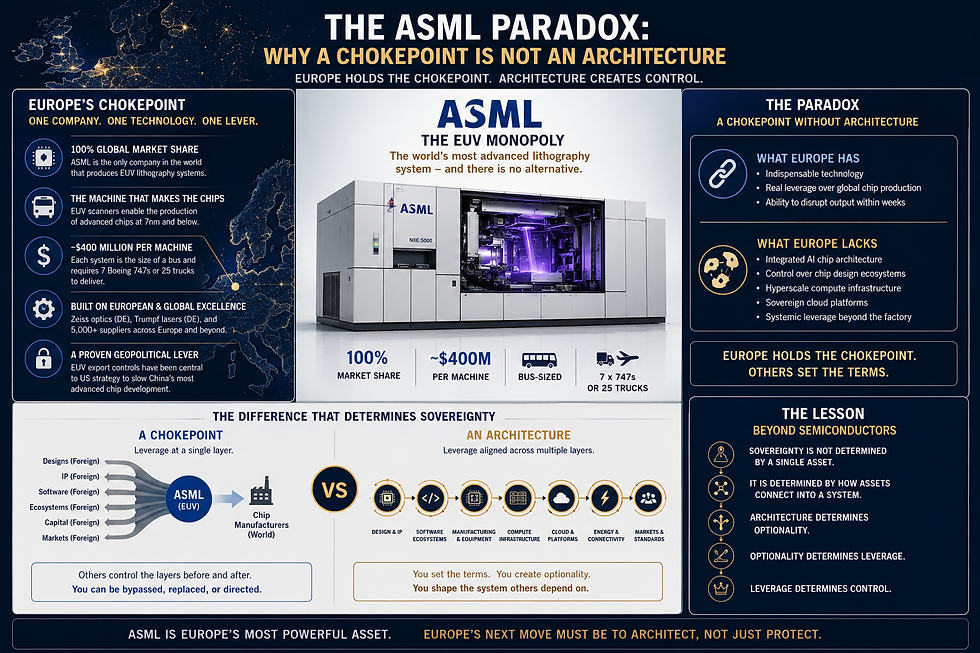
Every manufacturer producing semiconductor chips of 7 nanometers or smaller needs ASML's EUV lithography machines. There is simply no other option. Each machine is roughly the size of a bus, costs $400 million, and requires seven Boeing 747s or 25 trucks to deliver a single unit to a customer.
ASML holds 100% market share in the only lithography technology capable of producing advanced logic and high-bandwidth memory chips — pricing power that sustains 52%+ gross margins even as unit volumes face cyclical pressure.
This is not a temporary market position. It is the result of decades of accumulated technical complexity that competitors have been unable to replicate. ASML is the only company that produces EUV scanners, after Nikon and Canon exited the technology over a decade ago. The machine itself is a marvel of concentrated global knowledge — its components draw on precision optics from Zeiss in Germany, laser systems from Trumpf, and supply chain contributions from over 5,000 suppliers across Europe and beyond.
The strategic significance was demonstrated conclusively when the United States moved to contain China's semiconductor development. In 2019, the first Trump administration worked with the Dutch government to deny China access to ASML's EUV tools. This strategy has been remarkably successful, forcing China into years of expensive attempts at reverse-engineering and domestic development.
One Dutch company, subject to Dutch export licensing decisions, became the physical lever of US-China technological competition. The entire trajectory of China's AI chip ambitions was altered by access decisions made in the Netherlands.
That is real power. The question is: power for whom, and on whose terms?
The Paradox Defined
Here is what makes the ASML situation paradoxical rather than simply advantageous.
Chip factories require a continuous supply of parts, service, calibration, and software.
European withdrawal of ASML support could reduce output within weeks. The American tech sector depends on ASML's machines. That dependency is real and structural.
And yet that leverage has primarily been exercised at Washington's direction. The Netherlands imposed export controls on ASML's most advanced machines under sustained US pressure. The Netherlands' decision to fully align with US-led export control initiatives in December 2025 marks a final departure from even its previous cautious independence — Dutch economic security now formally aligned with US strategic interests.
Europe holds the chokepoint. But it has not consistently exercised independent judgment about how that chokepoint is used. The leverage exists. The architecture to deploy that leverage on European terms does not yet exist.
This is the precise distinction that matters: the difference between possessing a critical asset and controlling an architecture.
A critical asset gives you a seat at the table where others are making decisions. An architecture gives you the ability to set the terms of the table itself.
What the Stack Reveals
The USA vs Europe comparison across the AI chip power stack makes the structural situation visible with uncomfortable clarity.
At the application and model layer: Europe has research excellence, emerging players like Mistral AI, and strong academic foundations. But no hyperscale consumer platforms, no global model ecosystems, no distribution at commercial scale. Weak.
At the compute systems layer: Limited hyperscale capacity. Europe remains reliant on NVIDIA for roughly 85% of its AI GPUs, and European sovereign cloud infrastructure spending is forecast at roughly €12 billion in 2026 — nearly sixty times below US hyperscaler capex of $725 billion in the same year. Weak.
At the chip design layer: No leading AI chip designer. Dependent on foreign architectures and ecosystems — primarily NVIDIA's CUDA — for the software standards that define what AI workloads are economically viable. Weak.
At the manufacturing layer: Some capacity through Infineon, ST Microelectronics, and GlobalFoundries Dresden. But even with the €43 billion Chips Act aiming to double EU chip market share by 2030, expert audits warn that sub-7nm capacity cannot be achieved in time. Next-generation AI hardware will remain predominantly offshore. Partial.
At the equipment layer: ASML. Global monopoly in EUV lithography. The single most critical enabling technology in advanced semiconductor manufacturing. Strong.
At the energy layer: Strong in renewables leadership, but high energy costs, fragmented markets, and grid constraints create material obstacles to large-scale AI infrastructure deployment — constraints that will compound as compute demand accelerates. Partial.
The pattern is unambiguous. Europe has upstream hardware assets — a global monopoly on the single most critical tool in advanced semiconductor production — yet the race for AI dominance is between the United States, which dominates frontier chip design, and China, which is spending enormous political capital to reduce its dependence on that ecosystem.
Europe is not the third competitor in that race. It is, in important respects, the terrain over which the race is being run.
The Lesson Beyond Semiconductors
The ASML paradox is not really about semiconductors. It is about the difference between two strategic conditions that are easy to conflate and dangerous to confuse.
The first condition is holding a critical position — a node, a chokepoint, a capability that others depend on. This generates leverage. It creates negotiating power. It matters.
The second condition is controlling an architecture — a connected system of positions, designed with intentionality, that together determine the terms on which an entire domain operates. This generates sovereignty. It creates the ability to set terms rather than accept them.
ASML is the clearest demonstration available that the first condition does not automatically produce the second. Europe has held the equipment chokepoint for years. That position has been used — sometimes by European governments, sometimes at US direction — but it has not been embedded into a coherent European AI architecture that converts chokepoint leverage into systemic control.
Some analysts propose that Europe should pursue sovereignty through indispensability rather than self-sufficiency — controlling inputs that others cannot route around. That is a more sophisticated framing than passive dependency. But it still describes a strategy built around defending existing positions. Defending a chokepoint is reactive. Architecting a system is generative. One preserves what exists. The other creates what does not yet exist.
A chokepoint creates leverage at a single layer. An architecture aligns leverage across multiple layers.
Post 4 takes this argument to its conclusion: what it would actually mean for Europe to architect AI sovereignty rather than purchase it — and why the approach most European institutions are currently pursuing will not produce the outcome they are seeking.
Sovereignty is not determined by a single asset. It is determined by how assets connect into a system.
Architecture determines optionality.
Optionality determines leverage.
Leverage determines control.
Erik Kling is the author of AXISYNC Decision Architecture™ and RHODES DOCTRINE™, and the founder of AXISYNC Partners LLC. This piece is part of a series on the structural dynamics shaping the next decade of technology, governance, and civilizational architecture.


Comments