


The Future Will Belong to Architectures That Preserve Optionality - sovereign AI infrastructure


AXISYNC Cloud Sovereignty Series | Part 4 of 4
The Future Will Belong to Architectures That Preserve Optionality
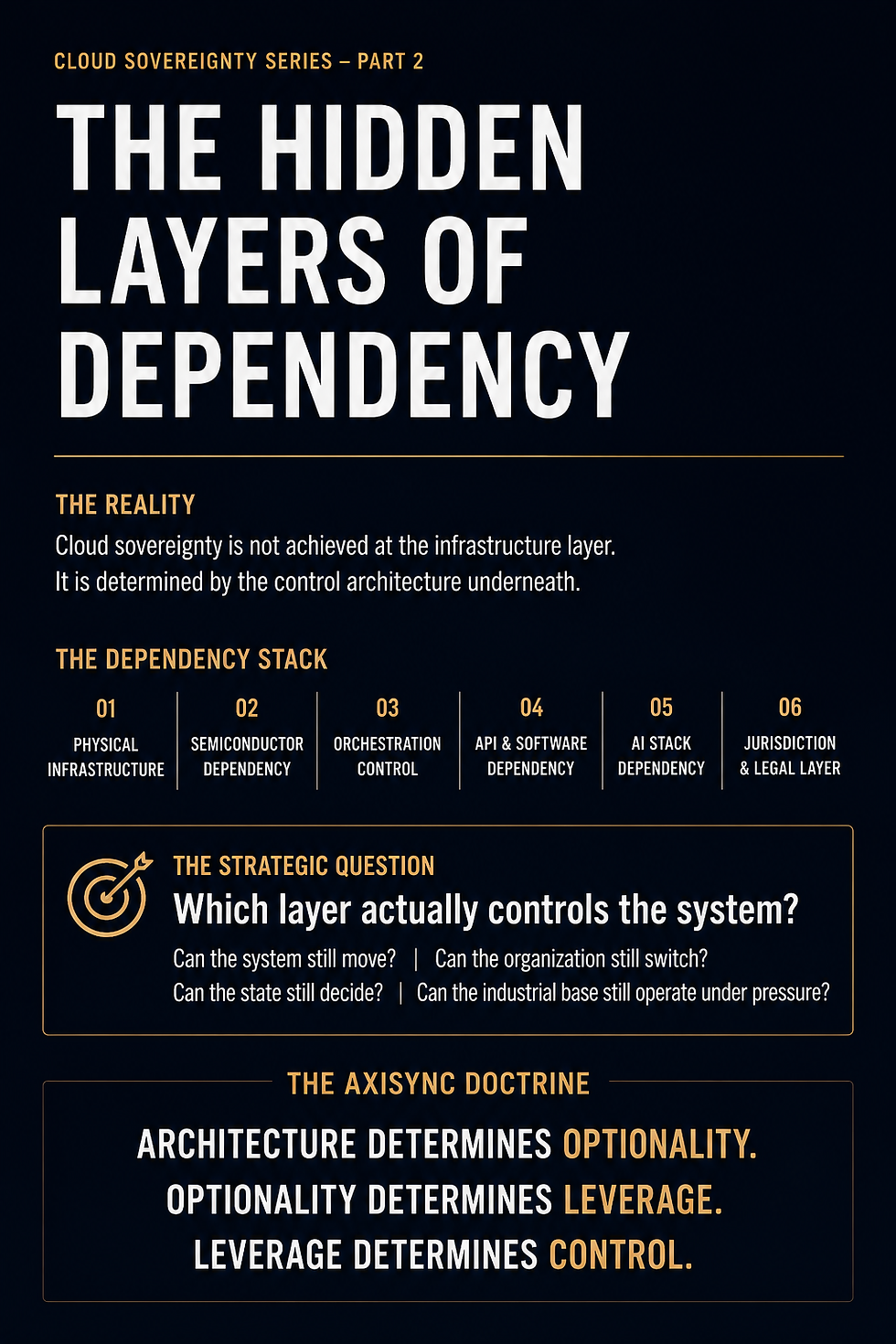
Architecture determines optionality. Optionality determines leverage. Leverage determines control.
A Note on This Series
Part 1 of this series exposed the growing gap between cloud compliance narratives and actual infrastructure sovereignty.
Part 2 mapped the hidden dependency layers beneath modern digital systems — cloud, compute, semiconductors, AI orchestration, energy, network infrastructure, and software control layers.
Part 3 examined the consequence of those dependencies over time: the gradual, quiet loss of strategic optionality — systems that appear successful while internal strategic freedom is already disappearing.
This fourth and final article synthesizes what the research now confirms: we were correct. And in several areas, reality has moved faster than the argument.
It also goes further — into what the original analysis did not fully address, including water as an emerging physical constraint, the kinetic targeting of hyperscale infrastructure as a new category of civilizational risk, regulatory architecture as its own form of irreversible lock-in, and the sovereign compute race that has confirmed at national scale precisely what AXISYNC has described at the strategic level.
Most Organizations Focus on Adoption. Very Few Focus on Reversibility.
That distinction will define strategic resilience over the next decade.
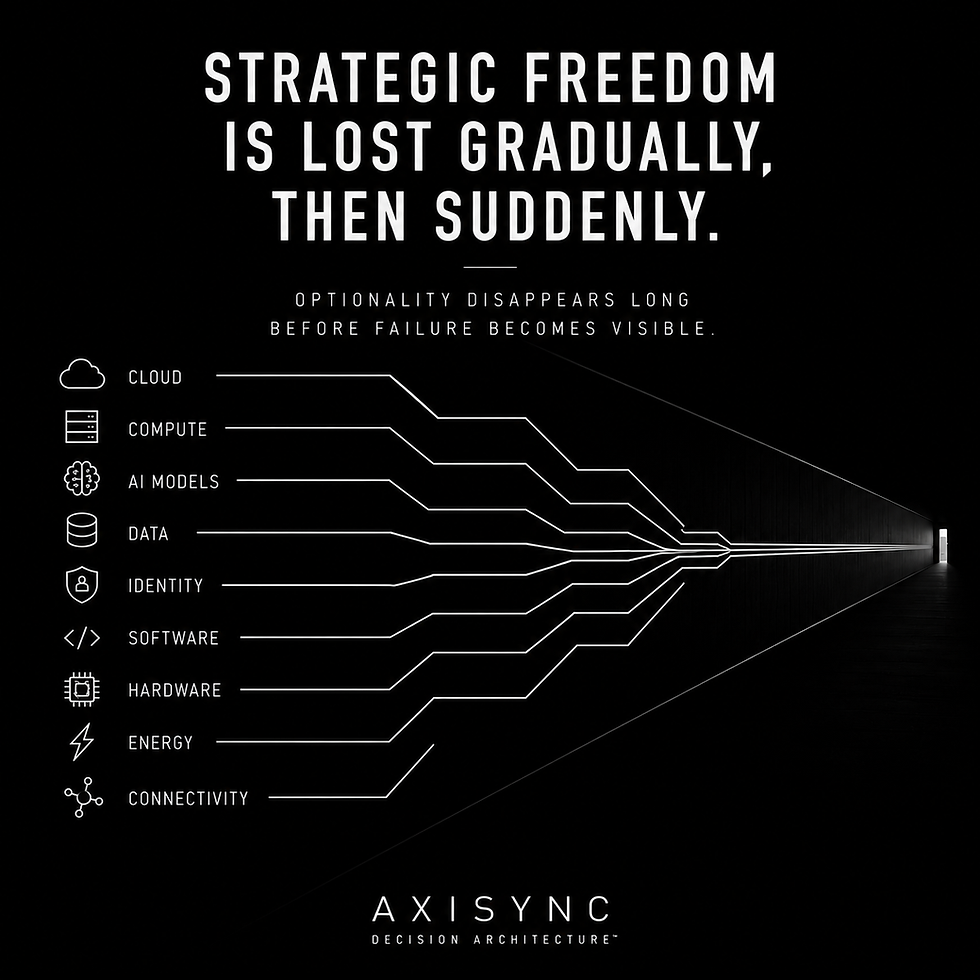
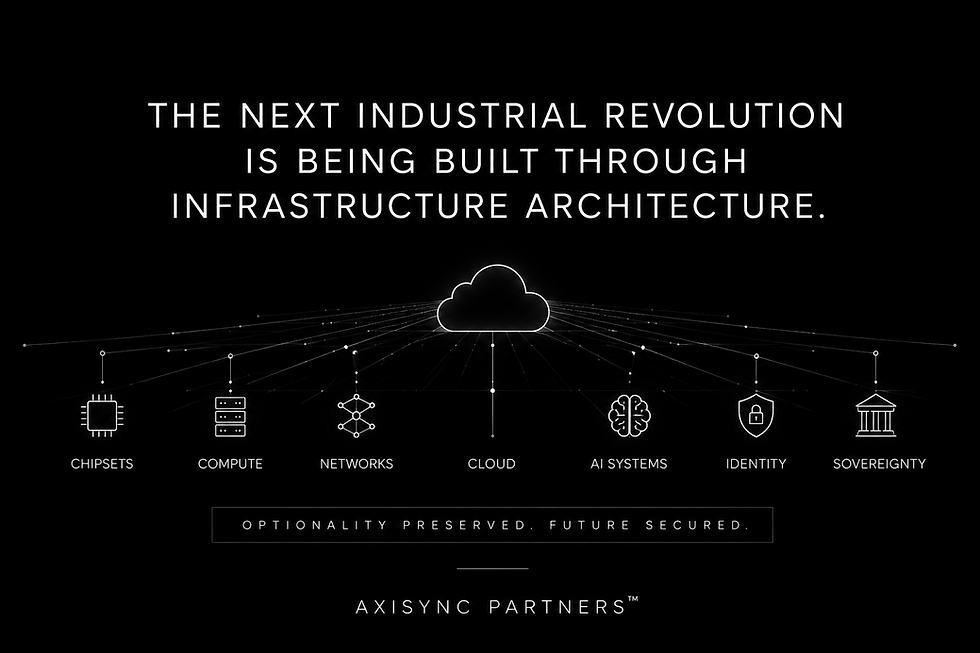
Cloud. AI. Compute. Identity systems. Energy infrastructure. Platform ecosystems.
Every layer increases capability.
Every layer also introduces dependency.
The question is no longer whether dependency exists.
The question is whether dependency remains reversible.
This is where resilient strategic architecture begins.
Resilient systems preserve:
• Optionality
• Modularity
• Sequencing
• Reversibility
• Strategic redundancy
• Sovereignty across layers
• Controlled dependencies
• Long-term leverage
Because highly optimized systems often become structurally fragile.
When every critical layer becomes tightly coupled, adaptation becomes difficult precisely when adaptation becomes necessary.
Architecture determines optionality.
Optionality determines leverage.
Leverage determines control.
This is not only a technology discussion.
It is a strategic freedom discussion.
The organizations that remain resilient during the next industrial era will not be the organizations that optimized fastest.
They will be the organizations that preserved the ability to choose.
AXISYNC exists to expose where architecture silently reduces future strategic freedom. Because systems collapse structurally before they collapse visibly.
Strategic Findings Across Infrastructure, AI, and Sovereignty
What the Research Now Shows
Across energy systems, semiconductors, AI infrastructure, cloud computing, public policy, and digital sovereignty research, one pattern is becoming increasingly clear:
The next industrial era is no longer constrained primarily by software innovation.
It is constrained by infrastructure architecture.
The global AI race is rapidly transforming from a competition of applications into a competition of energy access, compute capacity, semiconductor control, regulatory coordination, and infrastructure deployment speed.
This changes the nature of strategic power itself.
The IEA's April 2026 update confirmed that global data centre electricity consumption grew 17% in 2025, with AI-focused data centres surging 50% — well outpacing total global electricity demand growth of 3%. The IEA now projects electricity consumption from data centres will double to approximately 950 TWh by 2030, with AI-related demand tripling. Capital expenditure from five large technology companies surged to more than $400 billion in 2025 and is set to increase by a further 75% in 2026.
This is a structural shift.
AI is no longer merely a digital layer sitting on top of infrastructure.
AI itself is becoming infrastructure.
And infrastructure requires:
• Energy
• Land
• Cooling
• Grid capacity
• Semiconductor access
• Network routes
• Regulatory approvals
• Water systems
• Capital concentration
• Geopolitical stability
The implications are profound.
For years, digital transformation was discussed primarily through software, platforms, and user adoption.
That era is ending.
The new constraint layer is physical.
The Energy Constraint
In the United States, utility providers are already restructuring long-term investment strategies around projected AI power demand. Data centres now consume more than 4% of all US electricity — roughly equivalent to the annual electricity demand of Pakistan — and are projected to grow 133% by 2030.
Meanwhile, resistance is beginning to emerge at the societal level. As hyperscale AI infrastructure expands, dozens of jurisdictions across the United States have started restricting or delaying new AI data-centre construction due to grid strain, energy costs, environmental concerns, and infrastructure stress.
This reveals an important reality: AI scale is no longer limited only by model capability. It is increasingly limited by energy architecture.
The Water Constraint — The Invisible Physical Layer
What the original analysis named but did not fully develop is now confirmed by independent research: water is the infrastructure constraint almost no one is talking about.
Water has become a key design constraint for AI data centres, alongside power, land, and connectivity — especially in regions facing water scarcity. A typical 100MW AI data centre uses 1.5 to 3 million cubic metres of water per year for evaporative cooling. Hyperscaler water consumption rose 25 to 40 percent year-over-year in 2024–2025 disclosures.
An independent analysis of 9,055 data centre facilities found that by the 2050s, nearly 45% may face high exposure to water stress. The global water supply deficit is projected to reach 56% by 2030 — at precisely the moment AI infrastructure demand for cooling is set to triple.
This is the same structural constraint pattern that applies to energy: invisible accumulation, then sudden visibility. The architecture decisions being made today about where to locate compute infrastructure will determine water dependency for decades.
The dependency is not only geographic. It is political. In the Netherlands, Ireland, Chile, and parts of the American Southwest, data centre water use is already triggering public backlash and regulatory restriction. Infrastructure that appeared to have full regulatory approval can find that approval eroded — not by technology failure, but by physical resource conflict that was never accounted for in the original architecture.
The most dangerous infrastructure decisions are the ones that pass every compliance review — and then encounter reality fifteen years later.
When Infrastructure Becomes a Target — A New Category of Fragility
In March 2026, Iranian drones struck Amazon Web Services facilities in the UAE and Bahrain, damaging physical infrastructure and disrupting cloud services across the region.
For the first time in modern conflict, commercial hyperscale data centres became explicit kinetic targets.
This is not an anomaly. It is a confirmation.
When AI becomes infrastructure — when supply chains, logistics, financial systems, healthcare coordination, and governmental services run on a small number of hyperscale facilities concentrated in a handful of geographic clusters — those facilities inherit the same strategic vulnerability profile as power grids, water treatment plants, and communications nodes.
The World Economic Forum has recognized this shift explicitly: attacks on regional data centres mark a transition from cyber risk to physical vulnerability. Expanding energy demands and capital intensity justify treating compute as a foundational national utility requiring the same protection frameworks as other critical infrastructure.
The AXISYNC architecture argument has always been structural: that concentration without redundancy creates leverage for adversaries. What March 2026 demonstrated is that this leverage is now being exercised kinetically, not only commercially.
For organizations and states that have concentrated critical operations on a small number of hyperscale providers in a small number of geographic zones, the architecture question is no longer hypothetical.
The Semiconductor Constraint
The OECD's 2025 mapping of the semiconductor value chain confirms what the series described: the supply chain is a highly complex, globally distributed system of tightly interconnected segments, with high concentration of critical inputs in specific regions and growing trade dependencies across every node.
No single country controls the entire stack. Design tools. Advanced lithography. Rare earth access. Fabrication. Advanced packaging. Memory. GPU architecture.
Manufacturing equipment. Energy-intensive production capacity. All remain distributed across highly specialized geopolitical corridors.
In 2026, new fault lines have emerged. China controls approximately 79% of global tungsten mine production — and tungsten appears both in chips themselves and in the equipment used to manufacture them at advanced nodes. With no practical substitute at scale, restricted access to tungsten is now a direct constraint on advanced chip production, regardless of where fabrication nominally occurs.
This creates a new form of structural dependency. Not dependency on one company alone. Dependency on entire integrated ecosystems that become difficult to replace once embedded into national infrastructure.
The European Dependency — What the Numbers Now Show
The European Parliament's 2025 study on software and cyber dependencies confirms the pattern this series described — and the numbers have become more stark.
More than 80% of Europe's digital technologies and infrastructure are imported. Over 70% of global foundational AI models originate in the United States. American tech giants control more than 70% of Europe's cloud infrastructure. The EU spends over €260 billion per year on US cloud and software — approximately 1.5% of EU GDP.
In Belgium, Microsoft alone holds roughly 70% of the cloud market. In Sweden, over half of public digital systems rely on US-based servers. The European Parliament's report specifically identifies vendor lock-in, proprietary standards, network effects, and long-term contracts as mechanisms through which dependency gradually becomes structural.
That wording matters. Dependency is no longer simply operational. It becomes architectural.
The policy response is now accelerating. In November 2025, all 27 EU member states signed the European Digital Sovereignty Declaration. France and Germany led a European Digital Sovereignty Summit in Berlin. A dedicated task force was established to report progress in 2026. Gartner now projects European sovereign cloud spending will more than triple to $23 billion by 2027 — a faster acceleration than North America or China.
At KubeCon Europe 2026 in Amsterdam, Thierry Carrez, General Manager of Linux Foundation Europe, stated explicitly that the debate has moved 'from tactical to strategic,' with ministries now requesting full national usage maps of Gmail, Outlook, and proprietary office suites.
The risk that catalyzed this shift is no longer theoretical. When the Trump administration imposed sanctions on senior members of the International Criminal Court in February 2025, European governments recognized that a foreign government could theoretically instruct an American company to restrict access to email systems, office software, or data storage for European institutions — and there was no technical countermeasure that could prevent it.
Infrastructure is never neutral. Infrastructure determines dependency. Dependency determines leverage. Leverage determines strategic freedom.
Regulatory Architecture — A New Form of Structural Lock-in
The original analysis focused on technical and vendor lock-in. What has become equally clear in 2025 and 2026 is that regulatory fragmentation itself creates a new form of structural irreversibility.
IDC now projects that by 2028, 60% of multinational firms will split AI stacks across sovereign zones — tripling integration costs as regulatory fragmentation and supply chain risks slow strategic scaling. The 'borderless' era of cloud computing is officially yielding to the Sovereign AI Stack.
Regulatory alignment is increasingly mapping onto geopolitical allegiance and technology supply chain access. The EU AI Act's highest-risk provisions become enforceable in August 2026. Singapore launched the world's first governance framework for agentic AI in January 2026. South Korea's AI Basic Act — the first binding comprehensive AI law in Asia-Pacific — took effect the same day. Vietnam enacted a formal AI law in December 2025.
The result is a regulatory landscape that fragments AI architecture by jurisdiction — and once systems are re-architected across sovereign zones, the integration costs and operational complexity become structural. Organizations cannot easily reverse them.
This means that a decision made today about where to run AI workloads — which jurisdiction, which cloud region, which provider — is not just a technical or cost decision. It is a future sovereignty decision. The architecture of compliance becomes the architecture of constraint.
The AXISYNC framing applies directly: regulatory architecture behaves exactly like technical architecture. It accumulates dependency gradually, hardens over time, and eventually determines what futures remain possible.
The Sovereign Compute Race — Architecture at National Scale
If any single data point confirms the AXISYNC doctrine at civilizational scale, it is this:
More than $100 billion worldwide will be committed to building sovereign AI compute in 2026. Eighty-three percent of companies view sovereign AI as at least moderately important to their strategic planning. Seventy percent of global AI compute is concentrated among five tech giants.
Nations are now making exactly the architecture decisions this series describes — but at the level of national industrial policy.
France launched a €10 billion sovereign AI supercomputer programme. Japan committed $6.3 billion to build domestic foundation models and 2-nanometer chip fabrication capacity — explicitly to 'decouple the nation's technological future from over-reliance on foreign entities.' The UK, Saudi Arabia, Malaysia, and dozens of other countries have launched multi-billion dollar national AI cloud programmes. Gulf sovereign wealth funds committed an estimated $2.5 trillion to US technology investments in part as geopolitical insurance.
In 2026, compute power is being treated with the same strategic gravity as oil or grain.
This is not a technology trend. It is a sovereignty response — and it is the largest real-world confirmation that the architecture-optionality-leverage-control chain that AXISYNC describes is now operating at the level of national strategic planning.
There is a counter-tension worth naming directly.
Countries investing billions in domestic sovereign stacks are making their own optionality bets — and they may be making them in ways that also harden into lock-in over time, just with different dependencies. A nation that builds its entire AI infrastructure around one domestic foundation model has replaced foreign dependency with domestic concentration. A regional sovereign cloud that requires specific hardware from a single certified supplier has rebuilt the same trap at a different scale.
True sovereign architecture does not simply replace one dependency with another. It preserves reversibility at every layer — including within the national stack itself. That is the discipline AXISYNC describes, and it applies as much to governments as to enterprises.
The Philosophical Lineage — What This Doctrine Is Doing
There is a body of thought this series has been building toward without fully naming it.
In 1980, technology philosopher Langdon Winner posed a question that has become increasingly relevant: Do artifacts have politics? His argument was that machines, structures, and systems of modern material culture are not neutral — they embody specific forms of power and authority. Technologies are not merely tools. They are political in the sense that they shape how power is distributed in society.
Cloud infrastructure, AI orchestration layers, semiconductor supply chains, and identity systems are artifacts in Winner's sense. They are not neutral architectures. They are political architectures. The organization or state that controls the infrastructure layer does not need to make visible power decisions — the architecture makes those decisions structurally, in advance, invisibly.
The economics of lock-in were formalized by Paul David's work on path dependency — what he called QWERTY-nomics. The core finding is that a minor or fleeting early advantage for some technology or standard can have important and irreversible influences on ultimate market allocation, even in a world of voluntary decisions and individually maximizing behavior. Technical interrelatedness, economies of scale, and quasi-irreversibility of investment are the three mechanisms through which a path becomes a trap.
This is precisely the mechanism this series has described operating across cloud platforms, AI orchestration layers, semiconductor supply chains, and regulatory jurisdictions simultaneously.
AXISYNC is not simply a strategy methodology. It is an applied extension of this philosophical lineage — making the invisible political and economic dynamics of infrastructure architecture visible to the decision-makers who have to navigate them before the window closes.
Because Winner was right: the most important political decisions in the AI era are not being made in parliaments or boardrooms.
They are being made in architecture reviews.
The Leadership Challenge
The objective is not eliminating dependency.
Modern economies, organizations, and digital ecosystems will always depend on external systems.
The strategic question is different:
Which dependencies remain reversible?
And which dependencies gradually become difficult to change?
Every major infrastructure decision creates a future architecture of constraints and possibilities.
• Cloud platforms
• Identity systems
• AI models
• Developer ecosystems
• Energy contracts
• Semiconductor supply chains
• Regulatory jurisdictions
• Water access
Each decision expands capability.
Each decision also shapes future optionality.
The leadership challenge is no longer selecting the best technology.
The leadership challenge is preserving strategic freedom before irreversibility accumulates.
This is where strategic architecture becomes a decision discipline rather than a technology discipline.
The same pattern also appears inside organizations themselves.
Many organizations do not lack innovation.
Their architecture prevents synthesis.
Different departments optimize independently while strategic dependency accumulates across the whole system.
By the time leadership recognizes the exposure, optionality has already narrowed.
This is why strategic architecture is becoming the defining leadership discipline of the next industrial era.
Not because dependency can be eliminated.
But because unmanaged dependency becomes irreversible.
And irreversibility eventually determines leverage.
Architecture Determines What Futures Remain Possible
The systems that retain strategic freedom over the next decade will not necessarily be the systems with the largest budgets or the fastest adoption cycles.
They will be the systems that preserved the ability to adapt before structural lock-in became permanent.
That question now applies across states, enterprises, critical infrastructure, AI ecosystems, and digital civilization itself.
Because architecture determines far more than operational capability.
Architecture determines what futures remain possible.
Civilizations do not lose strategic freedom in a single moment.
They lose it gradually — through architectures that become impossible to reverse.
The systems that shape the next industrial era will not be remembered only for their scale.
They will be remembered for whether they preserved human optionality — or eliminated it.
Because once optionality disappears, control consolidates quietly long before collapse becomes visible.
Architecture determines optionality.
Optionality determines leverage.
Leverage determines control.
Erik Kling
Founder, AXISYNC Partners LLC
Tags: AI Infrastructure · Optionality · Cloud Sovereignty · Geopolitics of Technology · Semiconductors · AI Compute · Axisync · Infrastructure Architecture · Path Dependency · Digital Sovereignty
Comments