


EUROPE CANNOT BUY AI SOVEREIGNTY


By Erik Kling | AXISYNC Decision Architecture™
There is a pattern visible in how Europe is currently approaching AI sovereignty that deserves to be named precisely, because naming it is the first step toward changing it.
The pattern is this: Europe is responding to a structural problem with a financial solution.
The diagnosis is correct. The dependency is real. The urgency is warranted. But the primary response — more funding, more GPUs, more data centers, more gigafactories, more announcements — addresses the symptoms of structural dependency without addressing the architecture that produces it.
You cannot buy your way out of an architectural problem.
The Scale of the Ambition and the Scale of the Gap
Europe is not standing still. The political momentum behind AI sovereignty has accelerated significantly since 2024.
The Draghi report on European competitiveness, published in September 2024, called for a minimum of €750–800 billion in additional annual investment to close the innovation gap with the US and China. The EU's Competitiveness Compass, launched in January 2025, built on that diagnosis with a five-year strategic framework. The AI Continent Action Plan followed, with a €20 billion AI gigafactory program targeting at least 15 interconnected facilities across Europe by 2026. In November 2025, all 27 EU member states signed the Declaration for European Digital Sovereignty — an unprecedented political act explicitly recognizing technological dependency as a strategic risk.
The ambition is real.
The political will is real.
The investment is real.
And yet the numbers reveal the structural gap that ambition alone cannot close.
The combined capex of just four US hyperscalers — Google, Amazon, Meta, and Microsoft — reached approximately $725 billion in AI infrastructure in 2026, up 77% from $410 billion in 2025. European spending on sovereign cloud infrastructure is forecast at roughly €12 billion in 2026 — nearly sixty times below US hyperscaler capex. The Next Web
The EU's €20 billion gigafactory plan looks modest compared to its competitors: OpenAI launched a $500 billion compute plan, Anthropic announced $50 billion in US infrastructure investments, and the hyperscalers are each setting aside around $180 billion for 2026 alone. Techzine Global
The planned AI Gigafactories, totaling approximately 500,000 advanced chips, remain significantly smaller than comparable US infrastructure — OpenAI alone expects to own over 1 million GPUs. Cfg
These comparisons are not arguments against European investment. They are arguments against the belief that investment alone, at any plausible European scale, can resolve a structural dependency that was decades in the making.
The problem is not the size of the budget.
The problem is the architecture.
What Buying More Does and Does Not Solve
When Europe purchases more GPUs, it acquires compute capacity. It does not acquire control over the chip architecture, the software ecosystem, the supply chain, or the energy infrastructure required to sustain that compute capacity over time.
GPUaaS expands access to compute. It does not change who controls it. Beyond technical dependency, economic power follows control of computing distribution. Hyperscalers capture disproportionate value by intermediating access to scarce GPU resources, leaving European users exposed to externally set pricing, capacity allocation, and margin structures. The Next Web
When Europe builds more data centers, it acquires infrastructure on European soil. It does not acquire independence from the chip designers, the foundries, the equipment manufacturers, and the cloud software ecosystems that determine what that infrastructure can actually do — and on whose terms it operates.
American tech giants currently control up to 40% of Europe's operational computing capability and nearly half of upcoming data center projects. Europe suffers from what analysts describe as a dual deficit of insufficient private capital and fragmented public policy — unlike the US, where private companies pour hundreds of billions into AI infrastructure, or China, where the state streamlines investment. Euronews
The structural diagnosis from the Draghi report and the Letta report is accurate: Europe is not failing because of a lack of talent, research capability, or industrial base. It is failing because it has not converted those strengths into connected, competitive architecture.
As the Draghi report concluded, Europe is stuck in a static industrial structure with few new companies rising to disrupt existing industries or develop new growth engines — collectively failing to convert its strengths into productive and competitive industries on the global stage. Cyber Risk GmbH
Buying more compute does not resolve a static industrial structure. It adds capacity to a dependency architecture.
The Internal Dependency Trap - Europe AI Sovereignty
There is a second failure mode that European strategy must confront, one that is less discussed but equally dangerous.
If Europe's response to external dependency is to consolidate around a single European alternative — a single European cloud provider, a single European chip champion, a single European AI model — it has not solved the dependency problem. It has relocated it.
A European monopoly is still a monopoly.
A single European chokepoint is still a chokepoint.
The risk is not only external dependency on US or Chinese infrastructure. It is the structural condition of dependency itself — the loss of optionality, resilience, and the ability to negotiate terms — regardless of where the dependency originates.
True resilience comes from vendor diversity and interoperability. Multiple foreign vendors competing for European business is better for sovereignty than single-vendor dependency on any supplier, even a hypothetical European one. The greatest revolutions in technology — the internet itself, the Linux operating system, and GSM mobile standards — succeeded because they were open. CEPA
Sovereignty in AI is not secured through autarky or full-stack dominance, but through a state's ability to diversify options, manage interdependencies proactively, and align technological choices with national purpose. Institute Global
This distinction is fundamental. The objective of AI sovereignty is not self-sufficiency — the ability to produce everything domestically. The objective is preserving meaningful choice — the ability to negotiate terms, switch providers, build redundancy, and make decisions that reflect European values and interests rather than the constraints imposed by others.
These are different objectives. They require different strategies. And confusing them is one of the most consequential strategic errors a continent can make.
What Architecture Actually Requires
If sovereignty cannot be purchased and cannot be achieved through consolidation around a single European champion, what does it actually require?
It requires five things that are architectural rather than financial.
Diversity.
Multiple providers, multiple architectures, multiple innovation pathways at every critical layer of the stack. Not a European NVIDIA — a European AI ecosystem in which multiple chip approaches, multiple cloud providers, and multiple model developers compete and complement each other. Europe should pursue sovereignty through indispensability rather than self-sufficiency — controlling inputs, capabilities, and chokepoints that other players cannot route around, creating reciprocal dependence where others need European inputs and therefore acquire their own interest in keeping Europe stable and integrated. Bruegel
Redundancy.
Alternative paths for critical capabilities, so that no single point of failure — whether geopolitical, commercial, or technical — can sever access to the infrastructure Europe depends on. The lesson of the COVID supply chain disruption, applied to AI infrastructure, is that single-source dependencies are not cost efficiencies.
They are accumulated strategic risk.
Interoperability.
Open standards and modular systems that enable European organizations to move between providers, combine capabilities from different sources, and avoid the kind of deep ecosystem lock-in that CUDA represents in AI chip design. Interoperability is not a technical preference. It is a sovereignty mechanism.
Transparency.
Visibility across the full stack — knowing where dependencies exist, what the terms of those dependencies are, and what the consequences of disruption would be. Most European organizations engaging with AI infrastructure today do not have this visibility. They are making strategic choices without a complete picture of the architecture they are operating within.
Adaptability.
Designing for change rather than optimizing for current conditions. The AI infrastructure landscape of 2030 will look materially different from 2026. The organizations and nations that build flexible architectures — that preserve optionality as conditions evolve — will be better positioned than those that lock in to the current generation of infrastructure at scale.
These five requirements are not a policy checklist. They are the structural properties of an architecture designed to preserve meaningful choice over time. They are what distinguishes a sovereignty strategy from a procurement strategy.
The Deeper Question
Behind the sovereignty debate there is a question that European institutions have been reluctant to ask directly, because the answer is uncomfortable.
The question is not: how does Europe catch up with the United States in AI infrastructure?
That framing accepts a race Europe cannot win on US terms, at US scale, using US architecture.
The real question is: what kind of AI architecture serves European values, European industries, and European strategic interests — and how does Europe build the leverage to operate on those terms rather than someone else's?
Sovereign AI capability is defined as a nation or region's ability to develop and control critical AI capabilities to provide greater technological optionality and autonomy within their economic, political, and social context. McKinsey & Company
Europe's industrial strengths are real: precision manufacturing, energy transition leadership, regulatory credibility, deep research infrastructure, and sectoral expertise in automotive, healthcare, aerospace, and industrial systems. These are not consolation prizes in a race Europe is losing. They are the foundation of a distinctively European AI architecture — one that competes on efficiency, sovereignty, and new paradigms rather than raw scale.
European industry pays roughly double the electricity rate of US counterparts, according to ACER data published in 2026. That is a structural disadvantage at the energy layer that no amount of data center investment resolves without simultaneously addressing the energy architecture beneath it. Deep Tech Momentum
The path forward is not to replicate the US model at smaller scale. It is to architect a European model that converts genuine European strengths into genuine European leverage — at every layer of the stack, with genuine optionality built in by design.
The Conclusion the Series Has Been Building Toward
Post 1 established that the constraint has shifted from software to infrastructure — and that the decisions being made now in supply chains, energy agreements, and chip fabrication alliances will determine strategic optionality for a decade.
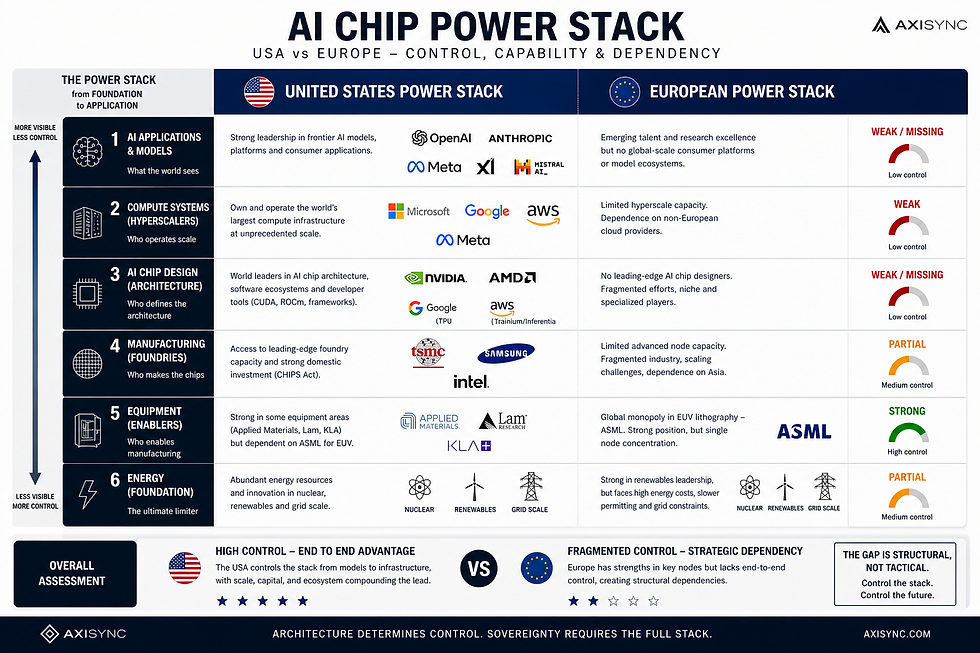
Post 2 showed that control concentrates at the lower layers of the AI chip power stack — and that the organizations building durable advantage are the ones asking which layers they need to influence, not just which model to deploy.
Post 3 demonstrated through ASML that holding a critical chokepoint is not the same as controlling an architecture — and that the distinction between possessing a critical asset and designing a connected system determines whether leverage translates into sovereignty.
Post 4 completes the argument: Europe cannot buy its way out of an architectural problem. It cannot consolidate its way to sovereignty. It can only architect its way there — by building diversity, redundancy, interoperability, transparency, and adaptability into the infrastructure layer by layer, with intentionality and strategic patience.
Sovereignty is the ability to keep your options open when the world changes.
That is not a procurement decision.
It is an architecture decision.
Europe cannot buy AI sovereignty. It must architect it.
The next analysis examines this dynamic operating in real time inside Europe's largest industrial company — and identifies the one architectural decision that determines whether the rented answer can ever be returned.
Architecture determines optionality.
Optionality determines leverage.
Leverage determines control.
Erik Kling is the author of AXISYNC Decision Architecture™ and RHODES DOCTRINE™, and the founder of AXISYNC Partners LLC. This piece is the final post in a four-part series on the structural dynamics shaping the next decade of technology, governance, and civilizational architecture.

Comments