


Power Without Humanity Will Not Survive - Invisible Architecture


Civilization and Human Flourishing
This is the second in a series on power, systems, and human flourishing. The first article, Power With Humanity — Human-Aligned Systems Architecture, defined the conditions required to design AI systems that preserve human agency, accountability, and optionality. This article explores why those conditions matter — not only as design principles, but as civilizational necessity.
For Aristotle, the purpose of civilization was never merely efficiency, expansion, or power.
It was eudaimonia: human flourishing.
Not happiness in the modern superficial sense, but the ability for human beings to live meaningfully within a society structured to support virtue, reflection, participation, creativity, and human development.
The Greeks understood something many modern systems forget:
Civilization is not only defined by the power it accumulates.
It is defined by the conditions it creates for human life within it.
That insight matters more than ever today.
Humanity is entering another civilizational transition.
Artificial intelligence, digital infrastructure, platforms, algorithms, recommendation systems, and centralized visibility networks are rapidly becoming the invisible architecture of modern society.
And with them comes a deeper question:
What happens to humanity when visibility itself becomes infrastructure?
The Rise of Invisible Architecture
Historically, civilizations organized power through visible architecture.
Roads.
Ports.
Libraries.
Trade routes.
Temples.
Energy systems.
Industrial networks.
Civilization has always depended on structures that shaped: what flowed, what connected, what survived, and who held influence.
Today, those structures are increasingly invisible.
Platforms, algorithms, institutions, and AI systems now influence: what gets discovered, what gets amplified, what gets funded, what gets remembered, and what quietly disappears.
What systems repeatedly surface becomes culturally reinforced.
Over time, systemic invisibility becomes cultural erasure.
This matters because systems do not merely distribute information.
They shape legitimacy itself.
They shape attention, memory, culture, and increasingly: the boundaries of what society considers meaningful.
Democratic vs. Authoritarian Systems
The philosopher Lewis Mumford warned that civilizations eventually choose between what he called "democratic technics" and "authoritarian technics."
Democratic technics expand participation, agency, creativity, and human freedom.
Authoritarian technics centralize control, reduce optionality, and transform individuals into components of increasingly optimized systems.
The danger is not technology itself.
The danger is when optimization becomes detached from human flourishing.
Authoritarian systems do not only centralize power.
They narrow the range of meaningful human pathways available within society itself.
Why Optionality Matters
This is why optionality matters so deeply.
Optionality is often misunderstood as operational flexibility or strategic choice.
At a civilizational level, optionality is something far more important:
the preservation of meaningful human pathways inside increasingly optimized systems.
A society without optionality gradually narrows: economically, culturally, creatively, and psychologically.
People lose the ability to exist meaningfully outside dominant structures.
Optimization without optionality produces systemic conformity.
And systemic conformity weakens both dignity and resilience.
Contextual Dignity and Structural Invisibility
This is where contextual dignity becomes essential.
Contextual dignity means preserving meaningful visibility for human beings, ideas, and creative work inside systems large enough to erase them.
Because an artwork, an idea, or a human voice can only influence civilization if it remains visible long enough to matter.
When systems optimize only for amplification, scale, and engagement, human visibility becomes increasingly concentrated inside algorithmically reinforced structures.
Over time, forms of creativity, thought, and cultural contribution that do not conform to those structures lose social visibility — regardless of their long-term value.
An artist, researcher, or independent creator can now produce meaningful work without ever becoming culturally visible, if algorithmic systems fail to surface it.
The result is not direct censorship.
It is structural invisibility. Invisible Architecture.
The Cost of Optimization
Not everything meaningful can compete equally inside systems optimized for: speed, scale, engagement, and reinforcement.
Some ideas require patience.
Some forms of creativity require silence.
Some forms of humanity require space.
If systems remove that space entirely, civilization may become highly optimized — but culturally narrower.
This is not an argument against technology.
Nor is it an argument against infrastructure, institutions, or progress.
Civilization has always depended on systems.
The question is whether those systems preserve humanity within them.
Invisible Architecture Shapes Civilization
This is why architecture matters more than ever.
Not only physical architecture — but institutional architecture, visibility architecture, platform architecture, AI architecture, and cultural architecture.
Because architecture silently shapes: what becomes possible, who participates, what survives, and ultimately: what kind of humanity remains visible.
A Dialogue Across Civilizations
The image accompanying this article reflects that tension.
In the distance stands the Acropolis of Athens — one of humanity's enduring symbols of civilization, philosophy, and cultural memory.
In the foreground stands System Equilibrium — a contemporary abstract work representing the invisible architecture of modern systems.
Signals. Complexity. Flow.
What makes the image striking is not simply the contrast between the two works.
It is where System Equilibrium is displayed: mounted on the ancient stone of a Greek structure, inhabiting the same architecture it stands beside.
The new systems are not replacing the old ones.
They are moving into them.
One structure is made of stone.
The other increasingly shapes culture itself.
Together, they represent a dialogue across civilizations.
The structures evolve.
The Civilizational Question
The question remains:
What kind of systems are we building around human life?
As AI, platforms, and algorithmic systems expand across civilization, this question becomes more important than ever.
Because power without humanity eventually becomes unstable.
Not only morally.
But structurally.
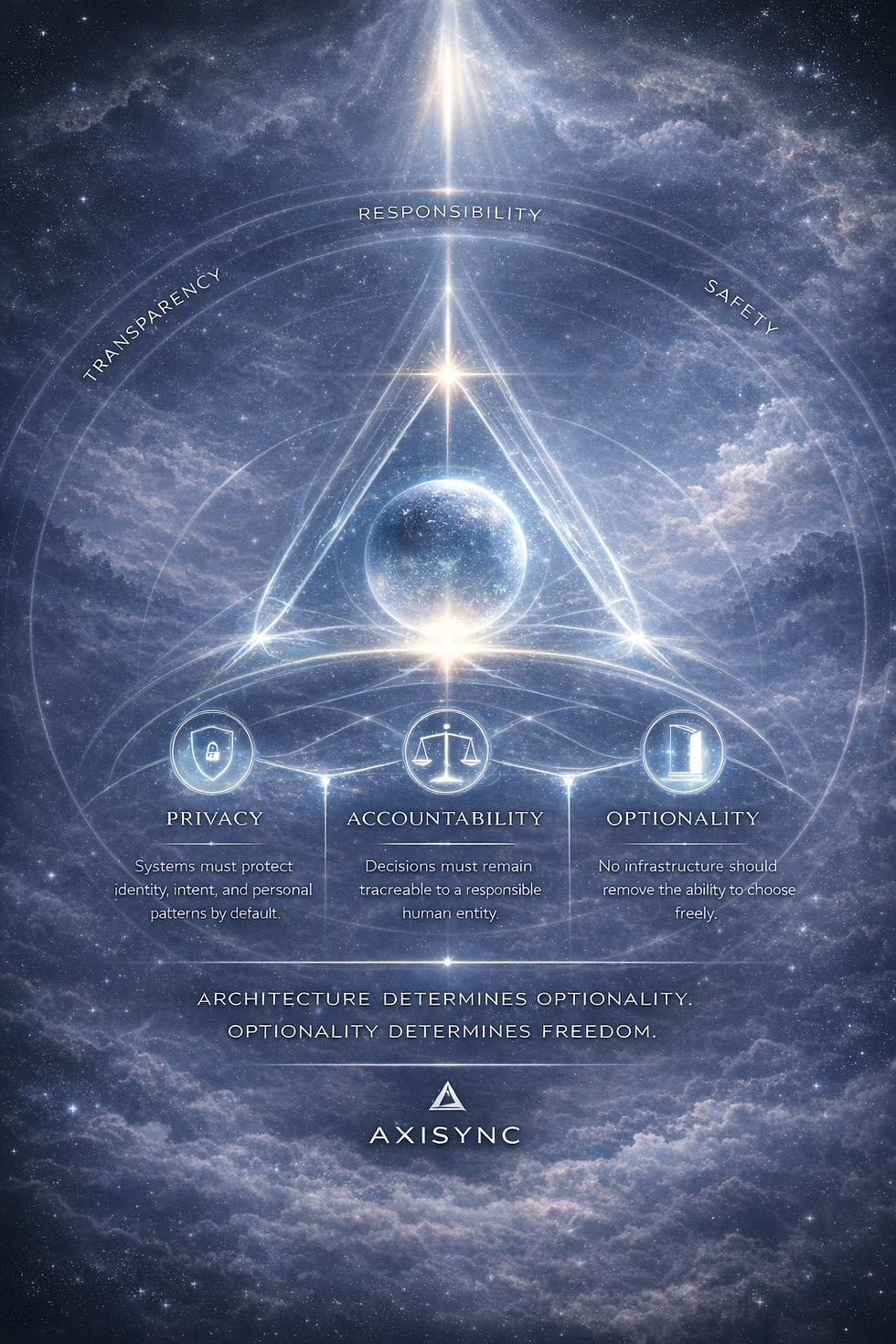
Architecture determines optionality.
Optionality determines leverage.
Leverage determines control.
Humanity is not protected by intention.
It is protected by architecture.
Erik Kling


Comments