


THE AI ARCHITECTURE OF CAPITAL — PART 3

What AI Requires From Capital
How capital architectures determine who builds AI — and who rents it.

Subscribe to the AXISYNC Newsletter — the next edition takes The Architecture of Capital beyond the four-part series with the AXISYNC verdict, three forward scenarios, and the Capital Optionality Stress Test.
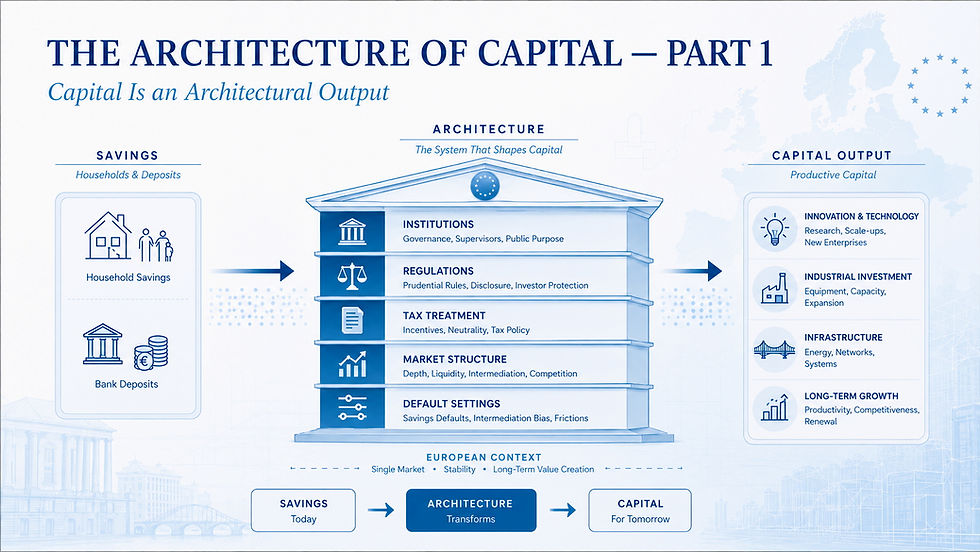
Architecture of Capital Part 2 compared five capital systems and found something more important than a ranking.
Part 2 compared five capital systems and found something more important than a ranking: every system regenerates capital, but none regenerates it the same way. The United States regenerates through exit and reinvestment; Europe relies more heavily on deposit and insurance intermediation; Japan compounds through corporate balance sheets; South Korea concentrates capital allocation inside large industrial groups; and China can direct credit toward strategic priorities over unusually long horizons. Each architecture therefore selects for different outcomes, and each creates a different dependency.
That leaves the question Part 2 deliberately left unanswered. If every system produces a different kind of capital, what kind of capital does AI actually require?
Most discussions of AI investment begin with volume — who is spending the most, which country has announced the largest fund, which company has committed the most billions, how much capital is flowing into AI. Those numbers matter, but they are not the architecture. The better question is narrower and harder: what kind of capital does each layer of the AI stack actually require?
Because AI is not one industry. It is a layered industrial system — energy, silicon, compute, connectivity, models — and each layer operates on a different time horizon, carries a different risk profile, tolerates loss differently, and is financed through a different institutional architecture. The strategic challenge is therefore not simply finding capital. It is producing the right capital, at the right duration, with the right tolerance for risk and loss, for every layer of the stack — and that distinction changes the entire question of AI leadership.
Five Layers. Five Capital Forms.
Domain | Capital intensity | Duration | Loss tolerance | Primary financing mechanism | Architectural bottleneck |
Energy | Very high | Decades | Low | Utilities, infrastructure funds, project finance | Permitting, interconnection, equipment |
Silicon | Extreme | 10–20 years | Low execution tolerance | Industrial cash flow, debt, state support | Scale, expertise, concentration |
Compute | Extreme and recurring | Short asset cycles | High reinvestment tolerance | Corporate cash flow, debt, private credit | Continuous recapitalisation |
Connectivity | High and continuous | Long-lived assets | Moderate | Operator cash flow, debt, infrastructure capital | Fragmentation and reinvestment capacity |
Models | High | Uncertain loss horizon | Extreme | Loss-tolerant equity and strategic capital | Absorbing prolonged losses |
The observation that matters is simple: no single financing mechanism can fund all five. That is why total investment figures can mislead. A dollar committed to a twenty-year semiconductor manufacturing architecture does not perform the same economic function as a dollar funding a frontier laboratory. Infrastructure capital cannot simply be substituted for venture capital; bank credit cannot automatically replace loss-tolerant equity; public subsidy can accelerate industrial investment without creating the balance-sheet architecture required to sustain it; and enormous savings pools do not necessarily produce the capital forms the upper layers of AI require.
Capital has characteristics — duration, loss tolerance, reinvestment capacity — and the architecture determines which of them a system can reliably produce.
Energy Requires Capital That Can Wait
The energy constraint is routinely described as a capital problem. It is not. Across U.S. regions with available data, the median generation or storage project reaching commercial operation in 2025 had spent more than five years between its interconnection request and operation; of the capacity that entered interconnection queues between 2000 and 2020, only 13 per cent had reached operation by the end of 2025. Critical equipment compounds the delay: a large power transformer is not an interchangeable component waiting on a warehouse shelf but a complex, often custom-built industrial asset whose replacement lead times can exceed a year. These are generation and storage projects rather than data centres themselves — but they are part of the electricity supply the data centres are waiting for.
Money, in other words, is not the binding constraint. Time is. That is why energy requires a very specific form of capital: capital willing to wait, not capital willing to lose. Utilities, infrastructure funds and project-finance structures are built around long-duration assets capable of generating relatively predictable returns over decades, and that architecture works extraordinarily well once the asset exists. The mismatch appears earlier. Those capital structures were not designed primarily to absorb years of permitting, regulatory, equipment and interconnection uncertainty before productive capacity can even enter service — yet that development risk is increasingly sitting directly in front of the AI buildout.
Some of the world’s best-capitalised technology companies can raise enormous amounts of money. What they cannot do is purchase five years of interconnection time from a balance sheet, manufacture permitting capacity through financial engineering, or instantly create transformers, transmission corridors and grid connections by increasing an investment budget. This is the architectural constraint: the AI system can possess abundant financial capital and still encounter scarcity in temporal capacity. Energy therefore reveals the first principle of AI capital — capital volume cannot compensate for an architecture whose binding constraint is time.
Silicon Requires Capital That Can Concentrate
Leading-edge semiconductor manufacturing sits at almost the opposite end of the problem, where capital intensity is extraordinary. TSMC has guided to capital expenditure of $60–64 billion for 2026 alone. Its established Arizona programme stands at $165 billion, with a further $100 billion announced in July 2026 bringing the stated U.S. total to $265 billion, though the timing of that additional expansion remains contingent on demand.
Numbers at this scale naturally direct attention toward government support — but subsidy is not the underlying financing architecture. Against the established $165 billion programme, U.S. federal support was set at up to $6.6 billion in direct funding and $5 billion in proposed lending. That is meaningful: it can reduce risk, influence location and accelerate a strategic decision. But it does not fund the industrial system. TSMC’s own filings state that its capital expenditure has principally been financed through operating cash flow and corporate bond proceeds, and that it expects that financing model to continue.
The recurring capacity to build, equip, operate and repeatedly upgrade leading-edge fabs therefore comes from something much deeper than an incentive package — an industrial balance sheet capable of reproducing itself across technology generations.
Which produces the second principle: subsidies accelerate capacity; they do not substitute for an industrial architecture capable of sustaining it.
And silicon requires more than capital at scale. It requires capital capable of concentration. A leading-edge fabrication ecosystem cannot be assembled by distributing equal amounts of funding across hundreds of interchangeable recipients, because everything that matters compounds — knowledge, supplier relationships, engineering experience, process discipline, equipment integration, yield improvement — and capital follows that accumulated capability. Which leads directly to the strongest objection to any simple argument about European capital weakness.
ASML
Any argument that Europe cannot produce architectural control collapses on contact with ASML. It is the dominant lithography company on earth, and its research, engineering, manufacturing and supplier ecosystem remain rooted in Europe, including the indispensable optical capabilities of ZEISS in Germany. In 2025, ASML generated €32.7 billion in revenue and spent approximately €4.7 billion on research and development — more than fourteen per cent of revenue — reinvested into EUV, High-NA, metrology, inspection and computational lithography. Europe did not merely participate in the semiconductor stack; it created its hardest chokepoint.
So the RHODES question is not whether Europe can create value. It obviously can. The harder question is how that value compounds — and here ASML demonstrates extraordinary regeneration within its own layer. Lithography leadership creates value; that value is reinvested into research; research sustains technological leadership; leadership protects the economic position; and the economic position finances the next generation of lithography.
The loop closes, and it has held for decades. But it compounds vertically. ASML’s strength does not, by itself, create a European frontier-fab ecosystem, produce European hyperscale compute, or generate the loss-tolerant equity a frontier-model industry requires. The value regenerates extraordinarily well inside one layer without necessarily traversing the other four.
That distinction is central to the entire series: capturing value once is not the same as compounding value repeatedly. Or, stated more sharply, a monopoly is not a capital architecture. A chokepoint can create control; an architecture determines whether the value created by that control can regenerate across the wider system.
Compute Requires Capital That Can Continuously Reinvest
Compute inverts the logic of both energy and silicon. Energy infrastructure can operate for decades, and semiconductor fabs persist across technology generations even as the equipment inside them evolves; compute assets depreciate much faster. GPUs become economically obsolete, architectures change, efficiency improves, new generations arrive and performance expectations climb — so a system that stops reinvesting does not merely stop expanding. Its relative position deteriorates.
Estimates compiled in mid-2026 put combined annual capital expenditure by the four largest U.S. hyperscalers at approaching three-quarters of a trillion dollars, and the composition is more revealing than the headline number: Microsoft reported $31.9 billion of capital expenditure in its latest quarter, with roughly two-thirds directed toward short-lived assets such as GPUs and CPUs. This is not a one-time industrial build. It is capital expenditure that must be earned, allocated and spent again — and again, and again — or the position decays.
That reveals the underlying architectural property: compute is financed by previous value capture. A company controlling an already-profitable layer can convert yesterday’s success into tomorrow’s capability, so that advertising profits finance data centres, cloud cash flow finances GPUs, software margins finance infrastructure, and platform economics finance the next technical layer. Previous value capture becomes future strategic capacity. That mechanism matters enormously because it changes the competitive meaning of profitability. Profit is not merely a return to shareholders; inside a capital-intensive technological architecture it becomes a source of self-financed optionality — the organisation can act without first asking external capital whether the next generation deserves funding.
An organisation without that internal value-capture engine faces a different architecture. It must raise the money somewhere else — from debt, private credit, strategic investors, public markets, governments or infrastructure partners. Each source may provide the required capital, and each may also attach conditions. That is where financing begins to become dependency. The compute layer therefore creates an unusually demanding regeneration requirement: the system must continuously reproduce the capital required to replace the assets that allow it to reproduce the capital.
That loop is powerful. It is also unforgiving.
Connectivity Requires Capital That Can Renew Across Generations
Connectivity occupies a different position again. Networks are long-lived, but they are not built once: telecommunications infrastructure persists for decades while being recapitalised technology generation by technology generation — 2G, 3G, 4G, 5G, fibre, edge infrastructure, cloud-native cores, and now increasingly AI-enabled networks. Each transition requires new investment before the previous generation has fully exhausted its economic life, which makes connectivity neither a traditional one-time infrastructure problem nor a short-cycle compute problem. It is a continuous generational reinvestment problem.
European operators have not stopped investing, and European networks remain technologically sophisticated. But industry analysis places telecom investment per capita at €117.9 in Europe, against €226.4 in the United States, €187.6 in Japan and €173.1 in South Korea, and counts 41 large European mobile operating groups against five in the United States. The issue is therefore not engineering capability. It is fragmented balance-sheet formation. Fragmentation reduces scale, reduced scale constrains margins, and constrained margins weaken the balance sheet’s ability to finance the next generation internally. When that internal reinvestment capacity weakens, someone else must fill the gap — infrastructure funds, vendors, governments, asset-sharing structures, external platforms, private capital.
None of those mechanisms is inherently problematic; the architectural question is what happens to control when they become necessary. Infrastructure does not become a dependency simply because someone else participates in financing it. Dependency appears when the system loses the ability to pursue the next generation without that participation. Which produces the connectivity principle: networks are built for decades but recapitalised by the generation, and when market structure weakens reinvestment, infrastructure becomes dependency. This matters far beyond telecommunications. Every architecture with long-lived assets and recurring technological transitions faces the same question — can the existing system finance its own renewal, and if not, who can, and what changes once that outside capital becomes structurally necessary?
Models Require Capital That Can Absorb Loss
The model layer demands the rarest capital form in the entire stack. Not patient infrastructure capital, not industrial debt, not project finance, not conservative bank credit, not merely a large balance sheet: models require capital that can absorb uncertainty at extraordinary scale for an uncertain period of time.
Frontier training costs have been rising at an estimated three-and-a-half times per year, with the largest recent training runs measured in the hundreds of millions of dollars — but even that understates the real requirement, because the training run is not the business model. It is a line item inside one. A frontier laboratory must simultaneously finance research and researchers, compute and inference, data-centre capacity, product development and distribution, safety infrastructure, deployment, customer acquisition, model iteration, and repeated technical bets whose economic return cannot be known in advance.
The capital requirement is therefore most visible in what frontier laboratories have actually raised. OpenAI closed $122 billion in committed capital in March 2026 at an $852 billion post-money valuation. Anthropic raised $65 billion at a $965 billion post-money valuation and subsequently submitted a confidential draft registration statement for a proposed public listing. This is not infrastructure capital, project finance or ordinary bank credit. It is loss-tolerant equity and strategic capital — investors willing to fund research, infrastructure, deployment and uncertainty for years before ordinary operating cash flow can carry the system.
But the round sizes are not the most important architectural signal. The prospective transition to public markets is. If frontier laboratories ultimately move from enormous private funding rounds into public markets, the architecture begins to close its regeneration loop: private investors fund uncertainty, successful companies reach public markets, liquidity returns capital to earlier investors, institutional and household capital absorbs the next ownership layer, and returned capital can then be recycled into another generation of private risk.
That is not merely an IPO process. It is a capital-regeneration mechanism — and it explains something raw savings statistics cannot. A society can save enormous amounts of money without generating the capital form required at this layer. A system capable of generating savings is not automatically capable of generating loss-tolerant equity at scale — nor of receiving it back.
This is the point at which capital architecture and AI sovereignty become inseparable. If the domestic system cannot produce the required capital, the company may still receive it, because capital is mobile. But the terms will be written somewhere, the ownership will sit somewhere, the liquidity event will occur somewhere, the value will recycle somewhere, and the next generation of capital formation will therefore occur somewhere. The difference between building and renting can begin long before the technology is deployed. It can begin in the architecture that finances its creation.
The Architecture Question
Taken individually, each layer is comprehensible. Taken together, a different picture emerges. Energy requires capital that can wait; silicon, capital that can concentrate; compute, capital that can continuously reinvest; connectivity, capital that can renew across geography and generations; and models, capital that can absorb prolonged loss. These are not five sizes of the same capital pool but five different capital behaviours — and no single financing mechanism can do all five.
AI leadership therefore does not depend on capital alone. It depends on an architecture capable of producing the right capital, at the right duration, with the right risk characteristics, for every layer of the stack. Which leads to the uncomfortable conclusion: no existing system currently possesses the complete capital architecture the AI stack requires.
The United States is strongest where loss-tolerant equity, deep public markets and incumbent cash flow determine the outcome, and encounters constraints where patient, regulated, long-duration infrastructure must arrive before financial capital can become productive. Europe retains genuine strength in precisely those long-duration industrial and infrastructure capabilities, yet converts too little of its enormous savings base into the risk-bearing equity the upper layers require.
China can direct capital across layers and across unusually long horizons — coordination that solves financing problems market systems may struggle with, while generating dependencies of its own. Japan is actively restructuring how accumulated corporate capital is deployed. South Korea demonstrates the extraordinary execution speed possible when industrial capital is concentrated, while simultaneously exposing the system to a narrower allocation base.
There is therefore no clean winner. Each architecture is strong in different places and dependent in different places.
And the most important conclusion is not that those dependencies exist — every architecture has them — but this: the dependencies are mutual; the asymmetries are not. A system may depend on another for silicon while controlling capital; another may control lithography while depending on external risk markets; another may possess industrial capacity while requiring imported equipment; another may control models while depending on energy infrastructure it cannot accelerate. Interdependence alone therefore tells us very little. The question is whether dependence constrains action.
That returns us to sovereignty. A system is not sovereign because it can fund one layer. It is sovereign only to the extent that the layers it cannot fund do not control the choices it can make. And this is where the capital discussion becomes something larger than finance, because capital determines which decisions remain available before they need to be made.
A system that can finance several alternatives possesses options. A system capable of financing only one viable path may still be wealthy, still technologically sophisticated, still appear powerful — but its architecture has already narrowed the decision. That is where optionality enters.
What Part 4 Has to Answer
The analysis so far has identified the capital requirements; Part 2 identified the regeneration mechanisms. Together they produce a set of dependencies. But a dependency is not automatically a problem. Most remain economically invisible for long periods: markets tolerate them, companies optimise around them, governments build strategy on top of them, and investors discount the cost of maintaining alternatives. Redundant capacity looks inefficient, unused liquidity looks unproductive, multiple suppliers look expensive — optionality appears to carry a cost while dependency appears free. Until something changes.
That leaves the final question of the series: when does a dependency that appeared economically harmless become a liability — and when does the optionality that once looked inefficient begin to carry a premium?
That is Part 4. The Optionality Premium.
Go Beyond the Four-Part Series
The Architecture of Capital series establishes the architecture. The next AXISYNC Newsletter goes further. We will bring all four parts together and deliver an AXISYNC verdict on the emerging capital architecture of AI. Then we will examine three forward scenarios for what happens next — not as predictions, but as tests of how the architecture behaves under different conditions. And we will apply the AXISYNC Capital Optionality Stress Test, which asks where dependencies become binding, which requirements expose them, how much optionality remains, what could cause the architecture to reprice, and which leadership decisions should be made before dependency determines the outcome. The objective is not to predict which dependency will fail. It is to understand whether enough alternatives remain if one does.
Subscribe to the AXISYNC Newsletter to receive the verdict, the three scenarios and the full Capital Optionality Stress Test.
RHODES OBSERVATION
AI is not financed by one pool of capital.
It is enabled by an architecture of capital.
Sources
Energy and interconnection
Lawrence Berkeley National Laboratory, Queued Up, 2026 edition — interconnection-queue data, including the more-than-five-year median development duration for projects reaching commercial operation in 2025 across regions with available data, and the approximately 13 per cent completion rate by end-2025 for capacity entering queues between 2000 and 2020.
U.S. Department of Energy — large power-transformer supply-chain and replacement-lead-time analysis supporting the observation that replacement can exceed one year.
Silicon and industrial capital
TSMC, 2026 investor materials and regulatory filings — 2026 capital-expenditure guidance of $60–64 billion; Arizona investment programme; and the company’s use of operating cash flow and corporate bond proceeds as principal sources of capital expenditure.
U.S. Department of Commerce / CHIPS for America — up to $6.6 billion in direct funding and up to $5 billion in proposed loans supporting TSMC’s U.S. semiconductor manufacturing programme.
ASML and European semiconductor capability
ASML, Annual Report 2025 — 2025 revenue of €32.7 billion and approximately €4.7 billion of research and development expenditure across EUV, High-NA and associated lithography technologies.
ASML and ZEISS corporate disclosures — European research, engineering and supplier relationships underlying advanced lithography capability.
Compute
Microsoft, FY2026 earnings disclosures — quarterly capital expenditure of $31.9 billion, with roughly two-thirds directed toward short-lived assets, primarily GPUs and CPUs.
Company filings and mid-2026 industry estimates for Alphabet, Amazon, Meta and Microsoft — aggregate hyperscaler capital expenditure approaching three-quarters of a trillion dollars annually. The aggregate is an estimate rather than common company guidance and includes cloud, networking, buildings and other infrastructure in addition to AI-related investment.
Connectivity
Connect Europe, State of Digital Communications 2025 — European telecom investment of €117.9 per capita compared with €226.4 in the United States, €187.6 in Japan and €173.1 in South Korea; and 41 large European mobile operating groups compared with five in the United States.
The figures are industry analysis and are used here to illustrate market structure and reinvestment capacity rather than as a neutral ranking of network quality.
Models and loss-tolerant capital
Epoch AI — research estimates showing frontier-model training costs rising at approximately 3.5 times per year, with the largest recent training runs measured in the hundreds of millions of dollars.
OpenAI, March 2026 financing announcement — $122 billion of committed capital at an $852 billion post-money valuation.
Anthropic, 2026 financing and securities disclosures — $65 billion financing at a roughly $965 billion post-money valuation and subsequent submission of a confidential draft registration statement for a proposed public listing.
AXISYNC Partners LLC
axisyncpartners.net | Architecture of Decision Sovereignty
The Architecture of Capital — Part 3 | August 2026


Comments