


The Kernel Problem: Why an Operating System You Don't Control Is Not an Operating System

Updated: Sep 1
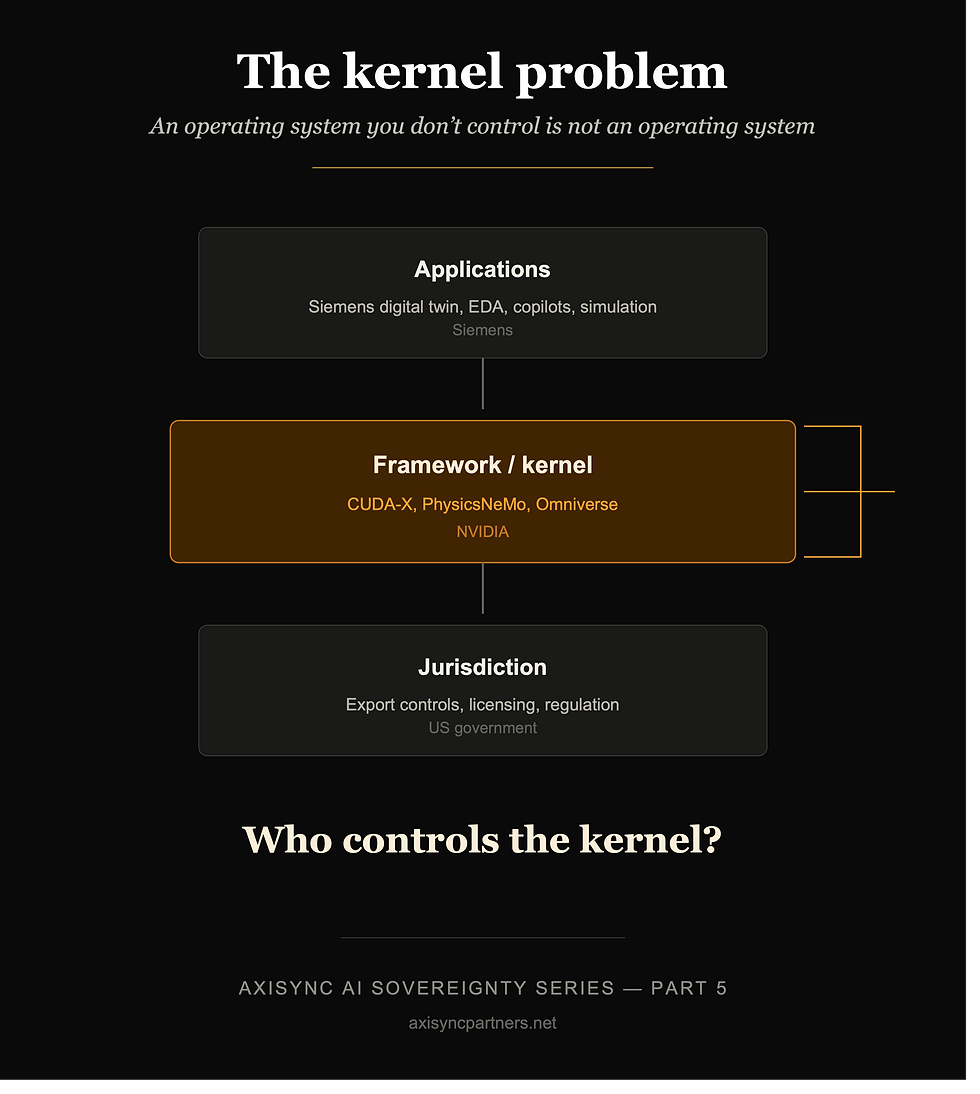
On January 6, 2026, at CES in Las Vegas, two chief executives stood on one stage and announced what they called the Industrial AI Operating System. Roland Busch of Siemens AG and Jensen Huang of NVIDIA were expanding a partnership that began in 2022 with the industrial metaverse and has since become the deepest integration between European industrial software and American AI infrastructure in existence.
The announcement deserves to be taken seriously. It is real architectural work, executed by two companies that understand architecture better than most. That is precisely why it deserves a layer-by-layer reading.
Because an operating system implies one thing above all: that you control the kernel.
The four previous analyses in this series established where control resides in the AI stack, how dependency migrates when pressure is applied to it, and why sovereignty cannot be purchased — only architected. This analysis asks the question that follows once those arguments are accepted. Not: who controls the technology? But: can you leave? Once a dependency is adopted, can it still be reversed — at which layer, at what cost, and for how much longer?
AXISYNC calls the test the Three-Layer Reversibility Audit. It examines any adopted dependency at three layers: the jurisdiction layer, the framework and kernel layer, and the data and domain layer. This article is its first public application — to the most consequential integration currently underway in European industry.
This article examines who controls the kernel of the Industrial AI Operating System, what was actually committed at CES, and where on the stack the reversibility of those commitments now sits. The facts below are drawn from primary sources — corporate press releases, SEC filings, and US government notices. The inferences built on them are labeled as inferences.
What was committed
The January 2026 announcement contains four commitments that matter for this analysis. They are quoted here at their exact scope, because scope is the entire question.
First, Siemens will complete GPU acceleration across its entire simulation portfolio and expand support for NVIDIA CUDA-X libraries and AI physics models.
Second, the companies will advance toward generative simulation using NVIDIA PhysicsNeMo and open models — autonomous digital twins delivering real-time engineering design and autonomous optimization.
Third, Siemens will integrate CUDA-X libraries, PhysicsNeMo, and GPU acceleration across its EDA portfolio — verification, layout, process optimization — targeting 2–10x speed-ups in key workflows.
Fourth, the companies aim to build the first fully AI-driven adaptive manufacturing sites, with the Siemens Electronics Factory in Erlangen targeted from 2026 as the first blueprint. Foxconn, HD Hyundai, KION Group, and PepsiCo are already named as evaluating the capabilities.
Read as a product roadmap, this is impressive. Read as an architecture, it raises one question: which of these layers does Siemens control?
"Industrial AI" is an incomplete phrase
Industrial AI describes an application layer. The phrase is silent about the three layers underneath it: the compute layer (who makes the silicon), the framework layer (whose libraries, runtimes, and models the applications are written against), and the jurisdiction layer (which government's law travels with the technology).
Siemens controls none of the three. The phrase performs a completeness it does not have. And the Industrial AI Operating System branding compounds the problem rather than solving it: an operating system is, by definition, the thing that controls the kernel. In this operating system, the applications are Siemens. The kernel is NVIDIA. And the kernel is subject to a foreign government's licensing regime.
This is not a hidden arrangement. It is the announced arrangement. What has been missing from the public discussion is a reversibility analysis: at which layer could Siemens — and the European industrial base it serves — still change course, at what cost, and for how much longer.
Open is a license property. Portability is an architecture property.
Part of the CES architecture wears the word "open." PhysicsNeMo, the physics-AI framework at the center of the generative-simulation commitment, is released under an open-source license. Open sounds reassuring. It is worth being precise about what it does and does not grant.
A license is a legal property: it tells you what you may do with the code — copy it, fork it, modify it. Portability is an architecture property: it tells you whether the code, your models, and your engineering investment can actually run anywhere else at comparable performance and cost. The first is granted. The second must be engineered, continuously and deliberately.
You may fork an open framework. You cannot fork its performance profile, its hardware-tuned kernels, its roadmap, or its developer ecosystem. When the optimization target, the reference infrastructure, and the engineering mindshare all belong to one vendor, the license grants permission to leave while the architecture withholds the capability to leave.
This is false optionality at the framework layer: an exit that exists on paper and costs more than staying. "Open" is the word that makes a dependency feel like a choice. By contrast, the other components of the committed stack — the CUDA-X libraries and the Omniverse runtime — are proprietary, and make no such gesture. There, the dependency is at least honestly labeled.
Siemens has already built the hedge — once
Here the analysis must credit Siemens with something most commentary misses, because it is the strongest fact in Siemens' favor and the sharpest question against the new architecture.
Siemens knows how to build framework-agnostic. It has done it, publicly, at the classical solver layer. Simcenter STAR-CCM+, the company's flagship multiphysics CFD code, has supported AMD GPUs for GPU-native computation since early 2024, extended support through the AMD Instinct MI300 series, and added AMD support on Windows in its 2026 release. Siemens engineers achieved this through the open ROCm/HIP stack and have publicly described the portability work. The company markets STAR-CCM+ explicitly as running across the full hardware spectrum: x86 and ARM CPUs, AMD and NVIDIA GPUs, on-premise and cloud.
This is not a footnote. It is an existence proof. At the solver layer, Siemens treated hardware-agnosticism as an engineering requirement and delivered it. The discipline exists. The capability exists. The institutional knowledge exists — in Munich, today.
Which makes the real question about the CES 2026 architecture precise and answerable:
Will the portability discipline Siemens demonstrated with STAR-CCM+ survive into the generative-simulation era — or does the new architecture quietly retire it?
Nothing in the public record answers this. No portability commitment exists for the generative-simulation layer, the CUDA-X integrations, or the Omniverse-based twin runtime — the layer where the next decade of value will live. The question is not whether Siemens has ever hedged. It has. The question is whether the standard Siemens set for itself at the solver layer will be applied to the layer that now matters most.
Only an architectural commitment can answer that question. A communications answer is also an answer.
The jurisdiction layer is not background risk. It is an active participant.
Every dependency analysis eventually meets the objection: these are commercial partners, the scenarios are hypothetical, no government would actually pull the lever. The record of 2025 removes the hypothesis. The lever has been pulled, documented in SEC filings, and then monetized.
The sequence, from primary sources:
On April 9, 2025, the US government informed NVIDIA that a license is required for export to China of its H20 product — and of "any other circuits achieving the H20's memory bandwidth, interconnect bandwidth, or combination thereof." On April 14, the government stated the requirement would apply for the indefinite future. NVIDIA incurred a $4.5 billion charge in a single quarter for stranded inventory and purchase obligations, was unable to ship a further $2.5 billion, and guided roughly $8 billion of affected orders the following quarter.
In its own correspondence with the SEC, NVIDIA characterized the charge as not arising from operations, competition, technology, or strategy, but as "the result of a determination outside our control."
That sentence deserves to be read slowly. The most valuable company in the world, describing its own government, in a regulatory filing: a determination outside our control. That is the jurisdiction layer, defined by the company that lives under it.
Then came the monetization. By August 2025, export licenses began flowing again — tied to an arrangement under which NVIDIA expects to remit 15 percent of revenue from licensed China-market H20 sales to the US government. That arrangement is itself revealing: as of NVIDIA's most recent quarterly filing, the US government has never codified the 15 percent figure in a published regulation. It exists as an understood condition of doing business, not as law.
Fifteen percent for what? No service rendered. No statutory tariff schedule. No published rule. It is the jurisdiction layer charging rent on the compute layer — a state converting its revocation capability into revenue participation, and doing so informally enough that no regulation has yet been written down to challenge, appeal, or rely on. Continuity of supply, it turns out, is not a commercial given. It is a licensable, priceable, negotiable asset — priced more like a discretionary toll than a tax — and the licensor is not party to any contract Siemens has signed.
One drafting detail in the April notice matters more than the headline. The rule was not written against a product name. It was written against a performance envelope — any chip meeting the specification, from anyone, including chips not yet designed. A control written against a named product expires with the product. A control written against a specification never expires; it pre-captures every future workaround. The regulator drafted at the architecture layer. Most of its targets are still thinking in products.
Today the licensing perimeter is China. Perimeters are policy. Policy changes faster than architecture. A European industrial strategist does not need to predict that the perimeter will move — only to note that a mechanism now exists, has been used, and has been priced, even before it has been formally codified.
Dependency Migration: the vector effect
If this were one company's procurement decision, it would be that company's risk to take. It is not one company's decision.
Siemens Xcelerator is the digitalization layer for a substantial share of European — and global — manufacturing. When the CES architecture ships inside Xcelerator, every customer adopting the digital twin, the copilots, and the simulation environment inherits the framework dependency and the jurisdiction exposure embedded in them. Foxconn, HD Hyundai, KION, and PepsiCo are the named first evaluators; the Xcelerator installed base is the eventual carrier.
This is Dependency Migration in motion: a dependency does not stay where it is signed. It migrates outward through the products of the company that signed it. One integration decision in Munich becomes the default architecture of an industrial continent — one license renewal, one copilot rollout, one commissioned twin at a time. By the time it is visible in any annual report, it is installed base.
The Steelman: Busch's wager, stated at full strength
This analysis is of an architecture, not of a man, and the architect's case deserves its strongest form — because it is a serious case.
Roland Busch has stated his ranking publicly, twice, with escalating concreteness. In an interview with the Financial Times published March 24, 2026, he warned that prioritizing Europe's own AI infrastructure over existing tools risks disaster for the EU: "You should not throttle your innovation speed for the sake of creating sovereignty." Building European infrastructure, he allowed, makes Europe more resilient over time — but Europeans should not wait for European AI factories before tuning their models. He described the EU's regulatory approach as miscalibrated, contrasting an American economy moving like a fast-flowing river with a European tech ecosystem he likened to standing water.
A month later, at Hannover Messe, the doctrine became capital allocation. Busch told Bloomberg in April 2026 that Siemens will prioritize AI investment in the US and China if the EU does not adapt its regulations — most of the company's €1 billion industrial AI investment will be directed to the US, with the AI Act and Data Act, in his words, missing the mark by treating industrial AI like consumer applications. Speed over sovereignty is no longer a quote. It is where the billion goes.
The implicit wager has three legs. First, that the compute layer will commoditize before the dependency becomes binding — alternative silicon will mature, and today's lock will become tomorrow's procurement choice. Second, that the defensible layer is industrial data, domain knowledge, and installed base — all of which Siemens keeps regardless of whose silicon runs underneath. Third, that the cost of abstention is not sovereignty but irrelevance: the industrial AI market will be captured by someone, probably building on the same NVIDIA stack, and a Europe that waits forfeits the application layer too.
This is a coherent position held by a serious operator, and parts of it are likely right. Its weakness is empirical, and it is singular: CUDA has resisted commoditization for eighteen years. The single best-documented fact about the framework layer is that it does not open on its own. And every step deeper into vendor-native generative simulation shifts the wager from "temporary hardware dependency" toward "permanent framework dependency" — which is exactly the migration from reversible to irreversible that the wager assumes will not happen.
A wager can be rational and still require a hedge. The hedge, in this case, has already been invented — by Siemens.
The verdict layer - kernel problem
Where, then, does reversibility actually sit? This is the Three-Layer Reversibility Audit, applied — layer by layer:
The jurisdiction layer: reversibility zero, by demonstration. No engineering decision in Munich changes the reach of the Export Administration Regulations or the precedent of April 2025. This layer can only be managed, never exited — and managing it is precisely what the other layers are for.
The framework layer: reversibility closing, not closed. At the classical solver layer, the STAR-CCM+ portability work keeps a genuine exit open. At the generative-simulation layer — CUDA-X integrations across the simulation and EDA portfolios, Omniverse-based runtimes, vendor-native physics AI — no portability commitment exists, and each completed integration raises the cost of one. On the announced trajectory, and this is an inference from public roadmaps rather than a documented date, the window for architecting portability into this layer closes within roughly two years. After that, "switching" no longer means changing suppliers; it means re-engineering the product portfolio Siemens sells to its entire customer base.
The data and domain layer: reversibility intact — the last unmortgaged asset. Industrial data, physics know-how, customer relationships, and installed base remain vendor-independent. This is the layer Busch's wager correctly identifies as defensible. It remains defensible only as long as the models trained on that data, and the runtimes those models live in, do not become single-vendor artifacts. The data layer's independence is not self-maintaining; it is maintained — or surrendered — at the framework layer above it.
Infrastructure determines optionality. Governance architecture determines whose optionality. The infrastructure being built here is genuinely impressive. The governance architecture above its kernel sits in Washington and Santa Clara — and the optionality it currently allocates to Europe's largest industrial software company is conditional, revocable, and, since August 2025, priced on terms the licensor has not even bothered to put into writing.
The question
None of this requires Siemens to abandon the partnership. It requires one architectural decision, made deliberately rather than by default: that the portability discipline proven in Simcenter STAR-CCM+ becomes a requirement of the generative-simulation layer — physics models, twin runtimes, and acceleration paths kept framework-agnostic even while they run, today, on the best available silicon.
That decision costs engineering effort. Its absence costs the exit. And it is being made right now — invisibly, inside product-engineering choices that will never appear in a press release, on a clock measured in quarters.
The ASML case showed that a chokepoint without an architecture is not control. The Siemens case shows the inverse: an architecture built on someone else's kernel is not an operating system. Europe now possesses both halves of the diagnosis. What it does with them is the architectural decision of the decade.
The question stands, and only Munich can answer it:
Does the STAR-CCM+ standard survive into the generative-simulation era?
Architecture determines optionality.
Optionality determines leverage.
Leverage determines control.
Sources: Siemens AG press releases (June 29, 2022; January 6, 2026; April 16, 2026); NVIDIA Newsroom and NVIDIA SEC filings (Form 8-K, April 15, 2025; Q1 FY2026 results, May 28, 2025; Form 10-Q, August 27, 2025; SEC correspondence, July 31, 2025). NVIDIA's Q2 FY2026 Form 10-Q states that NVIDIA expects to receive 15% of revenue from licensed H20 sales but notes that, to date, the US government has not published a regulation codifying that requirement. Siemens Simcenter release documentation (2402, 2406, 2602); Roland Busch interview, Financial Times, March 24, 2026 (quotes cross-verified across multiple independent reports of the interview); Roland Busch interview, Bloomberg, Hannover Messe, April 20, 2026; Financial Times reporting on US export license arrangements (August 2025). The ~2-year closure estimate for the generative-simulation layer is the author's inference from announced integration roadmaps and is presented as such.
AXISYNC™ — On the invisible decisions that determine who retains strategic freedom.

Comments