


Japan Rebooted AI Sovereignty

Japan just declared itself a sovereign AI power — not in the race everyone was watching, but on the ground beneath it. Read closely, “Japan” turns out to be two players moving in opposite directions: a state building sovereignty, and a financier funding someone else’s. The doctrine that treats either as the whole country will misread both.
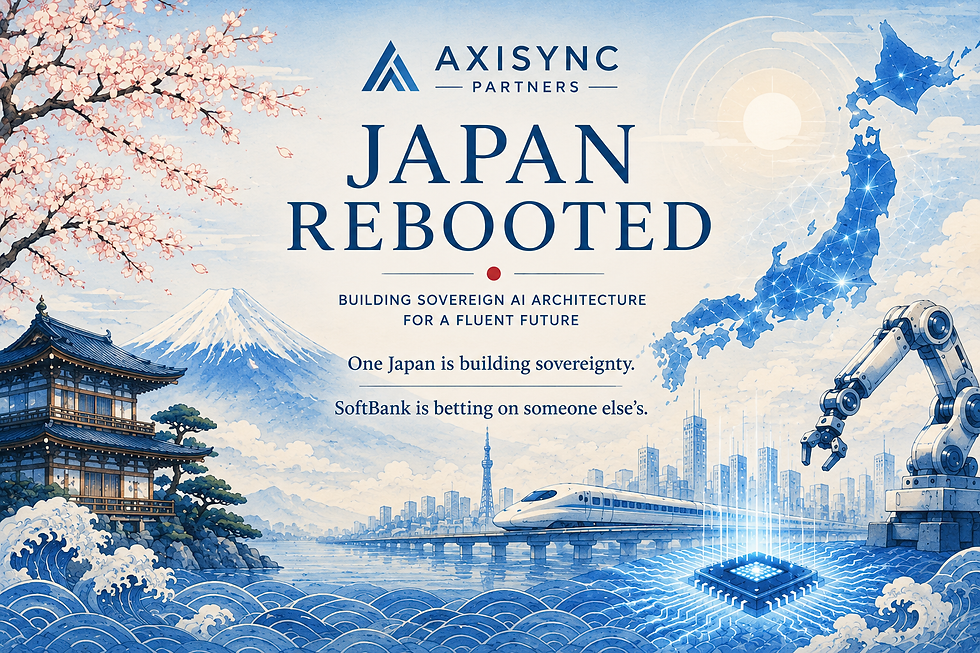
For three posts this series gave Japan a single role: the ally. The country that controls the materials layer nobody names, that is building the leading-edge fab Europe cannot build alone, that is architecting the photonic infrastructure most likely to matter once the GPU era plateaus. Every one of those claims is true and well-evidenced. None of them was the whole picture, and at the end of June the picture changed.
On June 30, 2026, Japan’s Ministry of Economy, Trade and Industry commissioned a five-year sovereign AI program built around a consortium called Noetra. The government’s own framing for the wider strategy is not modesty. Its Cabinet plan, adopted in December 2025, is titled around the phrase “Japan Rebooted” through “Trustworthy AI,” and its official language states plainly that Japan is behind and must recover. This is not a country treating AI as a side topic. It is a country that watched the chip industry consolidate elsewhere for thirty years and has decided, at the level of the state, to buy its way back in — with more than ten trillion yen of public support committed for AI and semiconductors through 2030.
The question this essay exists to answer is the one that follows directly: what kind of player has Japan just decided to be? The answer is more precise, and more useful to European strategy, than “a smaller version of the United States or China.”
What Japan Already Owns
Start with the ground, because the strategy only makes sense once you see what it is built on.
Japan’s industrial manufacturers hold roughly seventy percent of the global industrial robotics market. Beneath that sit Tokyo Electron, Shin-Etsu Chemical, JSR, and Sumitomo Chemical — the equipment and materials on which Korea’s memory industry and Taiwan’s logic industry both depend, a structural position so deep it barely appears in public analysis of who controls the AI stack. This is not aspiration. It is installed base. It is architecture Japan already possesses.
That distinction matters because it explains the shape of everything Japan is now doing. A country with no industrial base to leverage has to enter the AI race where the headlines are — at the frontier model layer, against OpenAI, Anthropic, Google, and the Chinese labs. A country that already owns the physical economy underneath AI has a different option available: build the layer where AI meets the physical world, and let everyone else fight over the chatbots. Japan has chosen the second path, and it has chosen it deliberately.
The Sovereign Core: Noetra
Noetra is that choice made concrete. It is anchored by SoftBank, Sony, NEC, and Honda, with the number of participating companies expected to grow toward forty-four across automotive, electronics, finance, and logistics, working alongside AIST, Japan’s national research laboratory. The government has committed up to one trillion yen — roughly six billion dollars — over five years, with an initial tranche of 387.3 billion yen in the current fiscal year, and a first foundation model targeted for release before the year is out.
Read what the model is designed to do, because that is the whole strategy in one line. Noetra’s technical target is a multimodal foundation model that processes language, images, video, and sensor data simultaneously — a model built not to answer questions on a screen but to let a machine interpret a physical environment and act inside it. It is paired with a deployment target of ten million AI-equipped robots across eighteen sectors by 2040, and a stated ambition to capture thirty percent of the global market in physical AI.
This is the answer to whether Japan can become a major AI node alongside the United States and China. It can — but not on the axis the question usually assumes. The United States and China are competing to own the model layer, the disembodied intelligence in the cloud. Japan has looked at that board, judged it lost or not worth the entry price, and opened a different one: embodied intelligence, the physical-world interface of AI, built on the robotics and manufacturing base it already dominates. Japan’s own analysts describe the national strategy in exactly these terms — not an attempt to copy the frontier-model race at the same scale, but a bet on the middle layer and on sector-specific AI where Japan has deep domain demand: manufacturing, mobility, healthcare, elder care, public administration. The domestic model efforts that do exist, from the GENIAC program to Rakuten’s Japanese-language models, are real but deliberately mid-tier and language-specific. They are not a bid for frontier dominance. They are a trust layer for a physical-AI economy.
And the sovereignty framing is explicit, not inferred. Japan is building Noetra, in its government’s own words, to reduce a dangerous over-reliance on technology from the United States and China. This is a decision-sovereignty play in the precise sense this series has used the term — an attempt to retain the ability to act, on its own terms, in the layer of the AI economy it judges most defensible.
The Substrate
A sovereign model needs sovereign ground to stand on, and Japan is building two more layers beneath Noetra.
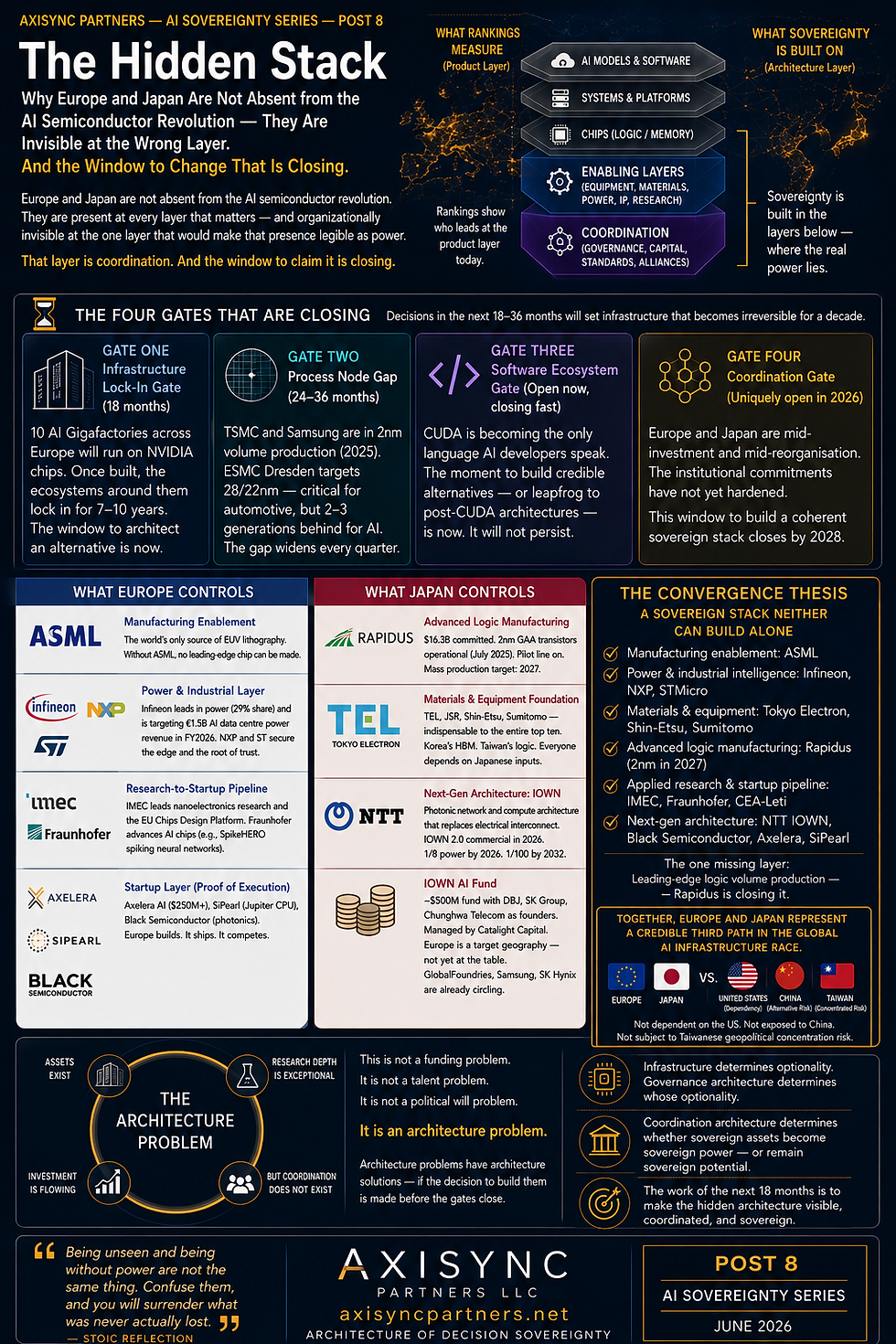
The first is leading-edge fabrication. Rapidus continues to run its two-nanometer pilot line in Hokkaido, operating since April 2025, with mass production still targeted for 2027 and reported transistor density essentially matching TSMC’s most advanced node. Its differentiation is structural rather than volume — a single-wafer, short-turnaround model aimed at customers who value speed and customization over the lowest per-unit cost. It is the only allied alternative to Taiwan-concentration risk anywhere close to this timeline, and it is on schedule.
The second is networking and power. NTT’s IOWN initiative — the most ambitious post-silicon infrastructure program currently being executed by any institution on earth — stood up a roughly five-hundred-million-dollar fund in June 2026 to commercialize all-photonic infrastructure, aimed squarely at the power bottleneck that now constrains AI more than compute does.
Stack the three legs together — Noetra’s model, Rapidus’s fab, IOWN’s network — and Japan is not assembling a weaker copy of the American stack. It is assembling a genuine node, defined as the physical substrate and physical interface of the AI economy. That is a coherent, defensible, well-funded position. It is also, on close inspection, a position with two open seams — and both of them are the seams this doctrine is built to find.
The Two Open Seams
Rapidus’s most advanced, most publicly confirmed customer relationships are American. IBM is its deepest technical partner, with roughly a hundred engineers co-located at Albany NanoTech; Tenstorrent is its first confirmed commercial customer; discussions with Broadcom are reported. Domestic customers — Fujitsu, Canon — are real but narrower. The CEO speaks of more than sixty prospects, but the confirmed names skew heavily toward the same country the entire project exists to reduce dependency on, at least at the platform layer. Japan built the fab to escape Taiwan-concentration risk.
Whether it escapes American demand-side leverage over that fab is not yet settled, and depends substantially on whether a non-American anchor customer materializes before the base locks in.
IOWN carries the same seam at the capital layer. Its fund’s founding governance sits with Japan’s NTT and Development Bank of Japan, South Korea’s SK Group, and Taiwan’s Chunghwa Telecom, with a former Samsung executive as operating partner and management run out of Silicon Valley and Tokyo. Europe is named as one of three target geographies for the fund’s capital — but as a recipient, not an architect, and the vehicle itself is described as focusing mainly on North America. Europe was not at the table when the structure formed.
Neither seam is evidence of Japanese hostility. Both are evidence that Japan, entirely reasonably, is building its sovereign node around the partners and customers already available to it — and that the United States is closer to that table than Europe is.
The Second Player
Here the word “Japan” stops being one thing.
Everything above describes the state — METI, AIST, Rapidus, IOWN, the Noetra consortium as an instrument of industrial policy. Sovereign, consortium-shaped, government-backed, physical-first, domestically anchored. But the largest single financial actor carrying a Japanese passport is not optimizing for any of that. SoftBank has gone all-in on the American frontier. It sold its entire stake in Nvidia and committed tens of billions of dollars to OpenAI and to the Stargate data-center build-out, with its founder as Stargate’s chairman. It acquired Ampere, poured further capital into Graphcore, and is spinning out a US-listed robotics vehicle of its own. The overwhelming direction of that capital is not Hokkaido. It is Abilene.
So there are two players wearing one flag, and they are pulling in opposite directions. The state is trying to build a nation’s sovereignty. SoftBank is trying to win a bet. Both are called “Japan.” Understanding the difference is the difference between reading this player correctly and misreading it entirely — and it is worth being exact about the second one.
Masayoshi Son is not an industrial builder. He is a capital-allocation machine running a single move, repeated across eras: identify the one winner-take-all platform of a technological cycle and buy the largest possible equity position in it, financed by whatever on the balance sheet can be sold or borrowed against. He invokes his Alibaba bet to justify the risk because it is the same bet — concentration, not construction. Applied to AI, that logic points at OpenAI and the American compute complex, not at Tokyo: he sold SoftBank’s entire Nvidia stake and committed tens of billions to OpenAI and Stargate to maximize exposure to the presumed winner. This is why the question “why doesn’t he fund Japanese sovereignty instead” misreads him. Son is not trying to make Japan sovereign; he is trying to own a share of whoever wins, and he has judged the winner to be American. The UK design assets he consolidated — Arm above all, the architecture beneath even SiPearl’s Rhea — are not held as Japanese national assets but pointed at that American bet as Stargate technology partners. The flag on the balance sheet and the flag on the sovereignty do not match. None of this is an accusation; it is a description. An actor with no stated commitment to openness, reversibility, or distributed control, operating in a domain where those are the sovereignty questions, should be read by his revealed strategy rather than his stated one — and his revealed strategy is that the balance sheet is the only bible. He is the clearest living counter-example to the principle this doctrine rests on: he does not merely tolerate the collapse of optionality, he is structurally positioned to profit from it, because owning a piece of the single winner is the entire design. We are not going to change that. It is simply worth knowing exactly what he is when his capital shows up in the room.
The consequence for the doctrine is precise. SoftBank optimizes for financial optionality at the level of the firm, and in doing so it spends down sovereignty optionality at the level of the nation. A Japanese champion’s capital — including the architecture beneath Europe’s own sovereign processor — is being deployed to build another country’s decision-sovereignty in AI. That is not a scandal. It is exactly the species of invisible dependency this framework exists to make visible, and it is instructive precisely because it appears inside the player the series has been friendliest toward.
Does Japan Need Europe?
The clean version of this series’ earlier framing was that Japan is the partner Europe’s second path needs. That remains true. What the current facts correct is the direction of the need.
During the Japanese prime minister’s June visit to Europe, Rapidus signed memoranda of understanding with the UK Semiconductor Centre and with Italy’s Fondazione Chips-IT. These are worth having and worth noting. They are also, on sober reading, frameworks for information exchange and research collaboration rather than mass-production commitments, and the plausible European customer pipeline behind them is thin — closer to sample volume than to a market. Japan’s real demand base is elsewhere: domestic, through Noetra’s forty-four companies and the ten-million-robot program, and American, through Rapidus’s confirmed customers and SoftBank’s Stargate commitments.
The honest conclusion is uncomfortable but strategically clarifying. Japan does not particularly need Europe. Europe needs Japan. The SiPearl–Rapidus relationship this series has treated as the single most concrete near-term action available remains exactly that — but it is an opportunity for Europe to seize as the party that needs it, not a gap Japan is waiting for Europe to fill. Naming that asymmetry correctly is not defeatism. It is the precondition for acting from a true position rather than an assumed one.
It also disciplines the tempting move — persuading SoftBank’s capital-allocation machine to fund a Europe–Japan tie. The instinct is understandable and the reasoning has a narrow floor: a structure in which SoftBank takes the returns position on a commercial layer while Europe rings the sovereignty layer with governance is the only shape in which both bibles are satisfied at once. But it should stay the exception, not the thesis. The Europe–Japan relationship should not run through SoftBank at all. It should run through the state side of Japan — Rapidus, IOWN, METI — which is structurally compatible with Europe because it is also sovereignty-first and consortium-shaped. State-Japan and sovereign-Europe speak the same language. SoftBank speaks a different one. Routing the relationship through Son means routing it through the one part of Japan whose incentives do not match Europe’s.
The Exit Test
The RHODES Exit Test does not ask whether a partner is friendly. It asks whether a dependency remains reversible. Applied to Japan as it stands today:
Technical exit is real. Rapidus’s manufacturing capability is genuinely additive rather than re-badged American capacity, and IOWN’s photonics is original architecture, not a repackaging of someone else’s.
Governance exit is currently absent. Europe holds no seat in the IOWN AI Fund’s founding structure and no formal say in how SoftBank’s consolidated design assets — Arm among them — are deployed. The governance of Japan’s sovereign node was set without Europe in the room.
Economic exit is untested. No SiPearl–Rapidus relationship yet exists to reveal what the actual terms of dependency on Japanese manufacturing would look like in practice.
A partner passing one of three tests cleanly, with the second set against Europe by default and the third genuinely open and actionable, is still a partner worth having — far better than the alternative of no leading-edge, allied fab access at all. It is not a partner whose terms can be assumed rather than negotiated.
A relationship earns the word “ally” through the terms it operates on, not through the flag it flies. Japan has earned real trust on the fabrication layer. It has not yet been asked, formally, to earn it on the governance layer — and an ally who is never asked is an ally whose terms were never actually tested.
The Role the Third Player Will Play
Put the pieces together and the shape is clear.
Japan is not the ally, and it is not a smaller America. It is a deliberate node on a different axis of the AI economy — the physical, embodied, industrial layer — built on capabilities it spent three decades accumulating and is now, through Noetra, Rapidus, and IOWN, converting into sovereignty. That is a serious position, and it is more defensible than the frontier-model race Japan has wisely declined to enter.
But “Japan” is two players, not one. The state builds sovereignty; SoftBank funds someone else’s. Any European strategy that treats the country as a monolith will negotiate with the wrong half. The tie Europe needs runs through state-Japan, on terms that must be asked for now, while the IOWN structure is still forming and before Rapidus’s customer base locks in — and it runs alongside, not through, a financier whose revealed strategy is to profit from exactly the concentration this doctrine exists to resist.
None of this is an argument against the Japan relationship. It is an argument against the last comfortable assumption this series had left standing: that a partner is safe because it is not the partner already criticized. Japan is a good partner. It is also a player with its own node to build, its own asymmetries, and, inside its own borders, an actor optimizing against the very sovereignty the state is trying to construct. That is not cynicism. It is the same ruler this doctrine applied to Brussels, to Washington, and to Pax Silica from the start. Japan has now been measured by it — and the measurement, precisely because it is honest, is the most useful thing this series can hand to whoever acts next.
Act where the terms can still be shaped.
Accept where they can no longer be changed.
And never confuse a friendly flag with a tested structure.
STOIC REFLECTION
Sources
Japan's national AI strategy and "Japan Rebooted"
Hello World Japan, "How Japan Wants to Win in AI: The Government's Real Strategy," May 2026 — AI Act in force June 2025; AI Basic Plan adopted by Cabinet December 23, 2025; Prime Minister-led AI Strategic Headquarters; more than ¥10 trillion in public support for AI and semiconductors through FY2030; strategy framed as recovery, not regulation; Cabinet language "Japan Rebooted" through "Trustworthy AI"; national bet described as the middle layer and sector-specific AI rather than the frontier-model race
Tony Blair Institute (institute.global), "Sovereignty in the Age of AI," January 2026 — sovereignty as strategic agency and optionality rather than full self-sufficiency
Noetra sovereign model and physical AI
The Japan Times, "Japan plans sovereign AI model and 10 million AI robots," July 1, 2026 — up to ¥1 trillion (~$6.1 billion) over five years; Noetra consortium including SoftBank and Sony; investor base expected to grow toward 44 companies; explicitly framed to reduce over-reliance on US and Chinese technology
Let's Data Science / Nikkei Asia and Ary News reporting, June 30–July 2, 2026 — Noetra anchored by SoftBank, Sony, NEC and Honda, working with AIST; initial FY2026 tranche of ¥387.3 billion; first foundation model targeted this fiscal year; target of ~10 million AI-equipped robots across 18 sectors by 2040; METI target of 30% of the global physical AI market by 2040; Japanese manufacturers hold roughly 70% of the global industrial robotics market (METI data)
ZeroHedge / Nikkei Asia, July 1, 2026 — multimodal foundation model spanning language, images, video and sensor data; Fujitsu and Rakuten reported as weighing participation
GENIAC and domestic models
METI / NEDO GENIAC program (helloworldjapan.com; nri.com) — Generative AI Accelerator Challenge; compute support for domestic foundation-model developers; participants including Preferred Networks, Rakuten, Sansan, Turing, ABEJA and NRI
Rakuten Group press release, "Rakuten AI 3.0," March 17, 2026 — Japanese-language LLM developed under GENIAC, released open under Apache 2.0
Rapidus 2nm
Rapidus Corporation (rapidus.inc) — 2nm gate-all-around pilot line operating since April 2025 at IIM-1, Chitose, Hokkaido; mass production targeted for 2027; single-wafer, short-turnaround (short-TAT) foundry model
TechPowerUp / Rapidus process reporting, 2026 — reported 2nm (2HP) logic density ~237 MTr/mm², essentially matching TSMC's N2
Rapidus funding — ¥267.6 billion round (February 27, 2026); additional ~$4 billion approved by METI (April 2026); ¥150 billion from Japan's Information-Technology Promotion Agency; government the largest shareholder with a golden share
Rapidus customers — IBM (deepest technical partner, co-located engineers at Albany NanoTech); Tenstorrent (first confirmed commercial customer); reported discussions with Broadcom; Fujitsu and Canon domestically
Rapidus–Europe MoUs
Rapidus / PRNewswire — MoU with the UK Semiconductor Centre (June 14, 2026) and with Italy's Fondazione Chips-IT (June 15, 2026), signed during Prime Minister Sanae Takaichi's visit to Europe
institude.org, "Europe Is Desperate for Chips, but the Outlook Doesn't Look Promising," 2026 — MoUs read as frameworks for information exchange and research collaboration rather than mass-production commitments; thin European commercial pipeline
NTT IOWN AI Fund
NTT / Light Reading / The Fast Mode, June 10, 2026 — IOWN AI Fund of approximately $500 million (~¥80 billion); founding partners NTT, SK Group, Chunghwa Telecom and the Development Bank of Japan, with Young Sohn (former Samsung) as operating partner; managed by Catalight Capital, based in Silicon Valley and Tokyo; targets photonics, AI semiconductors and IOWN-native models; target geographies North America, Asia and Europe, with primary focus on North America
SoftBank, Stargate and the UK design assets
OpenAI and SoftBank Group, Stargate announcements, 2025–2026 — up to $500 billion US AI-infrastructure venture; Masayoshi Son as chairman; Arm a key technology partner
Reuters / Investing.com, December 2025 — SoftBank sold its entire ~$5.8 billion Nvidia stake and committed up to $30 billion to OpenAI, part of more than $60 billion committed to OpenAI and related infrastructure
Tech Startups / CNBC, May 2026 — SoftBank injected $457 million into Graphcore (acquired 2024); acquired Ampere Computing; planned US-listed robotics spinout (Roze)
FinancialContent, March 2026 — "Project Izanagi" AI hardware effort; balance-sheet strain from the scale of the OpenAI commitment
AXISYNC Partners LLC
axisyncpartners.net | Architecture of Decision Sovereignty
Supplementary Essay — AI Sovereignty Series | July 2026


Comments