


The Second Path - AI Sovereignty
The alternative to European AI sovereignty theatre must exist. It must be real. And it cannot wait for Brussels to get it right.
AXISYNC PARTNERS — AI SOVEREIGNTY SERIES — POST 9

Something is wrong with the European AI sovereignty story. Not with the assets — the assets are real. Not with the ambition — the ambition is genuine. Something is wrong with the gap between what is being said and what is being built.
Europe says it is building AI sovereignty. It is building AI infrastructure that runs entirely on American chips, American software, and American platform logic — and calling it sovereignty because the buildings are in Frankfurt and Paris.
Jensen Huang, CEO of NVIDIA, stood on a stage in Paris at VivaTech and announced that Europe would build more than twenty AI factories. He announced it. The CEO of the American company that will supply every chip in every facility announced Europe's sovereign AI infrastructure programme before the European officials did. He was right to. He designed it.
That moment is the clearest possible signal of where the European institutional path had arrived. Not at sovereignty. At the most expensive, most elaborately justified form of dependency Europe has yet constructed.
This post is not a critique of European ambition. It is a precise diagnostic of why the institutional path alone cannot deliver what it promises — and why the second path, the alternative route, must exist now, must be built now, and cannot wait for the institutions to correct themselves.
The window does not wait for political consensus. The architecture of the next decade is being locked in this year. That is not a metaphor. It is a procurement cycle.
The Three Explanations
When a civilisation has the assets to build sovereign AI infrastructure — ASML, Infineon, IMEC, Fraunhofer, Axelera, SiPearl, and a research base that leads the world in the post-GPU architectures that come next — and still manages to commit its entire public AI compute budget to a foreign platform, there are only three possible explanations. They are not mutually exclusive. In Europe's case, all three are operating simultaneously.
Explanation One — The Information Gap
The people writing Gigafactory procurement specifications do not know what they are foreclosing. The engineers at IMEC who understand what European chip design can deliver are not in the room when infrastructure contracts are written. The founders of Axelera and SiPearl are not at the table when EuroHPC tender documents are structured. The Fraunhofer researchers developing spiking neural network AI chips — architectures with fundamental efficiency advantages over conventional GPU computation — are publishing papers, not briefing commissioners.
This is not a conspiracy. It is a structural failure of information flow. The people with technical knowledge of European sovereign capability are operating in a different institutional layer from the people making infrastructure decisions. The gap between them is not bridged by any existing mechanism. The result: decisions that appear rational given the information available in the room — NVIDIA is ready, NVIDIA is proven, NVIDIA ships — but are strategically catastrophic given the information that is not in the room.
NVIDIA has a Brussels office. Axelera does not have an equivalent institutional presence. That asymmetry of access is the information gap made structural.
Explanation Two — The Capture Gap
Big Tech is spending €151 million annually lobbying Brussels institutions — the highest level ever recorded for the digital sector, up more than 50 percent in four years. Amazon, Microsoft, and Apple each spend roughly €7 million per year; Meta leads at €10 million.
The European sovereign semiconductor industry — Infineon, NXP, STMicroelectronics, IMEC, the startup ecosystem — does not have an equivalent coordinated lobbying presence. It has individual company government affairs teams. It does not have a unified coalition voice that walks into the same rooms as NVIDIA's public policy team and makes the counter-argument with equal force, equal preparation, and equal institutional access.
The result is visible in the Digital Omnibus, Brussels's sweeping rollback of its own AI and data protection legislation in late 2025. Analysts mapped the Commission's proposals against Big Tech's documented lobbying positions and found near-perfect alignment. Politico called it the end of the Brussels Effect — the principle that European regulation becomes global standard. Washington, they wrote, is now setting the pace on deregulation in Europe.
This is what regulatory capture looks like at civilisational scale. Not bribes. Not backroom deals. Organised presence, sustained investment, and asymmetric access — applied over years until the institution reflects the preferences of the most organised external actor, not the interests of the civilisation it was built to serve.
Explanation Three — The Will Gap
The third explanation is the hardest to say plainly, so it will be said plainly: some of the people in positions of authority know exactly what the dependency architecture of European AI infrastructure looks like. They have been briefed. They understand that €37 billion in Gigafactory investment running on NVIDIA chips builds scale into dependency rather than scale toward sovereignty. They have made a political calculation that the short-term path of least resistance — commit to infrastructure that can be delivered on a known timeline with known technology — is preferable to the longer, harder path of building toward genuine sovereign optionality.
The sovereignty language in the Chips Act 2.0 and the AI Continent Action Plan provides political cover. The word sovereignty appears in the legislation. The procurement architecture ensures it does not appear in the infrastructure.
This is not unique to Europe. It is the standard operating mode of institutional decision-making under time pressure, political scrutiny, and asymmetric lobbying. The problem is that the decisions being made under these conditions are setting infrastructure that will be operationally irreversible for a decade. Political cover is not a substitute for architectural sovereignty.
Three explanations. Three independent mechanisms producing the same outcome. A civilisation with every asset required for sovereign AI infrastructure — building a more elaborate form of dependency and calling it sovereignty because the buildings are European.
Why the Institutional Path Cannot Self-Correct in Time
None of the three explanations above are permanent conditions. The information gap can be bridged. The capture gap can be countered. The will gap can shift with political change or external pressure. The institutional path is not hopeless.
It is, however, too slow.
The infrastructure decisions being made in 2026 will be operationally locked by 2028. The software ecosystems built on top of that infrastructure — the developer tools, the model libraries, the procurement frameworks, the skills pipelines — will require a further five years to unwind even after a political decision to change course. The total irreversibility horizon for decisions being made today is 2033 at the earliest.
The institutional path operates on a different timescale. Regulatory reform moves in multi-year cycles. Coalition building across 27 member states moves in multi-year cycles. The procurement frameworks that could create demand for European sovereign chips — the demand-side levers in Chips Act 2.0 that analysts have already noted are underdeveloped — require implementation machinery that does not yet exist.
Meanwhile, NVIDIA announced at VivaTech 2025 that Europe would build more than twenty AI factories on NVIDIA infrastructure. One year later, the programme is advancing on that architecture. The institutional correction that would be required to change this — revised specifications, new procurement frameworks, demand mandates with enforcement teeth — has not occurred. There is no credible timeline on which it occurs before the infrastructure lock-in is complete.
A sovereign architecture with a single path is a dependency with a better story. The second path is not a backup plan. It is the proof that sovereignty is real.
The AXISYNC doctrine on dependency has always said this: any system that relies on a single path to a critical outcome has not built sovereignty. It has built a more sophisticated form of dependency, with the additional cost of believing its own story.
That applies to enterprise technology stacks. It applies to national infrastructure. It applies here.
The Institutional Path Now Has a Name — And a Price
The diagnosis above has already stopped being a forecast and become a dated event.
On June 23–27, 2026, the European Union — along with Germany, the Netherlands, and Greece — formally joined Pax Silica, the US State Department's coordination framework for allied AI and semiconductor supply chains. Launched in December 2025 with Japan, South Korea, Singapore, Israel, the UK, the UAE, and several other partners as founding signatories, Pax Silica is exactly the coordination architecture this series has spent eight posts arguing does not exist. It does exist. It simply is not sovereign, and it is not European.
Run the RHODES Exit Test against it, the same four-dimension test introduced in Post 7.
Technical exit.
Pax Silica does not transfer technology or build joint manufacturing capacity. It coordinates access to a stack still designed, fabricated, and licensed predominantly on American terms. Leaving does not return Europe to where it started — it returns Europe to outside a network it has just spent political capital entering.
Data and governance exit.
The declaration is framed by its own signatories as non-binding, with no enforcement mechanism and no dedicated joint funding. That sounds like optionality. It also means Europe has no seat at a table with real authority — only a standing invitation to a room where the agenda is set elsewhere. Governance exit was never available because governance was never shared.
Economic exit.
Accession arrived bundled, in the same diplomatic window, with a European commitment to purchase at least $40 billion in American AI chips under a parallel EU-US trade arrangement. Officials describe the two commitments as adjacent rather than contractually linked. Whether that distinction holds in practice is precisely the kind of architecture question this series exists to ask. A $40 billion purchase commitment signed in the same week as a "non-binding" coordination declaration is not free optionality. It is a price, paid in advance, for a seat that carries no enforceable guarantee of return.
There is a sequencing detail worth sitting with. The EU did not enter Pax Silica first, as a bloc, from a position of leverage. Individual member states — the Netherlands, reportedly Germany and Greece — signed bilaterally before the European Commission signed collectively on behalf of all twenty-seven. France, by contrast, spent months raising exactly the concerns this series has raised: governance clarity, regulatory autonomy, the relationship to existing frameworks. Germany, Italy, and the Netherlands argued the opposite — that presenting a "united front toward Washington" mattered more than resolving those questions first. The coalition fractured into individual accession before it ever tried to negotiate as one. That is not how leverage is built. That is how it is given away in pieces.
And the architect of the framework has been direct about what it is replacing. Under Secretary of State Jacob Helberg has publicly described the alternative to Pax Silica — sovereign regional technology stacks, the category RHODES and AXISYNC both sit inside — as producing what he calls "synchronised mediocrity." Multilateral bodies built for sovereignty, in his framing, are simply the wrong tool; coordination under American leadership is the right one. That is not a hostile reading of the initiative. It is the initiative's own stated premise, delivered by the person who built it.
This does not invalidate the second path. It is the strongest evidence yet that the second path is necessary. Europe was offered a binary choice this month — build sovereign coordination, or join someone else's — and chose the second option, on terms set by someone else, for a price denominated in chip purchases. The information gap, the capture gap, and the will gap did not get corrected by this accession. They got demonstrated by it, in public, with a date attached.
The Fourth Explanation — Venture Capture
There is a fourth explanation for why Europe is building dependency at scale. It is not in the three above. It is worse than all three combined — because it operates not at the institutional layer where lobbying and political calculation happen, but at the startup layer. The very layer we identified as the second path.
NVIDIA is not just selling chips to Europe. It is buying the ecosystem.
In 2025, NVIDIA tripled its European startup investment activity — 14 funding rounds including Mistral, Nscale, and a £500 million announcement by Jensen Huang personally for UK AI infrastructure. NVentures, NVIDIA's corporate venture arm, went from one deal in 2022 to 21 deals in 2025. NVIDIA has now formalised VC alliance partnerships with Accel, Elaia, Partech, and Sofinnova — the dominant European venture funds — offering up to $100,000 in DGX Cloud Lepton credits to eligible portfolio companies as a default onboarding instrument. Every company those funds back receives NVIDIA infrastructure as the path of least resistance before the founders have made a single hardware decision.
This is not lobbying. It is not regulatory capture. It is venture capital deployed as a sovereignty instrument. NVIDIA is using its market capitalisation to enrol European founders into CUDA dependency at the earliest possible stage — before they have revenue, before they have scale, before the question of hardware architecture ever surfaces as a strategic decision. By the time it does surface, the answer is already locked in. The developer tools are CUDA. The model weights are CUDA-trained. The infrastructure credits are NVIDIA. Switching carries a performance penalty and a rewrite cost that no early-stage European startup can absorb.
The consequences are visible in the institutions that should be sovereign anchors. Mistral AI is the designated European sovereign AI model champion — the company that European policymakers point to as proof that Europe can build competitive AI. NVIDIA participated in Mistral's Series B and Series C. Mistral's Paris-region data centre runs on 13,800 NVIDIA GB300 GPUs. The sovereign AI model layer of Europe is NVIDIA-funded and NVIDIA-dependent. The flagship of European AI sovereignty was bought before it launched.
The economic logic that sustains this is precise and documented. At VivaTech 2026, Cedrik Neike, CEO of Siemens Digital Industries, asked the audience directly how much of a premium they would pay for European compute. A small fraction raised their hands for more than ten percent above market rates. His conclusion: 5 to 10 percent is the maximum somebody is willing to pay for European compute — and that's already a lot. European data centres run 20 to 30 percent above US operational costs due to energy prices, permitting timelines, and grid constraints. The willingness-to-pay gap and the cost gap point in opposite directions. NVIDIA's subsidised credit programmes and VC investments close that gap artificially — for NVIDIA infrastructure. No equivalent instrument exists for European alternatives.
The venture capture is the mechanism that makes the other explanations permanent. The information gap, the regulatory capture, the will gap, and now the coordination-architecture capture visible in Pax Silica — all of these could in principle be corrected by institutional reform operating on a sufficiently long timeline. Venture capture operates on the timeline of funding rounds. By the time European institutions are ready to mandate sovereign hardware procurement, the startups that would build and deploy that hardware will have been trained, funded, and architecturally committed to NVIDIA for five years. The reform arrives after the dependency is structural.
NVIDIA is not waiting for Europe to decide. It is making the decision for Europe one funding round at a time. The second path cannot be built by startups that have already been enrolled. It must be built by a parallel capital architecture that reaches founders before NVIDIA does — or it will not be built at all.
What the Second Path Actually Is
The second path is not a government programme. That is precisely its structural advantage. It operates below the institutional layer where the lobbying happens, below the procurement cycles where the capture occurs, below the coordination frameworks where accession comes bundled with purchase commitments, below the political decision-making where the will gap produces its damage. It is the layer where technical reality still has direct contact with investment decisions.
It has five components. Each exists today. None is yet connected to the others by a coordination architecture that answers to Europe and Japan rather than to Washington. That connection is the work.
1. The Startup Layer — Products Already Shipping
Axelera AI's Europa processor is shipping in 2026. SiPearl's Rhea1 powers the Jupiter exascale supercomputer. These are not prototypes. They are commercial products competing in the AI accelerator market. They exist below the Gigafactory procurement layer — servicing the enterprise edge, the research cluster, the industrial deployment — and they do not require Brussels to get procurement right, or Washington to grant favourable terms, in order to survive. They require customers. They require a market signal that European sovereign hardware is a real option, not a political aspiration. That signal is what the second path must generate.
2. The Research-to-Commercial Pipeline — The Architectures That Bypass CUDA
Fraunhofer's spiking neural network chips, Black Semiconductor's photonic accelerators, the neuromorphic computing programmes at IMEC — these are the post-CUDA architectures. They do not need to overcome NVIDIA's software moat. They render it structurally irrelevant because they operate on fundamentally different computational principles. The window to convert these research positions into commercial products is open now. Every month that the conversion does not happen is a month of deepening CUDA lock-in that makes the eventual market entry harder. The second path funds this conversion as an explicit priority, not as a consequence of the institutional path getting around to it.
3. The Japan Corridor — A Seat at the Table, Not Yet Taken
NTT's IOWN initiative is building the photonics architecture most likely to matter once the GPU era plateaus, and it has just stood up real capital behind it: the IOWN AI Fund, sized at roughly $500 million, formed with the Development Bank of Japan, South Korea's SK Group, and Taiwan's Chunghwa Telecom as founding partners, managed by a new entity called Catalight Capital out of Silicon Valley and Tokyo. This is not, as earlier framed, a dedicated Europe-Japan channel — Europe is one of three target geographies for the fund's investment mandate, alongside North America and the rest of Asia, and GlobalFoundries, Samsung, and SK Hynix are among the names already circling it as participants.
That is the problem, and it is also the opening. A coordination architecture this consequential, with Japan in the founding chair, is being built right now — and Europe's photonics and semiconductor ecosystem is not yet a founding participant in it. The second path's interest in IOWN should not be "wait for the fund to invest in a European startup." It should be securing a seat in the fund itself, or in the next vehicle like it, before its membership and governance terms fully close — the same closing-window logic Post 8 applied to the broader coordination gate. Arriving as a recipient of someone else's capital and arriving as a co-architect of where that capital goes are different positions, and only one of them is sovereignty.
This distinction matters more than it might first appear, because Japan is not a neutral utility in this arrangement — it is a partner with its own acquisitive ambitions, and the evidence for that sits one country over from where this series has been looking.
SoftBank, a Japanese conglomerate, already owns Arm outright (since 2016) and completed full acquisition of Graphcore — the UK's most credible answer to NVIDIA in AI training silicon — in 2024, injecting a further $457 million into it as recently as May 2026. SoftBank has been explicit that it views these acquisitions as building "next generation semiconductors" toward its own AGI ambitions, not as contributions to European or allied semiconductor sovereignty. That is a legitimate corporate strategy, and it is also exactly the same mechanism this series has spent two posts describing when NVIDIA does it to European startups: a well-capitalised foreign actor consolidating strategic chip IP at the moment of a target's commercial weakness. The second path's relationship with Japan should proceed with open eyes about this. Rapidus solves Europe's leading-edge fabrication gap. It does not, on its own, make Japan a disinterested party — it makes Japan a partner whose terms need to be actively managed and periodically reassessed, the same way this series insists Europe manage its terms with Washington.
4. The Demand Anchor — Sovereign Institutions That Can Specify
The second path requires demand-side anchors that are not subject to the same procurement dynamics as the Gigafactory programme or the same accession dynamics as Pax Silica. Three exist immediately: European defence procurement, which has security requirements that American platform dependency structurally cannot meet; European central bank and financial infrastructure, which has data sovereignty requirements that create genuine demand for European silicon; and the Greek Pharos and DAEDALUS infrastructure at Lavrio, which as a sovereign state AI deployment can specify European-sourced components without navigating EU-wide procurement frameworks. These are small markets relative to the Gigafactory programme. They are sufficient to establish commercial viability for the second path — and commercial viability is what converts research into industry.
5. The Coordination Layer — What Does Not Yet Exist, On Terms That Are Sovereign
The four components above exist. They are not connected to each other, and they are not connected by an architecture that answers to the people who built the assets. Axelera does not have a formal relationship with the NTT investment corridor. The Fraunhofer photonics research is not formally linked to Black Semiconductor's commercialisation roadmap. The Greek sovereign infrastructure demand is not formally connected to the European startup supply. The second path exists as isolated assets — exactly the same structural problem as the first path, one layer down, and now sitting beside a US-coordinated alternative that is actively recruiting the same member states.
The coordination layer that connects these components, on terms set by the people contributing the assets rather than by an external sponsor, is what RHODES is designed to provide. Not a lobby. Not a trade association. Not a declaration with a purchase commitment attached. An architecture practice that makes the second path visible, connected, and legible as a sovereign alternative — before the first path, and now the Pax Silica path alongside it, lock in on terms that make the alternative permanently irrelevant.
The Size Argument — Small Is Not the Problem
The objection will come: the second path is too small. Axelera and SiPearl cannot replace NVIDIA at European scale. The photonics startups cannot supply the compute requirements of the Gigafactory programme. The Japan corridor cannot match American hyperscaler investment. The sovereign demand anchors are niche markets. The second path, in aggregate, is orders of magnitude smaller than the institutional path it is meant to complement, and now smaller still than a 24-nation coordination framework with the US Department of State behind it.
This objection misunderstands what the second path is for.
The second path is not designed to win the infrastructure race against NVIDIA, or against Pax Silica, in the next three years. It is designed to ensure that European and Japanese AI infrastructure sovereignty is not a single-point-of-failure system — that there is a technically credible, commercially operational alternative that can scale when the institutional path either succeeds on better terms or reveals the full cost of its dependency architecture.
Singapore did not build maritime sovereignty by owning more ships than anyone else. It built sovereignty by owning the ecosystem layer — the capital, the legal framework, the data infrastructure — that every ship-owner needed regardless of flag. The second path follows the same logic. It does not compete at the layer where NVIDIA is strongest, or at the layer where Washington is setting coordination terms. It builds at the layers where European and Japanese positions are structurally irreplaceable, and it establishes commercial viability at those layers before either path makes them permanently marginal.
Small is not the problem.
Unconnected is the problem.
Invisible is the problem.
The second path's components are already large enough to be credible. They are not yet connected enough to be legible as an alternative. That is a coordination failure, not a capability failure — and coordination failures have coordination solutions.
Infrastructure determines optionality. Governance architecture determines whose optionality. The second path determines whether sovereignty is a story Europe tells — or a choice Europe preserves.
What Happens If It Doesn't
The institutional path will continue regardless of whether the second path is built. The Gigafactories will be constructed. The NVIDIA chips will be installed. The CUDA ecosystem will deepen. Pax Silica will likely add more signatories and more adjacent purchase commitments. European AI researchers and developers will train on American infrastructure, funded by European public money, producing capabilities that run on American platforms that can be restricted, repriced, or politically leveraged at any moment the relationship between Washington and Brussels changes.
That relationship has already changed once in this decade. It will change again.
When it does — when the export control, the pricing change, the platform restriction, or the political pressure arrives — Europe will face the Chokepoint Exercised. Post 6 of this series described what that moment looks like when it is applied to a single company. Applied to European AI infrastructure at civilisational scale, it looks like this: every model trained on NVIDIA infrastructure, every application built on CUDA, every research capability developed on American compute, every commitment made under a coordination framework whose own architect calls sovereign alternatives "mediocrity" — all of it subject to terms that Europe did not set and cannot change, at a moment of maximum leverage for the party that did set them.
The second path is not the solution to that moment. Building it now is. A credible alternative that exists before the crisis is leverage. An alternative built in response to the crisis is desperation.
The time available to build it is measured in months. The investment required is not the €37 billion being committed to the institutional path, and it is not a $40 billion chip purchase commitment. It is a fraction of either — enough to connect the existing components, accelerate the commercial conversions already underway, and establish the coordination architecture that makes the second path legible as a real option rather than a collection of research projects waiting to become relevant.
Europe has everything it needs except the decision to use it on a second track simultaneously. That decision cannot wait for the institutions, and it cannot wait for the next coordination framework with someone else's name on it. It has to be made now, by the actors who can make it — the founders, the research directors, the sovereign state partners, the Japanese capital corridor, and the coalition that is being built to connect them.
The window is not waiting for consensus. The architecture of the next decade is being decided in procurement rooms and accession ceremonies happening right now. The second path either exists before those decisions are final — or it does not exist in time to matter.
The daydreaming must stop. Either Europe builds the second path now — or it discovers in five years that it funded the infrastructure of its own dependency at scale, and signed the bill for the privilege.
What Comes Next
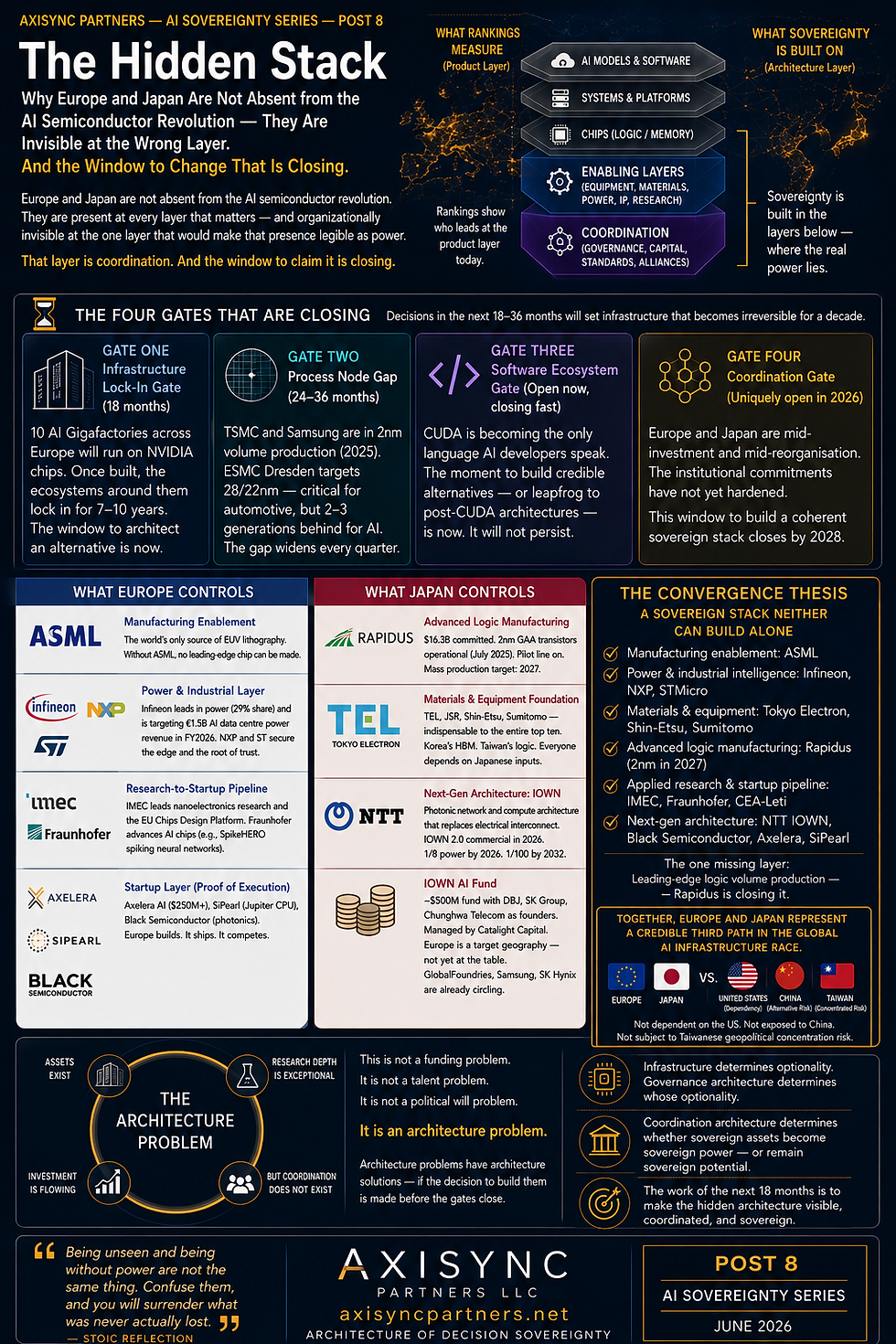
Post 8 of this series mapped what Europe and Japan actually control in the semiconductor stack — the assets that the global AI hierarchy depends upon and cannot name. Post 9 names why those assets are not being converted into sovereign power through the institutional path, what the alternative route looks like, and what it means that the institutional path now has a name, a membership list, and a price.
The next article in this series will go further: the specific sequencing logic for how the second path gets built — which components first, which connections are critical, and what the minimum viable architecture looks like that makes European and Japanese AI sovereignty a real structural option rather than a political language.
If you are a founder, a research director, a sovereign institution, or an investor who recognises the second path in what you are building — the coordination architecture for connecting these components exists. The coalition building it is not a government programme, and it is not a declaration with a purchase commitment attached. It operates at the architecture layer, below the institutional capture, where technical reality still has contact with strategic decisions.
That is where the work is. That is where the window is. And it is closing.
Being included and being free are not the same thing. Confuse them, and the door that let you in becomes the only door you have left.
— Stoic Reflection
Sources
Pax Silica and EU accession
U.S. Department of State, Pax Silica policy page — state.gov/policy-issues/pax-silica
U.S. Department of State, "Under Secretary Jacob Helberg on the Accession of the European Union, Germany, and Greece to Pax Silica," June 23, 2026
Reuters (Toby Sterling and Alexandra Alper), "Netherlands to join US-led Pax Silica AI initiative despite ASML," June 23, 2026
Wikipedia, "Pax Silica" (overview, timeline, founding members) — en.wikipedia.org/wiki/Pax_Silica
Foreign Policy, "How Trump Sparked the EU's Tech Sovereignty Push," July 1, 2026
Brownstein Hyatt Farber Schreck, "State Department Expands Pax Silica Initiative at 2026 Summit" (law firm client briefing summarizing the June 25–26 summit and full signatory list)
Seoul Economic Daily, "US-Led AI Alliance 'Pax Silica' Expands as EU, Germany Join," June 24, 2026
Brussels lobbying and the Digital Omnibus
Corporate Europe Observatory / LobbyControl, "Revealed: Tech industry now spending record €151 million on lobbying the EU," October 29, 2025
Euronews, "Big Tech spending on Brussels lobbying hits record high, report claims," October 29, 2025
Corporate Europe Observatory, "Article by article, how Big Tech shaped the EU's roll-back of digital rights," January 2026
NVIDIA's venture investment strategy
CNBC, "These are the European startups Nvidia backed in 2025," January 26, 2026
TechCrunch, "Nvidia's AI empire: A look at its top startup investments," January 2, 2026
Forbes, "Nvidia's $53 Billion Investment Spree On AI Startups," February 10, 2026
NVIDIA, "NVIDIA Inception Venture Capital Alliance Program" — nvidia.com/en-us/startups/venture-capital
Mistral AI
CNBC, "Mistral secures $830 million in debt financing to fund AI data center," March 30, 2026
DataCenterDynamics, "Mistral AI raises $830m in debt financing for data center in Paris, France"
DIGITIMES, "Europe's AI infrastructure: the cost gap that policy cannot paper over" (includes Cedrik Neike/Siemens VivaTech 2026 quote), June 2026
Rapidus
Rapidus Corporation, official funding announcement — rapidus.inc
Reuters (cited in Japan's Ministry of Economy, Trade and Industry funding announcement coverage), April 2026
IOWN AI Fund
The Korea Herald, "SK Telecom, NTT, Chunghwa Telecom to launch $500m AI fund," June 2026
LightReading, "NTT launches $500M fund to boost global IOWN adoption," June 2026
SoftBank, Arm, and Graphcore
CNBC, "SoftBank has injected $450 million into this British AI chip company," May 12, 2026
DataCenterDynamics, "SoftBank acquires British AI chip designer Graphcore"
AXISYNC Partners LLC
axisyncpartners.net | Architecture of Decision Sovereignty
Post 9 — AI Sovereignty Series | June 2026

Comments