


The RHODES Exit Test


The RHODES Exit Test
Most organizations evaluate a dependency by asking:
"Can we enter?"
Very few ask:
"Can we leave?"
Yet the ability to exit often reveals more about power than the ability to participate.
Because every architecture is easy to enter before its constraints become visible.
Why Exit Reveals More Than Entry
An architecture may appear open while becoming increasingly difficult to leave.
Contracts can be terminated.
Dependencies often cannot.
The distinction matters.
Because the future is rarely constrained at the moment of entry.
It is constrained when exit becomes impossible.
For decades, organizations have measured success through adoption.
How many users?
How many customers?
How many deployments?
How much growth?
But growth and optionality are not the same thing.
An organization can grow while simultaneously reducing its future freedom of action.
The reduction often remains invisible until a crisis occurs.
A regulatory change.
A geopolitical dispute.
A pricing shock.
A supply interruption.
A governance conflict.
Only then does the true architecture become visible.
The question is therefore simple:
If you had to leave tomorrow, could you?
Not theoretically.
Operationally.
Financially.
Legally.
Technically.
Organizationally.
If the answer is no, then participation has become dependence.
The RHODES Exit Test
Every dependency can be evaluated through five dimensions of exit.
Technical Exit
Can critical functions continue after separation?
Or does functionality disappear when the relationship ends?
Data Exit
Can data be migrated completely and independently?
Or does value remain trapped inside the existing architecture?
Governance Exit
Can decisions continue to be made without external permission?
Or does authority remain elsewhere?
Economic Exit
Can the organization absorb the cost of transition?
Or has the cost of leaving become prohibitive?
Organizational Exit
Can people, skills, and operating knowledge continue after separation?
Or has the organization itself become dependent on external expertise?
The RHODES Exit Test in Practice
The value of the RHODES Exit Test becomes visible when circumstances change unexpectedly.
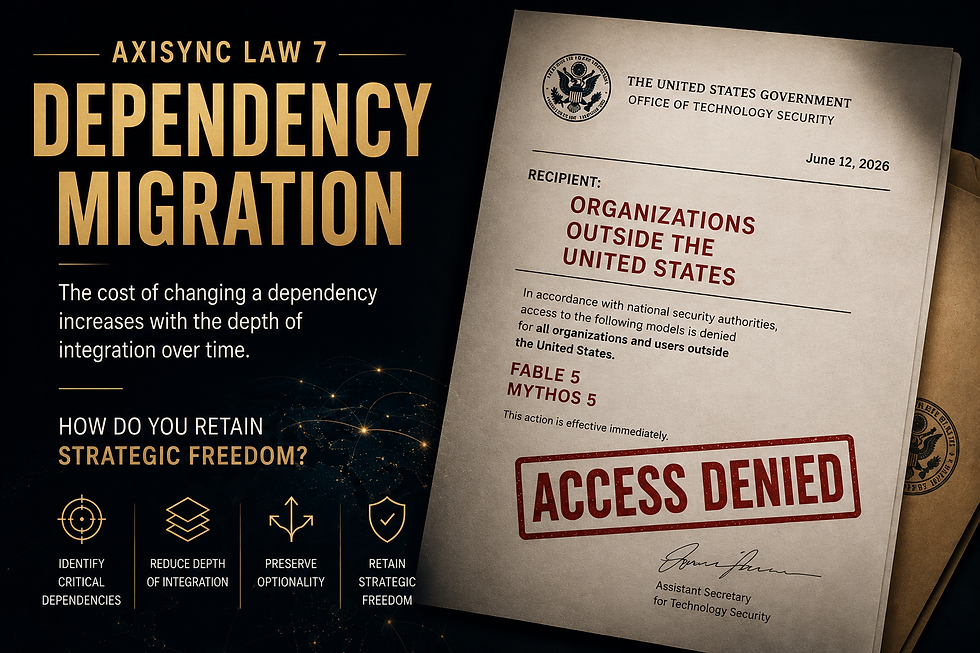
In June 2026, access to a suite of leading AI models became restricted for organizations across Europe. The event immediately exposed a series of architectural dependencies. Technical exit was limited because equivalent capabilities could not be replaced overnight. Data exit remained only partially available because workflows and integrations had already been built around the existing environment. Governance exit was absent because the decision originated outside the affected organizations. Economic exit remained uncertain because the cost of transition narrowed available options.
The event did not create the dependency.
It revealed it.
Most dependencies are discovered only after choice has already narrowed.
The Principle
A dependency does not become dangerous because it exists.
Every organization depends on something.
The question is whether that dependency preserves future choice.
The most resilient architectures are not those that eliminate dependency.
They are those that preserve the possibility of reversal.
Because reversibility preserves optionality.
And optionality preserves agency.
This principle applies equally to cloud infrastructure, AI systems, supply chains, institutions, and states.
The specific technology changes.
The underlying logic does not.
The Measure
The RHODES Exit Test therefore reduces a complex strategic question to a single measure:
If circumstances changed tomorrow, could you still act?
If the answer is yes, optionality remains intact.
If the answer is no, the dependency has already become architecture.
And architecture ultimately becomes destiny.
Architecture determines optionality.
Optionality determines leverage.
Leverage determines sovereignty.
The future is not determined by what you can enter.
It is determined by what you can still leave.
Every irreversible dependency begins as a reversible decision.
The purpose of architecture is to ensure that today's decisions do not unnecessarily eliminate tomorrow's choices.
Freedom is preserved not when every path is open, but when no path becomes impossible.
AXISYNC™ — On the invisible decisions that determine who retains strategic freedom.
This is the seventh post in the AXISYNC AI Sovereignty Series. Posts 1–6 are available at axisyncpartners.net.

Comments