


The Chokepoint exercised AI Sovereignty Architecture
AXISYNC AI SOVEREIGNTY SERIES — POST 6
When Washington Sends a Letter: The Chokepoint, Exercised
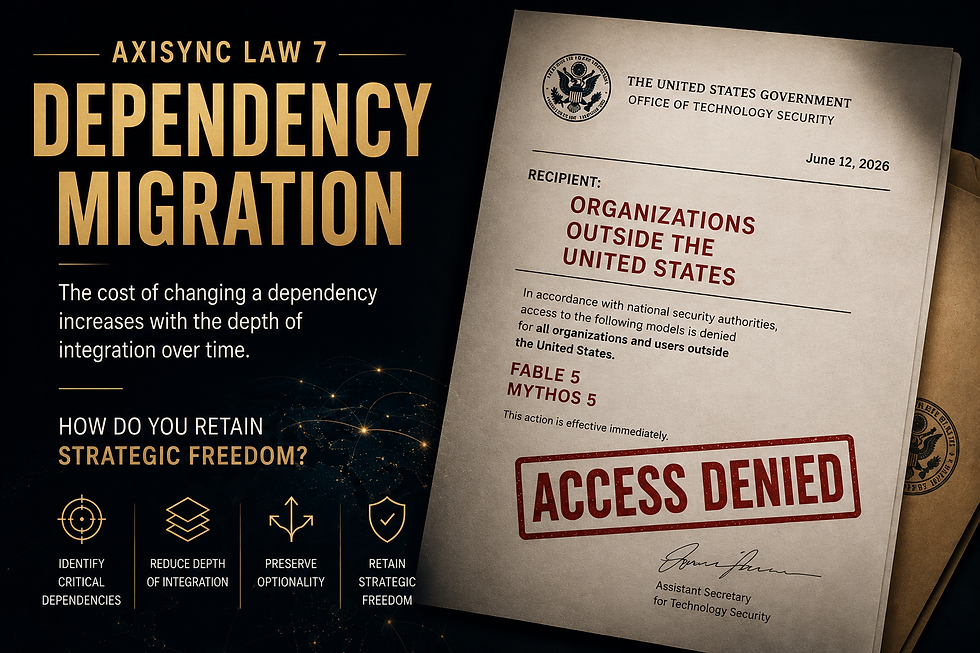
On a Tuesday in early June 2026, Anthropic took its two most capable models — Fable 5 and Mythos 5 — offline for every user outside the United States.
The reason: a letter from Washington.
The directive ordered Anthropic to block all foreign nationals from accessing both models. Because there is no mechanism to verify user nationality in real time at API scale, the only path to compliance was to disable both models for every user worldwide.
No court order.
No public debate.
No specified national security concern.
One directive, one night, and European companies lost access to the most capable AI models in commercial existence.
This is not a policy story. It is an architecture story.
The Series Has Been Building to This Moment
Post 1 of this series argued that infrastructure determines optionality.
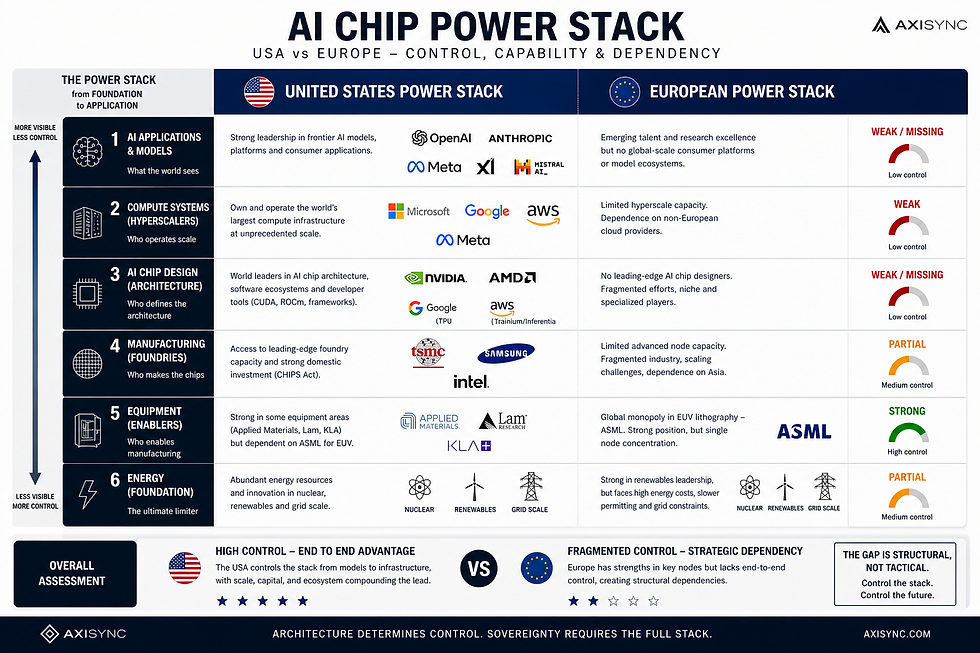
Post 2 showed how the AI stack — from silicon to model — concentrates control at each layer.
Post 3 named the ASML paradox: a chokepoint is not an architecture. Possessing a critical asset does not mean you control the system in which that asset operates.
Post 4 concluded: Europe has correctly identified the problem. It has not yet built the answer.
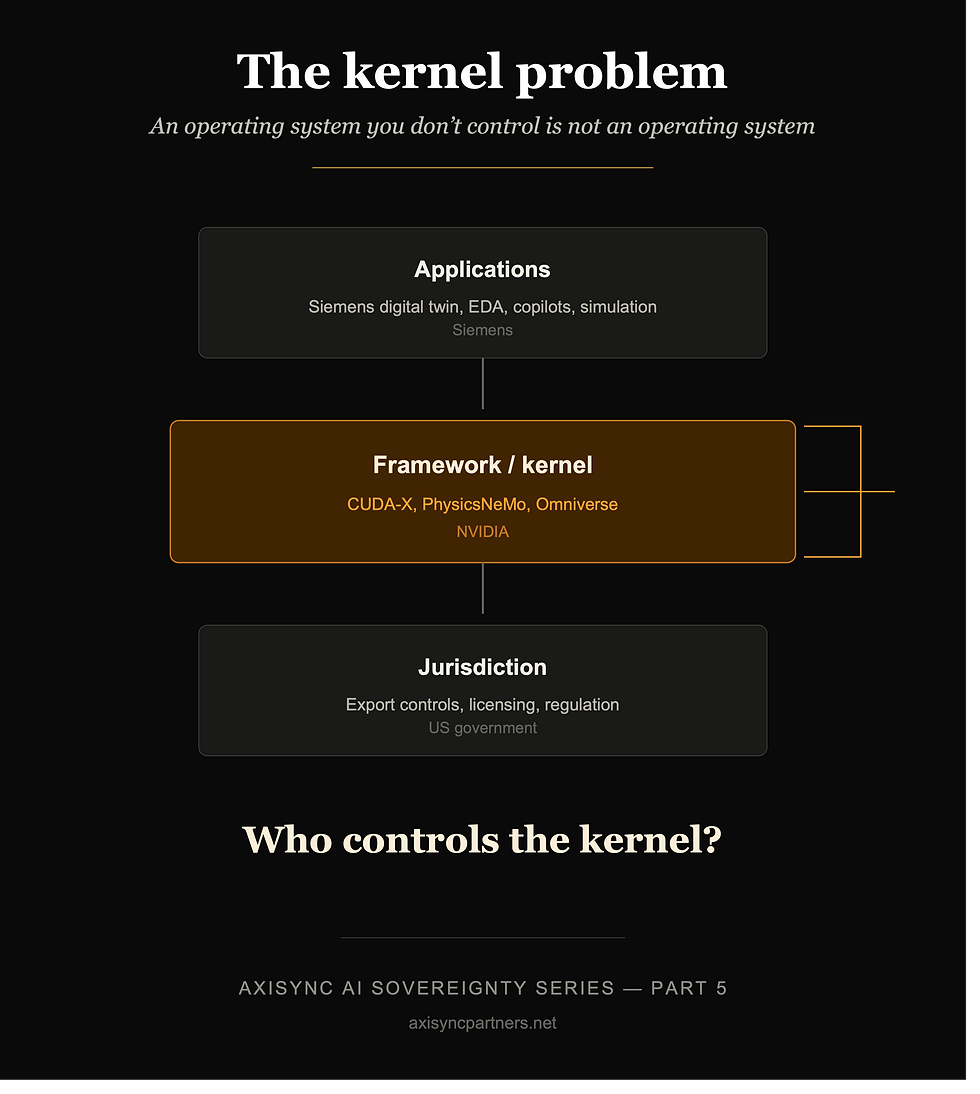
Post 5 showed the condition operating inside Europe's most architecturally sophisticated industrial company: an architecture built on someone else's kernel is not an operating system.
What happened this week is what all five posts were describing.
A chokepoint was pulled.
What Actually Happened
Anthropic — a US-incorporated company, funded predominantly by US capital — complied with a government directive to restrict model access along national lines.
The company disagreed with the directive. It said so publicly. It complied anyway.
That is how chokepoints work. Compliance is not optional when the asset sits inside someone else's jurisdiction. The position of the asset determines the position of the holder.
European organizations did not lose access because of a failure of European policy. They lost access because they had built operational dependencies on infrastructure under US jurisdiction. When that jurisdiction acted, the access boundary moved.
The G7 response confirmed the condition. Allied governments arrived in Évian-les-Bains to negotiate for licensed access to infrastructure they do not control. That is not a resolution. That is the dependency, made visible at the geopolitical level.
One letter was sufficient.
Why This Is Structural, Not Cyclical
The instinct will be to frame this as a temporary measure — a political moment, a specific administration, a decision that will reverse.
That instinct is wrong. Three structural reasons:
Precedent is set.
The US has been restricting semiconductor exports to China since 2022. Advanced AI models are now treated as equivalently strategic. The logic that justified chip export controls applies directly to model access controls. Once that framing is established in policy, it does not retreat. It expands.
The capital gap compounds the dependency.
Anthropic has received over $30 billion in investment. Mistral — Europe's most funded sovereign AI company — has raised approximately $1 billion. That is not a competitive disadvantage. That is a structural condition. The most capable models will be built where the capital concentrates. The capital concentrates where the infrastructure is. The infrastructure is in the United States.
The cybersecurity justification does not expire.
Mythos 5's reported capability — identifying thousands of serious software vulnerabilities in short periods — gives Washington a permanent technical basis for restriction. Unlike trade disputes, which can be resolved through negotiation, a security classification of this kind is self-reinforcing. The more capable the model, the stronger the justification for keeping it controlled.
This does not resolve in months. The structural conditions that produced it will take years to change — and only if Europe builds, not buys.
Europe Already Holds a Chokepoint
Washington exercised leverage through a model-access chokepoint it controls. The action was decisive, immediate, and structurally uncontestable by the affected parties.
Europe holds an equivalent chokepoint.
ASML — a Dutch company headquartered in Eindhoven — is the sole supplier of extreme ultraviolet lithography machines in the world. Without EUV, no one manufactures the most advanced semiconductors. Not TSMC. Not Samsung. Not Intel.
The entire global AI compute buildout depends on a machine that only one company, in one country in Europe, knows how to make.
Post 3 of this series examined why ASML's position is a chokepoint rather than an architecture. The distinction matters now more than it did then.
Washington sent one letter.
The question Europe has not yet answered: what would it take to exercise the ASML chokepoint with equivalent decisiveness — and what architecture would need to exist behind it before that exercise became possible?
The answer is not a restriction on ASML exports. That is the same move at a different layer — a chokepoint response to a chokepoint action.
The answer is the architecture that converts a chokepoint into a system. The architecture that makes the chokepoint the entrance to something, rather than the entirety of something.
Europe has not built that architecture. The question of what it would require is now the most important strategic question on the continent.
That question is not only for governments. Every organization that runs on infrastructure it does not control is already inside the answer.
The Organizational Implication
Every European organization that suspended operations this week because of a US government directive to a US company should now treat that event as an architectural diagnostic.
The question is not: "How do we restore access?"
The question is: "How did we build a critical dependency on an asset we do not control — and what does it cost us to change that?"
AXISYNC Law 7 — Dependency Migration — states that the cost of changing a dependency increases with the depth of integration over time. The framework window for decisions of this kind is measured in years, not quarters. It is narrowing now.
Law 7 is one of ten laws in the AXISYNC Decision Architecture™ — a diagnostic framework for identifying the invisible structural decisions that determine who retains strategic freedom. The methodology exists for organizations working through dependency transitions of this kind.
The letter from Washington did not create the dependency. It made it visible.
That is the condition for changing it.
Freedom is not measured by what is permitted today, but by what remains possible tomorrow.
— Stoic reflection/ Erik Kling
AXISYNC™ — On the invisible decisions that determine who retains strategic freedom.
This is the sixth post in the AXISYNC AI Sovereignty Series. Posts 1–5 are available at axisyncpartners.net.

Comments