


The Hidden Stack - AI semiconductor sovereignty

Why Europe and Japan Are Not Absent from the AI Semiconductor Revolution — They Are Invisible at the Wrong Layer. And the Window to Change That Is Closing.
AXISYNC PARTNERS — AI SOVEREIGNTY SERIES — POST 8
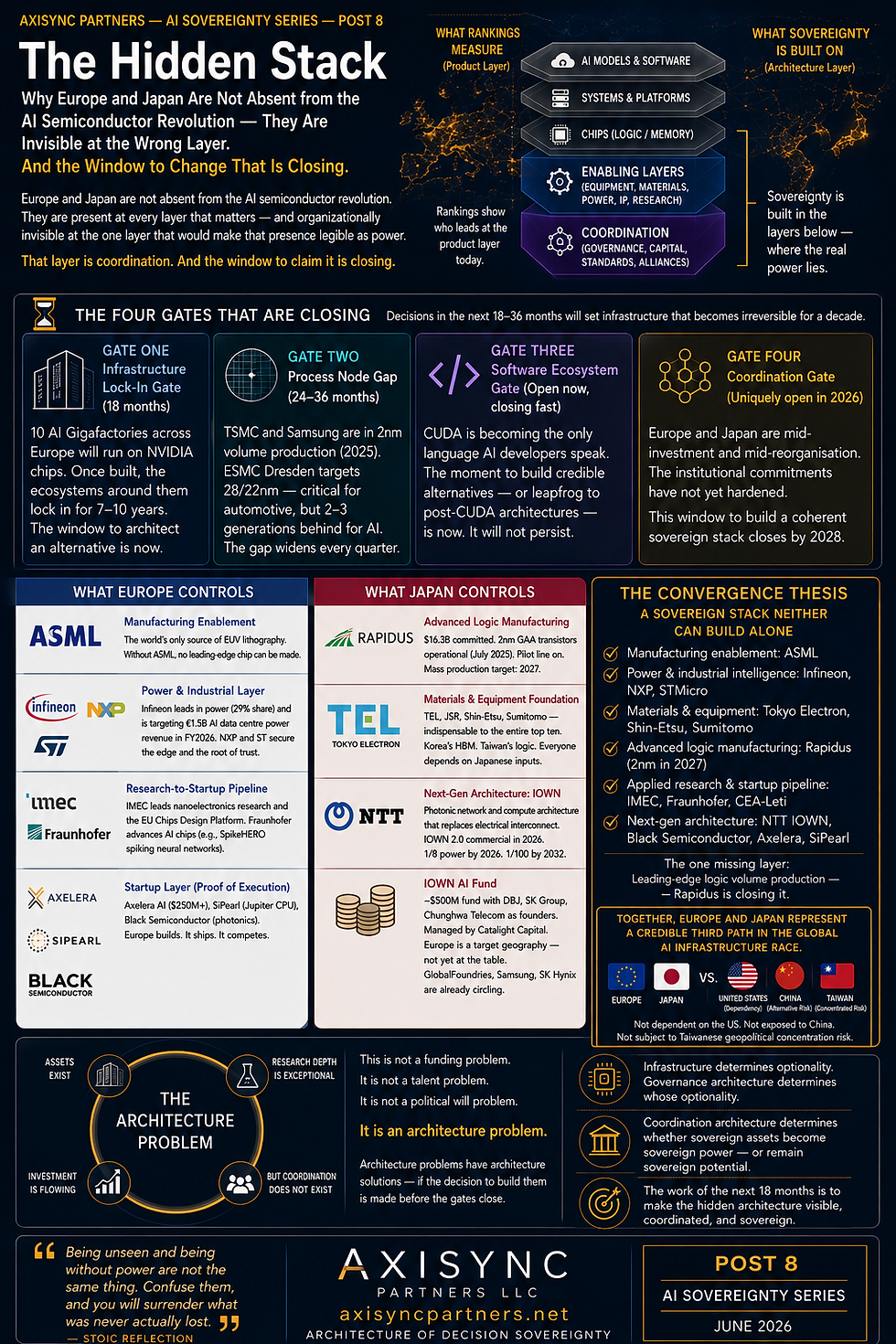
A ranking circulated widely this week. Ten companies. Ten flags. Eight American. One Taiwanese. One South Korean. The headline: these are the powers shaping the AI Revolution through AI semiconductors sovereignty.
Zero European. Zero Japanese.
If you accept the ranking at face value, the conclusion is damning. The civilizations that built the industrial world, that gave us the automobile, the chemical industry, precision manufacturing, and the modern research university — are absent from the defining technology of the next era.
The ranking is not wrong. But it is measuring the wrong layer. And the gap between what it shows and what is actually true — structurally, technically, strategically — is the most important misunderstanding in the current global technology debate.
Europe and Japan are not absent from the AI semiconductor revolution. They are present at every layer that matters — and organizationally invisible at the one layer that would make that presence legible as power.
That layer is coordination. And the window to claim it is closing faster than most people in positions of authority appear to understand.
The Four Gates That Are Closing
Before mapping what Europe and Japan control, the urgency argument must be stated plainly.
This is not a ten-year problem. The decisions being made in the current budget cycle — in Brussels, in Tokyo, in corporate boardrooms across the continent — are setting infrastructure that will be operationally irreversible within 18 to 36 months. Four gates are closing simultaneously.
Gate One — The Infrastructure Lock-In Gate (18 months)
Ten AI Gigafactories are being built across Europe right now. Seven countries. Thirty-seven billion euros in public and private commitment. These are the physical facilities on which European AI researchers, startups, and institutions will train their models, run their inference, and build their competitive positions for the next decade.
Every one of them will run on NVIDIA chips.
This is not speculation. It is the documented architecture of the programme. European public money is constructing the physical infrastructure of American AI sovereignty. Once the facilities are built, the software ecosystems around them — the developer training pipelines, the procurement contracts, the model libraries — will lock in for seven to ten years minimum. The window to architect an alternative is not after construction. It is now, during construction, when specifications can still change.
Gate Two — The Process Node Gap (24–36 months)
The leading-edge foundry market is an oligopoly defined by scale, experience, and process know-how. TSMC and Samsung both entered volume production at 2nm in 2025. Every quarter that passes without a credible European advanced-node strategy is a quarter of compounding disadvantage. The gap does not hold still while policymakers deliberate. It widens.
The current European response — the ESMC fab in Dresden, a joint venture between TSMC, Bosch, Infineon, and NXP — targets 28/22nm process nodes. Critical for automotive and industrial. Two to three generations behind the leading edge for AI. The investment is real and strategically sound for its intended market. It is not an answer to the AI infrastructure question.
Gate Three — The Software Ecosystem Gate (open now, closing fast)
NVIDIA's CUDA platform has spent nearly two decades becoming the de facto standard for GPU computing. Its installed base grows with every data center built, every developer trained, every AI model deployed on American infrastructure. The moment to build a credible alternative software ecosystem is before CUDA becomes the only language AI developers speak.
That moment is now. It will not persist.
The architectures that bypass CUDA entirely — neuromorphic, photonic, analog inference — do not need to overcome that moat. They render it structurally irrelevant. European and Japanese research institutions are disproportionately positioned in exactly these post-CUDA architectures. That position has commercial value only if it converts to product before the market calcifies.
Gate Four — The Coordination Gate (uniquely open in 2026)
Europe and Japan are simultaneously mid-investment, mid-reorganisation, and politically motivated to act on semiconductor sovereignty. The EU Chips Act 2.0 is active. Rapidus in Japan is in pilot production. The research coalitions, the policy frameworks, the institutional relationships required for coordination exist in nascent form.
What does not exist is the coordination architecture that converts these parallel sovereign efforts into a coherent non-US, non-China, non-South Korean stack.
That architecture is uniquely buildable in 2026. The institutional commitments have not yet hardened. The coalition logic has not yet been written. In 2028, when contracts are signed and infrastructure is operational, this window will be closed.
What Europe Actually Controls - AI semiconductor sovereignty
The MacChart ranking measures end-product market position. It does not measure who controls the enabling layers that the entire top ten depends upon. At those layers, Europe holds structural positions that are not optional — they are foundational.
The Manufacturing Enablement Layer — ASML
Every chip in that ranking — every TSMC 2nm wafer, every Samsung HBM stack — is made using machines that only one company on earth can produce. ASML, Dutch, manufactures the extreme ultraviolet lithography systems without which no leading-edge chip can be fabricated. The Dutch government has progressively tightened export licensing on ASML's most advanced systems in step with US and allied controls — moving the most critical manufacturing capability inside a narrower, security-vetted circle of buyers.
ASML is already a geopolitical instrument. The question is whether the civilisation that produced it coordinates its broader semiconductor position around that fact — or continues to allow ASML to operate as an isolated asset disconnected from a sovereign strategy.
The Power and Industrial Layer — Infineon, NXP, STMicroelectronics
Infineon holds a 29% market share in automotive power semiconductors and 32% of the automotive MCU market. It is now pivoting that position directly into AI infrastructure, targeting €1.5 billion in AI data centre power revenue in fiscal 2026 and accelerating capital investment to expand that capacity. Infineon has joined NVIDIA's MGX AI Factory Ecosystem — not as a dependent supplier but as the power delivery architecture for next-generation AI server racks. It has certified security solutions for NVIDIA's Jetson Thor AI platform. Europe's largest industrial semiconductor company is inserting itself into the AI infrastructure stack at the power layer.
NXP and STMicroelectronics are executing parallel strategies in automotive AI chips and secure microcontrollers — the security root of trust that every sovereign AI deployment requires.
These are not legacy companies in decline. They are European champions repositioning into the AI era at the layer they have always dominated: the power, security, and industrial intelligence layer that makes AI deployable in the physical world.
The Research-to-Startup Pipeline — IMEC and Fraunhofer
IMEC, based in Leuven, Belgium, is the world's leading independent nanoelectronics research hub. It works with virtually every major semiconductor company on the planet. It now coordinates the EU Chips Design Platform — a consortium of twelve European partners providing startups and SMEs direct access to design infrastructure, fabrication pathways, packaging, and testing. The bottleneck has shifted: Europe is no longer unable to do the research. It is not yet converting research into commercial companies fast enough.
Fraunhofer, Germany's applied research network spanning 76 institutes, has launched a dedicated Chip AI Research and Innovation Centre in Heilbronn, jointly run by Fraunhofer IIS and IAF. Its mandate: develop chips for AI applications and use AI to improve chip design itself. Fraunhofer IIS is separately leading the SpikeHERO consortium, developing AI chips based on spiking neural networks — an architecture with fundamental energy efficiency advantages over conventional GPU computation. These are not pilot programmes. They are funded, staffed, and producing results on commercial timescales.
The Startup Layer — Proof That Europe Can Build
Axelera AI, a Dutch company spun out of IMEC in 2021, has raised over $250 million — the largest investment ever made in an EU AI semiconductor company. Its Europa processor, targeting edge servers and enterprise systems with up to 629 TOPS of AI performance, is shipping in 2026. This is a commercial product competing in the AI accelerator market, not a research demonstration.
SiPearl, French, has taped out the Rhea1 processor — 80 ARM Neoverse cores with High Bandwidth Memory — which will power EuroHPC's Jupiter exascale supercomputer. Europe's sovereign supercomputing infrastructure runs on a European-designed processor. This fact is almost entirely absent from public discourse about European AI capability.
Black Semiconductor, German, is working at the intersection of photonics and next-generation chip architectures. Light-based AI accelerators, targeting a tenfold improvement in energy efficiency for neural network processing, are expected on pilot lines by 2027. This is not catch-up. If the trajectory holds, it is leapfrog.
Europe is not absent from the AI semiconductor revolution. It is structurally present at every critical layer — and organisationally absent at the one layer that converts presence into power.
Japan — The Missing Piece of the Sovereign Stack
The MacChart ranking omits Japan entirely. This is understandable — Japan produces no leading-edge AI GPUs, operates no dominant AI cloud, and runs no globally competitive AI software platform. By the metrics the ranking uses, Japan is not present.
By the metrics that determine who controls the next decade of AI infrastructure, Japan is arguably the most consequential actor not yet integrated into a coherent Western sovereign strategy.
Rapidus — The Most Ambitious Industrial Bet Since Postwar Reconstruction
Japan has not manufactured leading-edge logic chips since the 1990s. For three decades it watched the architecture of the global chip industry consolidate in Taiwan, South Korea, and the United States — and did nothing structural to reverse it.
That era ended in 2022 with the founding of Rapidus.
The Japanese government has now committed $16.3 billion to make Rapidus a world-class semiconductor manufacturer. Cumulative state support stands at approximately 2.35 trillion yen. This is described, explicitly, not merely as an industrial investment but as a geopolitical statement — that Japan is no longer willing to watch from the sidelines as the world's most critical technology infrastructure consolidates in the hands of a few foreign actors.
The structure is instructive. The government is now Rapidus's largest shareholder, with 11.5% voting rights and a golden share veto over major strategic decisions — preserving operational autonomy while retaining sovereign override. This is not nationalisation. It is sovereign industrial architecture executed with precision.
On July 18, 2025, Rapidus announced the successful operation of gate-all-around transistors for 2nm semiconductors — the architecture that TSMC and Samsung use at the leading edge. The Chitose IIM-1 facility powered up its pilot line in April 2025. Target for mass production: 2027. Japan is not planning to compete at the leading edge. It is competing there now.
Rapidus has formed partnerships with IBM for process technology and with IMEC for research support. The Japanese and European semiconductor ecosystems are already technically connected. The question is whether that technical relationship becomes a strategic sovereign alignment.
The Materials Layer — The Foundation Underneath the Foundation
While Rapidus captures attention, Japan's deeper structural position in the global semiconductor supply chain is in materials and manufacturing equipment — the layer beneath the fab that almost no public analysis names.
The HBM memory that SK Hynix, Samsung, and Micron ship — the memory architecture that makes AI computation possible at scale — depends indispensably on Japanese companies for the materials and equipment required to produce it. Tokyo Electron. JSR. Sumitomo Chemical. Shin-Etsu Chemical. These are not supporting players. They are structural dependencies of the companies that appear in the top ten.
Korea's memory dominance runs on Japanese materials. Taiwan's leading-edge logic runs on Japanese equipment. The entire MacChart top ten depends on Japanese inputs that do not appear anywhere in the ranking. This is precisely the AXISYNC definition of invisible strategic position: present at every critical layer, legible at none.
NTT IOWN — The Architecture That Comes After the GPU Era
NTT's IOWN initiative — Innovative Optical and Wireless Network — is the most ambitious post-silicon infrastructure programme currently being executed by any major institution on earth. Its premise: replace electrical signals with light, end-to-end, across data centre interconnects, board-to-board connections, chip-to-chip links, and eventually within the chip package itself.
IOWN 2.0 is commercially live in 2026. NTT targets one-eighth of current data centre power consumption by 2026, and one-hundredth by 2032. It is commercialising second-generation photonic-electronic convergence devices in partnership with Broadcom. It is co-developing ultra-low-latency optical quantum computing architectures with OptQC.
The strategic significance for the coalition argument is this: NTT has just stood up real capital behind IOWN — the IOWN AI Fund, sized at roughly $500 million, founded with the Development Bank of Japan, South Korea's SK Group, and Taiwan's Chunghwa Telecom as governance partners, and managed by a new entity, Catalight Capital, out of Silicon Valley and Tokyo. Europe is one of three target geographies for the fund's capital, alongside North America and the rest of Asia — it is not yet a governance partner in shaping where that capital goes, and GlobalFoundries, Samsung, and SK Hynix are already among the names circling the fund as participants.
That is the opening, not a disqualification. A coordination architecture this consequential, with Japan in the founding chair, is being assembled in real time. The question for Europe is not whether NTT's capital will eventually reach a European photonics startup. It is whether Europe secures a seat in shaping that fund's governance now, while its structure is still forming, or arrives later as one recipient among many in a vehicle co-designed by Tokyo, Seoul, and Taipei without European input. Those are different positions, and the coalition logic this series is arguing for depends on choosing the first one before the window closes.
The Convergence Thesis — A Sovereign Stack Neither Can Build Alone
Europe and Japan, assessed together, cover every critical layer of the semiconductor stack:
Manufacturing enablement: ASML's EUV lithography — the only pathway to leading-edge fabrication.
Power and industrial intelligence: Infineon, NXP, STMicro — the layer that makes AI deployable in physical infrastructure.
Materials and equipment: Tokyo Electron, Shin-Etsu, Sumitomo — the foundation the entire top ten is built on.
Advanced logic manufacturing: Rapidus targeting 2nm production in 2027, connected to IMEC for research.
Applied research and startup pipeline: IMEC, Fraunhofer, CEA-Leti — converting research depth into commercial companies.
Next-generation architecture: NTT IOWN, Black Semiconductor, Axelera, SiPearl — building what comes after the GPU era.
The one layer not yet covered: leading-edge logic volume production. Rapidus is targeting it. The ESMC Dresden fab provides industrial-grade capacity at automotive nodes. The gap is real — and it is the only gap in an otherwise comprehensive sovereign stack.
Neither Europe alone nor Japan alone can claim this stack. Together, with the right coordination architecture, they represent a credible third path in the global AI infrastructure race — not dependent on American software platforms, not subject to Taiwanese geopolitical concentration risk, not exposed to Chinese strategic alternatives.
The MacChart ranking shows ten companies. It does not show the architecture underneath them. That architecture — the enabling layers, the research pipelines, the next-generation technology positions — is where Europe and Japan are not absent. It is where they are hidden.
The work of the next 18 months is to make that hidden architecture visible, coordinated, and sovereign.
The Architecture Problem
A civilisation that controls the manufacturing enablement layer of the entire global chip industry (ASML), the power infrastructure layer that AI compute depends on (Infineon), the world's leading nanoelectronics research institution (IMEC), the sovereign supercomputer processor (SiPearl), the materials foundation of the top ten's memory stack (Japan), and the next-generation photonic architecture (NTT) — that civilisation is not technologically absent.
It is architecturally uncoordinated.
The assets exist. The research depth is exceptional. The investment is flowing. What does not exist is the coordination layer that makes these assets legible as a sovereign stack — a coherent architecture with a defined build sequence, clear gating logic, and an explicit answer to the question every sovereign actor must eventually face:
What do we control, in what sequence, at what cost, and with what irreversibility window?
The AXISYNC diagnosis is precise: this is not a funding problem. It is not a talent problem. It is not a political will problem. It is an architecture problem. And architecture problems have architecture solutions — if the decision to build them is made before the gates close.
Infrastructure determines optionality.
Governance architecture determines whose optionality.
Coordination architecture determines whether sovereign assets become sovereign power — or remain sovereign potential.
The ranking shows you who leads at the product layer today. AXISYNC exists to make visible what the ranking cannot show: who controls the architecture underneath — and what it will take to claim it before the window closes.
Being unseen and being without power are not the same thing. Confuse them, and you will surrender what was never actually lost.
— Stoic Reflection
AXISYNC Partners LLC
axisyncpartners.net | Architecture of Decision Sovereignty
Post 8 — AI Sovereignty Series | June 2026

Comments