


The Insurance Doctrine - AI Sovereignty Strategy
Joining a coalition and building an alternative to it are not competing decisions. Treating them as if they were is how sovereignty actually dies.

Posts 8 and 9 mapped a problem and named a path. Post 8 showed that Europe and Japan control nearly every critical layer of the AI semiconductor stack and are organisationally invisible at the one layer — coordination — that would convert that control into power. Post 9 showed that the institutional response to that gap now has a name, Pax Silica, and a price: late accession on unequal terms, and a framework whose own architect describes sovereign regional capability as producing "synchronised mediocrity" — accession arriving alongside a separate EU pledge, made under the EU–US trade agreement rather than as a term of accession itself, to purchase at least $40 billion in US AI chips.
The natural reading of those two posts is that Pax Silica and the second path are opposites — that joining one means abandoning the other. That reading is wrong, and it is worth being precise about why, because the imprecision is exactly where sovereignty gets lost.
Accession and insurance are different decisions, made for different reasons, evaluated against different risks. Confusing them does not make a country or a company safer. It makes the second decision — the one that actually determines whether you have a future choice — disappear inside the first one, unexamined, because everyone assumes it was already answered.
It was not.
What Accession Actually Buys
There is a rational case for joining Pax Silica, and this series should state it plainly rather than treat it as a mistake to be corrected.
Pax Silica buys near-term market access: preferential positioning in a US-coordinated supply chain at a moment when GPU allocation, export licensing, and AI infrastructure investment are being decided in rooms that matter. It buys political alignment at a time when standing outside every coordination framework carries its own cost — isolation is not neutrality, it is simply a different exposure. It buys a seat, even an unequal one, at discussions that are happening regardless of who is in the room. For a country like Greece, signing early may also buy something more specific: visibility inside a framework that is actively allocating attention and investment, at a moment when standing outside it risks being overlooked entirely.
None of this is irrational. A government or a company that joins Pax Silica is not making an error. It is making a near-term access trade, and the trade may well be worth making.
What Accession Cannot Buy
What it cannot buy is reversibility.
Run it again through the four-dimension test introduced in Post 7. Technical exit does not improve — the underlying stack Pax Silica coordinates access to is still designed and fabricated predominantly on American terms. Governance exit was never on offer — the declaration is explicitly non-binding, which sounds like protection but functions as the opposite: it means no signatory has enforceable authority over how the framework evolves, including over its own future terms. Economic exit narrows, not widens — that same $40 billion chip-purchase commitment is capital that cannot simultaneously fund an independent alternative. And data exit, in the form it matters most here, is really a research and talent exit: every engineer-hour and every dataset routed through the coordinated stack is an hour and a dataset not building toward an independent one.
Accession does not insure against the moment Pax Silica's terms change unfavourably. It cannot, by definition, because accession is what created the exposure to those terms in the first place. Insurance against a dependency cannot be purchased from the entity you are dependent on. It has to be built somewhere else, by someone else, in parallel.
That is what the second path is for. Not a rejection of accession. The thing accession cannot provide.
The Model Layer Is Already Spent
There is a complication that makes this more urgent than a clean philosophical distinction, and it needs to be named directly: the most visible "sovereign AI" champion in each half of the proposed coalition has already taken NVIDIA's money.
In Europe, Mistral AI — the company European policymakers point to as proof that the continent can build competitive frontier AI — has NVIDIA as an investor across multiple rounds, and its flagship Paris-region data centre runs on 13,800 NVIDIA GB300 GPUs.
In Japan, the parallel is almost exact. Sakana AI is Japan's equivalent flagship: a Tokyo-based foundation model company explicitly built around Japanese language and culture, founded on the premise that Japan needs AI that reflects its own values rather than importing someone else's. NVIDIA invested in Sakana's Series A in 2024 and remains a strategic partner across research, data-center access, and community-building. NVIDIA has separately announced plans to open a research lab in Japan and invest directly in the broader local startup ecosystem — the same ecosystem-capture instrument deployed through the Accel/Elaia/Partech/Sofinnova alliance in Europe, applied to the same target.
This is worth sitting with rather than glossing over. The model layer — the layer most visible to policymakers, most cited in sovereignty announcements, most photographed at summits — is already compromised on both sides of the coalition this series is proposing. And it goes beyond the flagship companies. NVIDIA's Inception programme now counts more than 370 AI startups in Japan alone, and NVIDIA has direct infrastructure relationships with the telecom and cloud layer that sits beneath the model layer — SoftBank's sovereign AI supercomputer and AI-RAN network, KDDI's generative AI infrastructure, Sakura Internet's GPU cloud serving Japan's National Institute of Informatics. This is not a single captured flagship. It is an ecosystem wired in from the cloud layer up. That is not a reason to abandon the second path. It is the reason the second path cannot be built at the model layer, or at the cloud infrastructure layer beneath it.
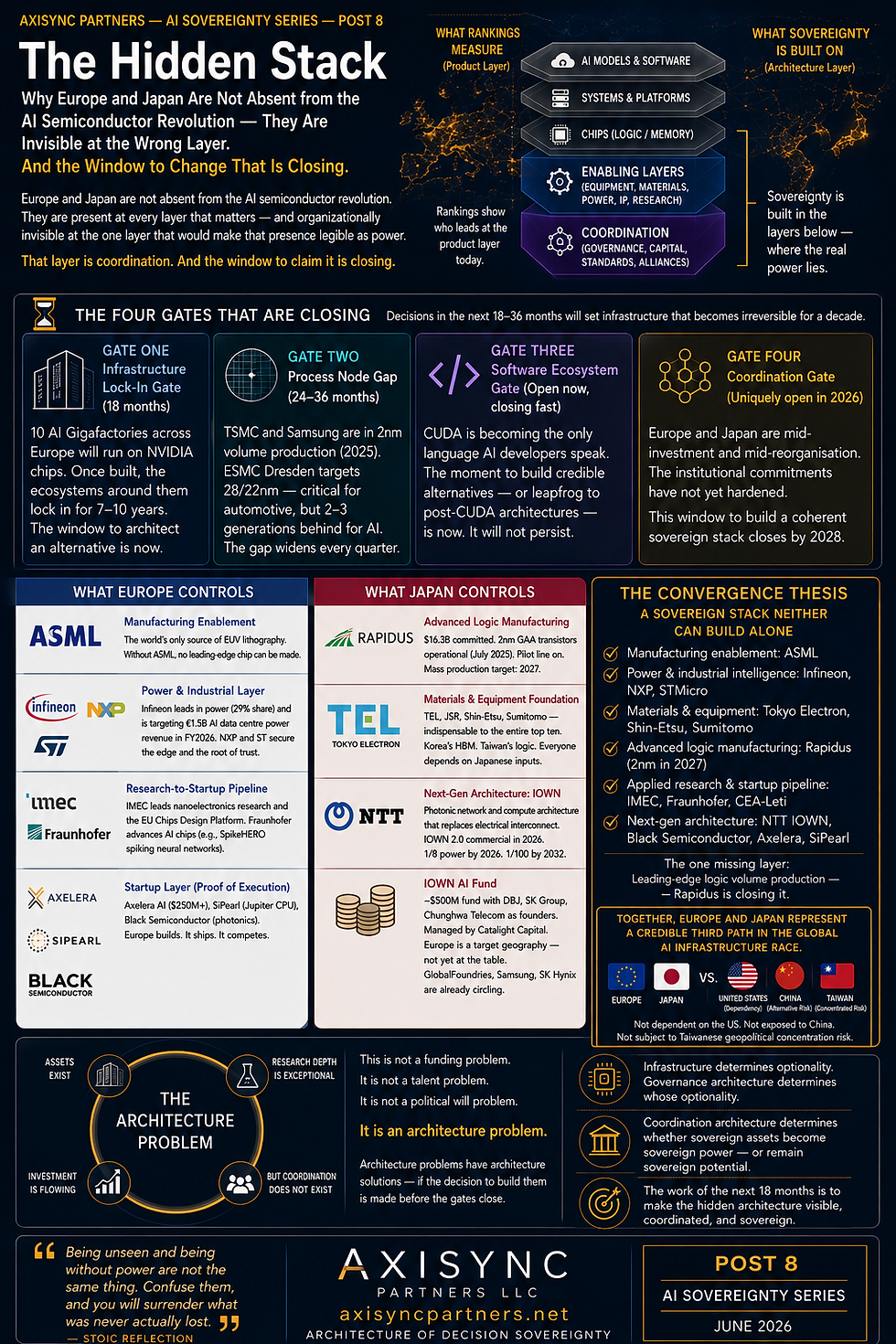
It has to be built at the layers beneath both: the chips, the materials, the photonics, the manufacturing equipment. Axelera, SiPearl, Black Semiconductor, Fraunhofer's spiking-neural-network research, Tokyo Electron and Shin-Etsu's materials position, Rapidus's 2nm manufacturing, NTT's IOWN architecture. None of these is a foundation-model company or a cloud provider chasing the same capital and infrastructure relationships NVIDIA has already locked in. All of them sit in segments where NVIDIA either cannot easily buy the position — manufacturing equipment, materials chemistry, photonic architecture — or has not yet finished trying.
Post 8 already mapped this stack. Post 9 already proposed connecting it. What this post adds is the order in which that connection has to happen, because sequencing is not a detail — by the doctrine's own Law 8, it is the decision that determines the outcome space.
The Sequencing Logic — Minimum Viable Architecture
The temptation, facing a problem this size, is to design the coordination layer first: build the consortium, write the charter, define the governance, then go looking for participants. That is the institutional path's own instinct, and it is precisely why the institutional path moves too slowly to matter. Brussels did not fail to build sovereign infrastructure because it lacked a coordinating body. It has several. It failed because none of them connected technical capability to commercial demand fast enough to outpace the lock-in.
The second path has to build in the opposite order: demand first, connections second, formal coordination last — formalising relationships that already generate revenue, rather than designing a structure and hoping participants arrive.
Step One — Anchor the demand side before anything else.
Nothing downstream matters if there is no buyer who cannot use the alternative anyway. Two demand anchors require no new institution to activate: European defence procurement, which has security requirements that structurally exclude dependence on a foreign platform; and financial infrastructure with data sovereignty mandates, where the requirement to keep data and processing within jurisdiction already exists in regulation. A third candidate needs a caveat stated plainly rather than assumed away: Greece's Pharos AI Factory, anchored by the DAEDALUS supercomputer at Lavrio, is sovereign at the application and governance layer — its own Greek-language model, its data-handling rules, its mandate as a EuroHPC AI Factory — but the system itself runs on more than 2,000 NVIDIA Grace Hopper superchips supplied through Hewlett Packard Enterprise. It is not, as currently built, a hardware demand anchor for European or Japanese silicon. It is exactly the gap between appearing sovereign and being reversible this series exists to name, and it should be treated as a target for the next procurement cycle, not cited as proof the second path already has a sovereign state buyer. The first move is not a coalition announcement. It is closing one or two procurement relationships between an existing European or Japanese chip or accelerator company and a defence or financial-sector anchor, on commercial terms, with no political framing required. A signed contract is worth more at this stage than a declaration with twenty-four signatories.
Step Two — Connect the shipping products to that demand, not the research.
Axelera's Europa processor is scheduled to ship — Axelera announced availability beginning in the first half of 2026 — and SiPearl's Rhea1 is sampling to customers, with availability slated for the end of 2026. They do not need five years of development before they can serve as proof that the second path produces something a sovereign buyer can actually deploy. The second move is making sure the demand anchors secured in Step One are actually procuring from these companies specifically — converting the abstract case for European silicon into purchase orders that show up in both companies' commercial pipelines. This is the step that makes the second path real to anyone evaluating it from the outside, including the Japanese capital in Step Three.
There is a second, more specific move available inside this same step, and it is the clearest Europe-Japan manufacturing connection currently sitting unbuilt. SiPearl's Rhea1 is manufactured at TSMC in Taiwan — not because SiPearl prefers Taiwan, but because SiPearl's own leadership has said publicly it would manufacture at an allied advanced-node fab if one existed, and Europe's own advanced-node facility, the ESMC fab in Dresden, is built for 12–28nm automotive and industrial nodes, not the leading-edge processes Rhea1 needs. Rapidus, in Hokkaido, is building exactly that leading-edge capacity, is actively seeking customers beyond its current IBM- and Tenstorrent-heavy pipeline, and has open capacity in exactly the window when SiPearl's chiplet-based Rhea2 and Rhea3 generations are scheduled — 2027 and 2028. A formal second-source manufacturing relationship between SiPearl and Rapidus for Rhea2 or Rhea3 would do something no MoU or coordination declaration can: give Europe's flagship sovereign processor a fabrication path that runs through an allied democracy instead of through Taiwan-concentration risk on one side or American foundry dependence on the other, and give Rapidus its first confirmed, named European customer — a customer list from which Europe is, so far, entirely absent. This is a contract to pursue now, not a future component of the architecture — SiPearl's roadmap timing and Rapidus's capacity ramp are aligned for exactly this window. The pattern isn't unique to SiPearl: Axelera already fabricates Europa on Samsung's 5nm process in Korea — European design, allied-democracy fabrication. That is the template, not the flaw; the open move is simply to widen the set of allied fabs Europe can reach, which is exactly what a SiPearl-Rapidus relationship would do.
Step Three — Seek a seat in the capital that is already moving, not just its proceeds.
NTT's IOWN AI Fund, roughly $500 million and founded with the Development Bank of Japan, South Korea's SK Group, and Taiwan's Chunghwa Telecom, is private capital that does not require Brussels' permission and is not waiting for a coordination architecture to be built before it deploys. It is also not, as earlier framing in this series suggested, a dedicated European corridor — Europe is one of three target geographies for its investments, alongside North America and the rest of Asia, with GlobalFoundries, Samsung, and SK Hynix already circling it. The move available to Europe is therefore not "wait to be invested in." The founding tier — NTT, SK Group, Chunghwa Telecom, and the Development Bank of Japan — is already set. So the live move is to enter now as a co-investor while the fund's LP structure is still forming, and to put the question directly to the fund: a seat beyond the founding tier, on terms comparable to those Japan, Korea, and Taiwan already hold. The seat is still open — but the structure is closing, and Europe has not yet moved to take one. Once Steps One and Two produce a small number of companies with real commercial traction, that seat becomes the channel for connecting them to the fund's capital on negotiated terms — not as a future ambition, but as a named co-investor relationship secured before the fund's structure fully closes. This is also the first moment Japan and Europe would be connected by something other than a shared MoU: an actual governance relationship inside a capital vehicle, not just a hoped-for allocation from it.
Step Four — Route the research pipeline into the same channel, not a separate one.
Fraunhofer's spiking neural network work, Black Semiconductor's photonic accelerators, and the neuromorphic programmes at IMEC are positioned to bypass CUDA entirely rather than compete with it. The fourth move is ensuring these research programmes have a pre-negotiated commercialisation path into the same demand anchors and the same capital corridor established in Steps One through Three, rather than spinning out into a separate, unconnected startup layer that has to rebuild the relationships from zero. This is where "the coordination layer" stops being an abstraction and becomes a specific, repeatable handoff: research result to funded startup to anchor customer, on a timeline measured in months, not the multi-year cycle the institutional path runs on.
Step Five — Formalise the architecture only after it has a track record, and govern it as equals from day one.
This is the step the institutional path gets backwards, and it is also where the second path has to avoid repeating Pax Silica's own structural mistake. By the time there is a connected chain — anchor customer, shipping product, aligned capital, research pipeline — running for even a small number of cases, the coordination layer RHODES is designed to provide stops being a pitch and starts being a description of something that already exists. At that point it can be formalised. The governance principle has to be set at that moment, not negotiated later under pressure: no founding members and late joiners, no member admitted on terms that include a purchase obligation, no veto held by a single contributor regardless of size. Pax Silica's accession structure — early movers favoured, latecomers bundled with commitments, no enforceable shared authority — is the architecture to avoid, not adapt. A coordination layer built the way Pax Silica was built would just be a smaller, slower version of the same dependency, with a European or Japanese flag on it instead of an American one.
This Is Not Hypothetical — It Is Already Happening in Miniature
On May 7, 2026, SiPearl and Semidynamics — a Barcelona-based fabless RISC-V company building memory-centric AI infrastructure — announced a formal strategic partnership to build a joint European rack-scale AI compute platform for large-scale inference, explicitly targeting the EU's AI Factory and Gigafactory procurement programmes together, with coordinated sales and marketing. No government convened this. No coordination declaration preceded it. Two companies, in two different countries, working in the same layer this series calls the Startup Layer, connected because the fit was obvious once someone looked for it. Semidynamics' CEO put the logic exactly as this series would: "Sovereignty is about controlling the design, not just the location." The honest caveat belongs in the same breath — Semidynamics itself carries non-European inputs, including a strategic investment from Korea's SK hynix and a recent 3nm tape-out at TSMC in Taiwan. That does not sink the example; it sharpens it. The connection this series argues for lives at the design and coordination layer, not in a fantasy of total autarky — the same distinction between appearing sovereign and being reversible this post applies everywhere else.
This is Step Two happening without waiting for Steps One and Three to be formalised first — proof that the sequencing logic in this post describes a real tendency in the underlying ecosystem, not just a plan someone hopes gets adopted. It is also the clearest available answer to the size objection Post 9 already anticipated: the second path's components are not only large enough to be credible, they are already finding each other. The work remaining is not to invent this kind of connection. It is to make it happen faster, more often, and with the demand-anchor and capital-corridor steps arriving in support of it rather than lagging behind it — which is exactly the SiPearl-Rapidus opportunity described in Step Two, still unmade as of this writing, sitting one relationship behind the one that already closed.
Equal Members or No Members - AI Sovereignty Strategy
This is worth stating as a standalone principle, because it is the one place this series is willing to set a hard condition rather than describe a trend.
A second path that replicates Pax Silica's governance — asymmetric entry timing, bundled financial obligations, non-binding commitments with no enforceable shared authority — is not an alternative. It is the same architecture with different signatories. The entire argument against the institutional path collapses if the second path simply rebuilds its flaws at smaller scale.
The condition has to be: every contributor to the second path — Axelera, SiPearl, NTT, Fraunhofer, IMEC, the sovereign demand anchors, the coordination practice itself — participates on terms negotiated before capital moves, not after. No purchase commitments bundled into governance access. No founding-member tier that permanently outranks later participants who bring equivalent assets. No structure where one contributor's withdrawal threatens the whole, which is itself a reversibility test the architecture has to pass on its own terms.
This is more expensive to build than copying an existing template. It is also the only version of the second path that is actually insurance, rather than a second dependency wearing the language of sovereignty.
What This Changes About the Series So Far
Posts 8 and 9 were diagnostic — what exists, why it isn't coordinated, why the institutional path captures rather than builds. This post is the first prescriptive one, and it changes the frame slightly from where Post 9 left it. The second path is not the alternative to Pax Silica. It is the condition that makes Pax Silica accession survivable rather than terminal. A country or a company can rationally join the institutional path and still need the second path to exist — in fact, the more deeply it joins the institutional path, the more urgently it needs the second path to exist, because that is precisely the scenario the Exit Test was built to evaluate.
Accession answers what you can access today. Insurance answers what you can still do tomorrow if today's terms change. A civilisation that has only answered the first question has not secured its future. It has postponed the moment it discovers it never had one.
The work in the next eighteen months is not choosing between these two paths. It is making sure the second one is real enough, connected enough, and governed well enough that it is still there the day the first one's terms change — because they will.
An Arc Closes. The Work Does Not.
This is the tenth and final post in the numbered arc that began with the observation that infrastructure determines optionality. Posts 8 through 10 form a single argument, read in sequence: what Europe and Japan actually control, why that control isn't converting to power, and what building the alternative actually requires, in what order, under what governance.
That argument is now complete. It is not closed.
A doctrine that treats optionality as the thing worth protecting cannot itself end at a fixed post count and call the subject finished — the moment this series stopped watching would be the moment it stopped being useful. Pax Silica will add signatories. The IOWN AI Fund's governance will either open to Europe or fully close. The SiPearl-Semidynamics platform will either scale or stall, and the SiPearl-Rapidus relationship this series has argued for either gets made or it doesn't. Each of those is a fact still being written, not a conclusion this series reached and then walked away from.
What closes here is the arc, not the doctrine. AXISYNC will keep building on exactly this foundation — tracking what moves, naming what doesn't, and returning to the specific, dated, checkable claims this series has made whenever the facts underneath them change. That is the only kind of sovereignty worth taking seriously: not a position declared once, but a position maintained in AI Sovereignty Strategy.
An answer given once is a fact. An answer defended every time the facts change is a doctrine. Build the second, or the first was never yours to keep.
— Stoic Reflection
AXISYNC Partners LLC
axisyncpartners.net | Architecture of Decision Sovereignty
Post 10 — AI Sovereignty Series | June 2026
Sources
SiPearl and Semidynamics
PRNewswire (official release), "Semidynamics and SiPearl Announce Strategic Cooperation to Develop EU-Sovereign Rack-Scale AI Compute Platform," May 7, 2026
HPCwire, "SiPearl and Semidynamics Partner to Develop EU-Sovereign Rack-Scale AI Compute Platform," May 7, 2026
SemiWiki, "Semidynamics and SiPearl Announce Strategic Cooperation to Develop EU-Sovereign Rack-Scale AI Compute Platform," May 8, 2026
Semidynamics newsroom, strategic investment from SK hynix (April 2026) and 3nm tape-out at TSMC; Jon Peddie Research, May 2026 — CEO Roger Espasa on controlling the design, not the location
Pax Silica and EU accession
U.S. Department of State, Pax Silica policy page — state.gov/policy-issues/pax-silica
U.S. Department of State, "Under Secretary Jacob Helberg on the Accession of the European Union, Germany, and Greece to Pax Silica," June 23, 2026
Reuters (Toby Sterling and Alexandra Alper), "Netherlands to join US-led Pax Silica AI initiative despite ASML," June 23, 2026
Wikipedia, "Pax Silica" (overview, timeline, founding members)
Foreign Policy, "How Trump Sparked the EU's Tech Sovereignty Push," July 1, 2026
Brownstein Hyatt Farber Schreck, "State Department Expands Pax Silica Initiative at 2026 Summit"
Euronews, "The EU is set to join US-led chip alliance Pax Silica," June 1, 2026 — the EU–US trade agreement includes a pledge to purchase at least $40 billion in US AI chips, reported as parallel to, not a term of, Pax Silica accession
Jacob Helberg, "The Digital Sovereignty Trap," U.S. Department of State, June 24, 2026 — origin of the "synchronised mediocrity" formulation
NVIDIA's venture investment strategy and Mistral AI
CNBC, "These are the European startups Nvidia backed in 2025," January 26, 2026
TechCrunch, "Nvidia's AI empire: A look at its top startup investments," January 2, 2026
CNBC, "Mistral secures $830 million in debt financing to fund AI data center," March 30, 2026
Rapidus
Rapidus Corporation, official funding announcement
Reuters (cited in Japan's Ministry of Economy, Trade and Industry funding announcement coverage), April 2026
Tom's Hardware and TrendForce, Rapidus 2nm customer pipeline — IBM and Tenstorrent lead, Fujitsu among early clients; 60+ firms in talks, no volume customer yet signed, 2025–2026
Axelera AI (Europa AIPU)
Axelera AI (BusinessWire; HPCwire), "Axelera Announces Europa AIPU," October 21, 2025, and Axelera Europa product page (axelera.ai) — Europa AIPU/PCIe shipments announced to begin H1 2026; Europa fabricated on Samsung Foundry's 5nm process (Korea), per Samsung VP of Foundry Technology Planning; Metis is Axelera's shipping first-generation product
SiPearl roadmap, ESMC and manufacturing
EE Times, "SiPearl Tapes Out Rhea1 Processor, Closes Series A, Preps Series B," July 2025 — CEO Philippe Notton: SiPearl would use an allied advanced-node fab in Europe if one existed; ESMC Dresden set for the 12–28nm range; Rhea2 and Rhea3 scheduled 2027–2028
Tom's Hardware, "SiPearl's long-awaited Rhea CPU… availability scheduled for end of 2026," 2026; heise online, first Rhea1 silicon powered on May 13, 2026
ESMC (esmc.eu) and TSMC press release, Dresden fab — 28/22nm and 16/12nm FinFET nodes for automotive and industrial use, production from 2027
Sakana AI and NVIDIA in Japan
Sakana AI, "Announcing Our Series A" (2024) — NVIDIA among Series A investors; strategic collaboration on research, data-center access, and community-building
Forbes and Nasdaq, NVIDIA joins Sakana AI's $100M Series A — Tokyo-based sovereign-AI foundation-model company, September 2024
NVIDIA blog, "Japan's Startups Drive AI Innovation with NVIDIA Accelerated Computing" — 370+ Japanese startups in the Inception programme
NVIDIA newsroom, "Japan Cloud Leaders Build NVIDIA AI Infrastructure" — SoftBank sovereign AI supercomputer, KDDI, and SAKURA internet serving the National Institute of Informatics (NII)
NTT IOWN AI Fund
NTT, Inc. official news release (group.ntt/en/newsrelease/2026/06/10), IOWN AI Fund, June 10, 2026 — primary announcement
NTT, SK Group, Chunghwa Telecom and the Development Bank of Japan, IOWN AI Fund launch (~$500 million, managed by Catalight Capital), June 10, 2026
Light Reading and The Korea Times, IOWN AI Fund coverage — target geographies North America, Asia and Europe; GlobalFoundries, Samsung and SK hynix among 20+ interested investors, June 2026
Greece: Pharos AI Factory and DAEDALUS
EuroHPC Joint Undertaking, "EuroHPC JU Signs Procurement Contract for DAEDALUS" — HPE selected vendor; system integrated with the Pharos AI Factory
GreekReporter and The National Herald, DAEDALUS — 2,000+ NVIDIA Grace Hopper (GH200) superchips, Lavrion/NTUA, installation summer 2026, full Pharos services autumn 2026
Pharos AI Factory (pharos-aifactory.eu) — DAEDALUS TOP500 (#31) and Green500 ranking, 2026


Comments