


THE ARCHITECTURE OF CAPITAL — PART 4 The Optionality Premium

How capital architectures determine who builds AI — and who rents it.

Subscribe to the AXISYNC Newsletter — the next edition goes beyond the four-part series with the AXISYNC verdict, three forward scenarios, and the Capital Optionality Stress Test.
Begin with the objection, because it is a good one.
In ordinary valuation, markets often appear to punish optionality. Diversified groups can trade below the sum of their parts. Idle cash attracts pressure. Redundant suppliers look inefficient. Unused capacity depresses returns. A company that preserves too many alternatives can look less disciplined than one that commits capital to the path with the highest visible return.
So a series that ends by simply declaring that optionality is valuable would be making a weak claim. It would also be contradicting a large body of corporate-finance evidence showing that flexibility has a carrying cost.
That is not the argument.
The question is not whether optionality has value in the abstract. The question is when the value of optionality exceeds the cost of carrying it.
What a Contingent Liability Actually Is
Accounting provides a useful language for the mechanism, but the analogy has to be used precisely.
Under IAS 37, a contingent liability can be a possible obligation whose existence will be confirmed by uncertain future events, or a present obligation that is not recognised because settlement is not probable or its amount cannot be measured reliably. It is generally disclosed rather than recognised on the statement of financial position unless the possibility of an outflow is remote.
This essay borrows the logic of that treatment; it is not claiming that strategic dependency is literally an accounting liability. The useful insight is that an exposure can exist before it becomes economically visible in the price, the budget, or the decision set. The underlying arrangement does not suddenly come into existence when the stress arrives. What changes is recognition.
That is what dependency does. Supplier dependence, capital-market dependence, infrastructure dependence, political dependence and concentrated decision-making can sit outside the valuation model for years because the arrangement continues to function. The cost appears negligible precisely because the dependency has not yet been tested.
Then a requirement arrives that the architecture cannot satisfy internally. The external supplier is unavailable. The listing window closes. A technology generation turns. A capital-allocation decision is repriced. The dependency that looked free becomes an obligation to obtain something from somewhere else, on terms the system does not fully control.
Which produces the mechanism this series has been building toward: markets discount optionality when the relevant dependency appears remote; they reprice optionality when the dependency becomes visible.
That is not a moral claim and it is not an argument for permanent redundancy. It is a claim about recognition. Diversification can look wasteful when dependency looks cheap. The same diversification can look like resilience when the cost of dependency rises. Both observations can be true because the value of optionality is conditional, not constant.
Part 2 already showed a version of this in the governance reforms of Japan and South Korea. Cross-shareholdings, trapped capital and concentrated allocation were tolerated for long periods because their cost was embedded in the architecture rather than isolated in a single line item. When capital efficiency and shareholder returns became explicit standards, buybacks accelerated, holdings unwound and reform became a source of repricing. Markets did not suddenly discover capital allocation. They changed their assessment of an exposure that had existed for years.
Two Sets of Liabilities
The series has now produced two different sets of dependencies.
From Part 2, each capital architecture carries an obligation attached to how it regenerates. Exit and reinvestment depend on market access. Deposit and insurance intermediation depend on other pools supplying risk-bearing equity. Corporate compounding depends on incumbent management allocating retained capital well.
Conglomerate recycling depends on concentrated judgment. State-directed credit depends on political priorities remaining sufficiently aligned with technological reality.
From Part 3, each layer of the AI stack carries a different requirement. Energy carries permitting, interconnection and equipment lead times. Silicon carries concentration and accumulated process knowledge. Compute carries short economic lives and continuous recapitalisation. Connectivity carries market structure and generational reinvestment.
Models carry an uncertain loss horizon and require unusually loss-tolerant capital.
Two taxonomies. Neither is a valuation by itself.
A dependency becomes economically relevant when it meets a requirement that exposes it.
That means the analysis is not in either list. It is in the pairings.
Where the Liabilities Meet
Not every combination matters. Most pairings are ordinary: an architecture that can finance a layer comfortably produces no exposure worth pricing. The interesting cases are the ones where a capital architecture meets a requirement it is structurally less able to satisfy.
The useful question is therefore not "Which system is most vulnerable?" Severity rankings create false precision. The better question is observable: What condition would make the dependency visible?
Europe — External risk capital
Requirement it meets: model loss horizons.
Becomes visible when: a frontier lab requires a round larger than domestic pools can supply and takes capital from abroad.
United States — Market access
Requirement it meets: continuous compute recapitalisation and frontier-lab liquidity.
Becomes visible when: debt absorbs a growing share of the buildout, borrowing terms reprice, or the public-market handoff weakens.
China — Political and technical persistence
Requirement it meets: silicon concentration across decades.
Becomes visible when: domestic tools advance, but frontier performance, equipment access or the technology path fails to converge on schedule.
South Korea — Concentrated judgment
Requirement it meets: silicon capital intensity.
Becomes visible when: a sharp repricing of Samsung Electronics or SK Hynix propagates into the national market; July 2026 provided a live example.
Japan does not appear above for a reason. Its most visible liability in Part 2 — incumbent judgment over trapped capital — is currently being reduced rather than accumulated through governance reform, balance-sheet pressure and higher expectations for capital efficiency. An architecture actively reducing an exposure belongs in the analysis, but not in a list designed to identify dependencies that remain under-recognised.
The Structural Mismatch: Europe and Models
Europe and frontier models remain the cleanest mismatch in the series.
The layer requiring the most loss-tolerant capital is served by the architecture least likely to produce it at frontier scale. Model development requires equity willing to fund research, infrastructure, deployment and repeated technical uncertainty for years before ordinary operating cash flow can carry the system. As established in Part 2, European venture financing has operated at roughly one-third of U.S. scale as a share of GDP, while European institutional allocation to venture remains far below American levels.
This is not a claim that Europe cannot build frontier models. It is a claim about what happens when a European laboratory reaches a financing requirement larger than domestic risk pools can comfortably absorb. The capital may still be available — but from somewhere else, through an architecture that sets different terms for ownership, governance, liquidity and value recycling.
The dependency is invisible until the round is needed. Before that moment, the company is European, the talent is European, the research may be European and the technology may be created in Europe. At the financing threshold, however, the architecture determines where the next decision can be made without asking someone else for permission.
That is the distinction this series has used throughout. A system is not sovereign because it can fund one layer. It is sovereign only to the extent that the layers it cannot fund do not control the choices it can make.
The Live Test: The United States and Compute
The American capital architecture remains the strongest in this series by a considerable distance. It regenerates through exit and reinvestment, supports the deepest venture market in the world, and possesses public markets capable of absorbing risk at a scale other systems struggle to match.
It is also now running the most visible stress test of its own defining mechanism. Mid-2026 estimates place hyperscaler capital expenditure at roughly three-quarters of a trillion dollars for 2026. Goldman Sachs expects about $750 billion of hyperscaler capex against roughly $778 billion of operating cash flow, with debt issuance equivalent to around one-third of capital spending this year. Reuters has also documented weaker bond-demand metrics and wider borrowing spreads as issuance accelerates, while Morgan Stanley forecasts global AI-related debt issuance approaching $570 billion in 2026.
None of those figures establishes failure. The companies remain highly profitable, demand for AI infrastructure remains strong, and the U.S. architecture has repeatedly demonstrated an ability to mobilise capital at scale. The important point is different: the buildout is increasingly drawing on the external financing channels that the architecture is supposed to make available when internal cash flow is no longer sufficient on its own.
At the same time, the loss-tolerant equity layer above the infrastructure is preparing for its own handoff. Anthropic confidentially filed for a U.S. initial public offering on June 1, and OpenAI followed with a confidential filing in June. If those listings proceed, public markets will be asked to absorb companies whose private valuations and capital requirements are unprecedented in the history of the technology sector.
That makes the U.S. case unusually valuable analytically. The dependency is not hidden. It is being tested in public, with prices attached: bond spreads, cover ratios, free cash flow, equity valuations and ultimately the terms on which frontier laboratories can move from private to public ownership.
The base case can still be that the mechanism holds. But that is exactly the point.
A strong architecture is not one without dependencies. It is one whose dependencies can be exercised repeatedly without collapsing the decision set.
The Subtle One: China and Silicon
China reaches the silicon problem from the opposite direction.
At first reading, the pairing looks almost perfectly matched. State coordination can mobilise capital over long horizons, sustain industrial policy through cycles and fund capacity that a market process might reject on near-term return criteria. The architecture can keep financing the learning curve long after ordinary private capital would demand a clearer path to profitability.
The July 2026 start of production of domestically developed immersion DUV lithography machines is important precisely because it demonstrates that this persistence can produce genuine technological progress. Reuters described the development as a key step in reducing reliance on foreign technology while also noting that it does not pose an immediate commercial threat to ASML.
That changes the formulation of the liability. It would be wrong to say that directed capital cannot solve technological constraints. Sustained capital can fund engineering, experimentation, supplier formation and repeated failure, and those activities can move the frontier.
What the architecture cannot guarantee is parity on a chosen timetable. It cannot appropriate accumulated process knowledge instantly. It cannot guarantee reliability, yield, throughput or frontier performance simply because the funding horizon is long. And it cannot guarantee that the priority selected today remains the correct priority across a decade in which tools, controls, architectures and competitive positions continue to change.
The liability is therefore not "the state cannot innovate." The liability is more precise: coordination concentrates the bet. Long-duration capital creates persistence, but persistence also extends exposure to the original judgment. If the technology path is correct, the architecture can look extraordinarily powerful. If the path is wrong, the same persistence delays discovery of the mistake.
That observation applies far beyond China. Any system that substitutes concentrated coordination for distributed market discovery receives speed, scale and persistence in exchange for a narrower process of error correction.
Korea: When Concentration Becomes Visible
South Korea now gives the series something it did not have when the first draft of Part 4 was written: a live demonstration.
Samsung Electronics and SK Hynix together accounted for more than half of the KOSPI's market value by late July. That concentration had financed genuine leadership in one of the most capital-intensive layers of the AI stack. It also meant that a repricing of two companies could transmit directly into a national equity benchmark.
In the July rout, Reuters calculated that Samsung and SK Hynix drove 76 per cent of the KOSPI's 2,257.8 trillion won loss in market value. The market has since rebounded sharply; by August 13 the KOSPI had risen roughly 22 per cent from its July 30 low and re-entered technical bull-market territory. That rebound matters because this is not an argument that Korean concentration “failed.”
The event demonstrates something more useful: concentration changes the transmission mechanism. When a small number of corporate allocation decisions represent an unusually large share of a national market, firm-level expectations can become system-level volatility with remarkable speed. The same architecture that produces scale and execution also produces sensitivity to the judgment, cycle and valuation of the firms through which the capital is concentrated.
Concentrated corporate judgment and concentrated political judgment are different institutional arrangements, but they can produce similar exposure profiles. Both trade diversification of judgment for speed, persistence and scale. The question is not whether that trade is good or bad. The question is whether the architecture recognises the liability before the market does.
What This Means for Optionality
Now the original claim can be stated without overreaching.
Optionality is not free, and it is not always valuable. Redundant suppliers cost money. Unused capacity earns less. Cash reserves can depress returns. Multiple technical pathways slow commitment. A system that carries options indefinitely can destroy value through indecision just as easily as a system that carries too few can destroy value through dependency.
The optionality premium is therefore state-contingent. Its value rises as the probability and cost of a dependency being called become more visible. When dependency appears remote, optionality looks like waste. When the architecture is tested, the same positions can be repriced as resilience, continuity and strategic freedom.
Nothing about the spare supplier, the second financing channel, the unused capacity or the alternative technology path necessarily changed on the day of repricing. What changed was the perceived probability that it would be needed.
Which produces the final mechanism of the series: Optionality carries a visible cost. Dependency carries a contingent cost.
Which one is expensive depends on what the architecture is about to be asked to do.
The Close
Four parts, one argument.
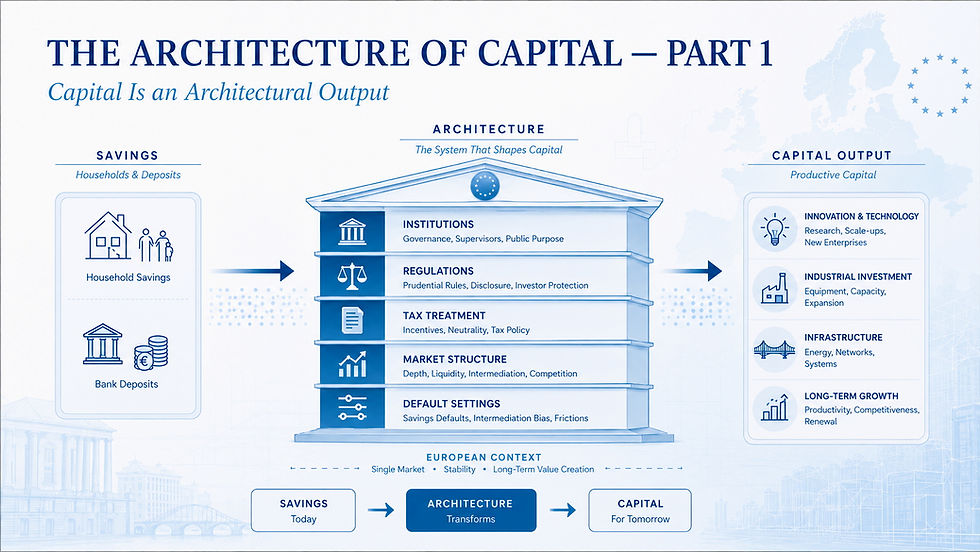
Part 1 established that capital is an architectural output. Part 2 showed that different systems regenerate capital through different institutional mechanisms. Part 3 showed that the AI stack requires several distinct forms of capital, none of which can be supplied by one financing mechanism alone. Part 4 completes the argument: every regeneration mechanism solves one problem while creating a dependency somewhere else.
Dependencies are not failures of planning. They are the structural consequence of having an architecture at all. Every system in this series has them. What differs is the requirement that would expose them, the speed at which the exposure would propagate, and the number of alternatives still available once it does.
Architecture determines what a system can finance. Dependency determines what it must obtain from somewhere else. Optionality determines how many alternatives remain when the dependency is tested.
Many dependencies will never be called. That is precisely why they remain underpriced for so long. The ones that are called often appear to arrive suddenly, even though the architecture that produced them has been visible for years.
The surprise belongs to the observer who was watching the balance sheet. The warning belongs to the observer who was watching the architecture.
Beyond the Four-Part Series
The public series ends here. The next AXISYNC Newsletter does something different: it turns the argument into an applied decision architecture.
We will deliver the AXISYNC verdict on the emerging capital architecture of AI, examine three forward scenarios for how the architecture could evolve, and apply the Capital Optionality Stress Test to identify where dependencies become binding, what could cause them to reprice, and how much decision freedom remains under stress.
The purpose is not to predict which architecture "wins." It is to identify which decisions need to be made while optionality still exists — before a dependency narrows the available set of choices.
Subscribe to the AXISYNC Newsletter to receive the verdict, the three scenarios, and the full Capital Optionality Stress Test.
RHODES OBSERVATION
Markets do not price dependency.
They price the moment dependency becomes visible.
Sources
The analytical framework in Part 4 synthesises the evidence established in Parts 1–3. The sources below cover the accounting definition and the material developments updated for this publication.
Accounting and contingent liabilities
IFRS Foundation, IAS 37 — Provisions, Contingent Liabilities and Contingent Assets — Definition and treatment of contingent liabilities used as the accounting reference for the strategic analogy.
United States — compute, debt and public-market handoff
Reuters, July 29, 2026 — Hyperscaler debt binge pushes yields up as investor demand cools — Goldman Sachs estimate of roughly $750 billion in 2026 hyperscaler capex, projected operating cash flow, debt issuance and bond-market repricing.
Reuters, July 22, 2026 — AI investment boom puts Big Tech free cash flow under pressure — Free-cash-flow pressure and the shift from asset-light platform economics toward capital-intensive AI infrastructure.
Reuters, June 10, 2026 — Global AI debt issuance to top $500 billion in 2026 — Morgan Stanley forecast of nearly $570 billion in global AI-related debt issuance in 2026.
Reuters, June 8, 2026 — OpenAI files for U.S. IPO after Anthropic — Confidential IPO filings by OpenAI and Anthropic and the prospective private-to-public capital handoff.
China — silicon and lithography
Reuters, July 28, 2026 — China starts production of home-grown immersion DUV chipmaking tools — Start of domestic immersion-DUV production and its significance for technology self-sufficiency, while not yet posing an immediate commercial threat to ASML.
South Korea — concentration and transmission
Reuters, July 29, 2026 — South Korea stock rout breaks records as SK Hynix results disappoint — Samsung Electronics and SK Hynix together accounting for more than half of KOSPI market value during the selloff.
Reuters, August 7, 2026 — Korean ants swarm back to Wall Street as KOSPI rout dents homecoming drive — Reuters calculation that Samsung and SK Hynix drove 76% of the KOSPI market-value wipeout during the decline.
The Wall Street Journal, August 13, 2026 — South Korea KOSPI enters new bull market — Approximately 22% rebound from the July 30 low, included to distinguish transmission risk from a claim of structural failure.
Series evidence carried forward
The Architecture of Capital — Part 2 — Capital-regeneration mechanisms, European venture-capital scale, Japan governance reform, China industrial-policy architecture and South Korean concentration framework.
The Architecture of Capital — Part 3 — Five-layer AI capital requirements: energy, silicon, compute, connectivity and models.
AXISYNC Partners LLC
axisyncpartners.net | Architecture of Decision Sovereignty
The Architecture of Capital — Part 4 | August 2026


Comments